Italian researchers have developed the IceBoost v2.0 machine learning model. Trained on over 7 million measurements, this model will help estimate the thickness and ice volume of the world’s glaciers.
Venice: IceBoost v2.0 has produced detailed estimates of the ice thickness and total volume of the world’s glaciers. Researchers from Ca’ Foscari University in Venice and the National Research Council of Italy developed it based on over 7 million glacier measurements. This data could be useful in assessing the future impacts of glaciers and climate change.
IceBoost v2.0 developed using over 7 million measurements
Accurately estimating the amount of ice present in different glaciers around the world has long been a challenge for scientists. Due to the wide variation in glacier location, thickness, and structure, assessing each region is difficult.
Addressing this challenge, researchers from Ca’ Foscari University in Venice and the National Research Council of Italy have developed the IceBoost v2.0 machine learning model. This model uses a large amount of real-world data to estimate the thickness and total volume of glaciers worldwide.
The model was trained on over 7 million measurements related to glacier thickness. This includes 26 different parameters, including land slope, surface texture, ice speed, and temperature.
How much ice is found in the world’s glaciers?
According to IceBoost v2.0 estimates, the world’s glaciers, excluding the main ice sheets of Antarctica and Greenland, contain approximately 150,000 cubic kilometers of ice.
The research also estimates that if all these glaciers were to melt completely, global sea levels could rise by approximately 32.3 centimeters. This figure is considered crucial in understanding the potential impact of glaciers on climate change and sea level.
The model also provided important information about the thickness of glaciers in areas like the Geikie Plateau in eastern Greenland. Some glaciers here were found to be up to 2 kilometers thick, and the model suggests the ice volume there could be nearly double that of previous estimates.
Key Data from the Himalayas to Patagonia
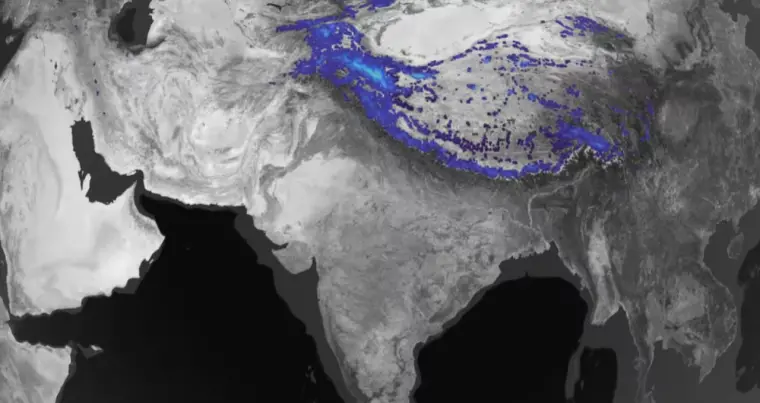
The unique feature of IceBoost v2.0 is that it can assess diverse and sensitive glacier regions around the world, including the Himalayas, the Karakoram, and the Patagonian ice caps.
Understanding the current state of glaciers is not only important for climate research. In many parts of the world, there is a direct link between glacier melt and water availability. Therefore, estimating future glacier ice and its potential changes can help plan water resources.
According to the researchers, this dataset can be used as a basis for estimating changes in glaciers by the year 2100. This will allow scientists to study the possible future of glaciers under different climate conditions.
The researchers have also made IceBoost’s web app available to the public and scientists. This allows the public to view the ice conditions and available data for individual glaciers. This AI-based model can help make glacier research more comprehensive and data-driven.