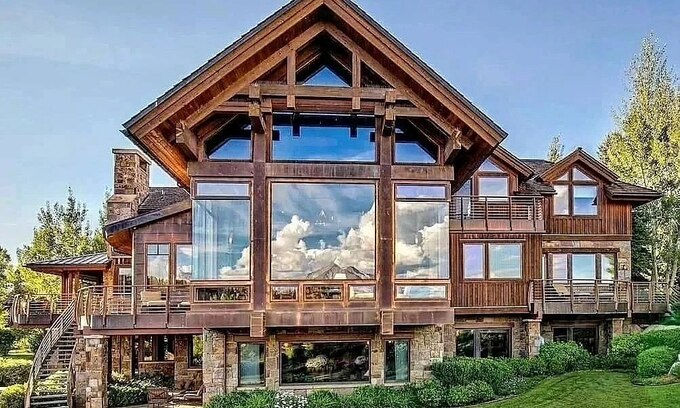
While many countries rely heavily on brick and concrete for housing because of their strength and durability, the U.S. developed a different construction tradition. Around 90% of American homes are built with wood, according to The Times.
|
A wood-framed house. Photo from Instagram |
Historical roots
Wood became a natural building material when European settlers arrived in North America in the 17th century. Vast forests provided an abundant supply of timber, allowing homes to be constructed quickly with locally available materials.
Over time, timber construction became deeply embedded in American building practices, while wood also remained popular for its natural appearance in both home interiors and exteriors.
Faster construction
Wood-frame homes can generally be completed more quickly than concrete structures because they require less labor and no waiting period for concrete to cure.
The shorter construction process helps reduce overall costs. Standardized house plans and prefabricated building kits are also widely available, allowing some homeowners to carry out portions of the construction or finishing work themselves.
Abundant timber
North America’s extensive conifer forests provide a large supply of construction-grade timber, helping keep wood relatively affordable.
Timber is also much lighter than brick or concrete, making it easier and less expensive to transport to construction sites.
Greater mobility
Americans move around five times on average over the course of their lives, according to studies.
The relatively low cost and short construction time of wood-frame homes fit a society in which people frequently relocate. Building, selling, replacing or renovating such homes can be more practical than doing the same with heavier and more expensive structures.
Lower rebuilding costs
Financial factors also favor wood construction in some parts of the U.S. Homes built with more expensive and durable materials can receive higher property valuations, potentially resulting in larger property tax bills. Wooden homes may be assessed at lower values, helping reduce those costs for owners.
The U.S. also faces high home insurance costs and significant losses from wildfires. Even in fire-prone areas, insurers often provide little financial incentive for homeowners to build entirely with more fire-resistant materials such as concrete or steel.
Instead, insurance systems generally place greater emphasis on repairing or rebuilding homes quickly after disasters.
Because timber construction is so common, the U.S. has a large pool of builders experienced in working with wood, while materials are readily available. This can make reconstruction faster and less expensive.
Some building-material suppliers have also offered discounts to wildfire victims when replacing damaged homes.
Structural flexibility
Large parts of the U.S. are exposed to earthquakes, hurricanes and tornadoes.
Wood’s relatively light weight and flexibility allow timber structures to absorb movement more effectively than some rigid materials, potentially reducing the risk of severe structural failure in certain disasters.
Wood-frame homes are also easier to modify, extend and renovate because individual parts of the structure can often be altered without major reconstruction.
Natural insulation
Wood provides natural thermal insulation and slows the transfer of heat through a building.
This can help homes retain warmth during winter and stay cooler during summer, an advantage in regions of the U.S. with large seasonal temperature differences, according to Medium.
Easier repairs
Wooden homes are more vulnerable than concrete structures to fire and some forms of severe weather, but they are not necessarily fragile.
Properly designed timber homes can withstand smaller earthquakes and weaker tornadoes. In areas exposed to particularly powerful storms, some homeowners also build reinforced concrete basements that can serve as shelters.
When damage does occur, wood structures are generally simpler and cheaper to repair because damaged beams, panels or wall sections can often be replaced individually rather than requiring extensive reconstruction.