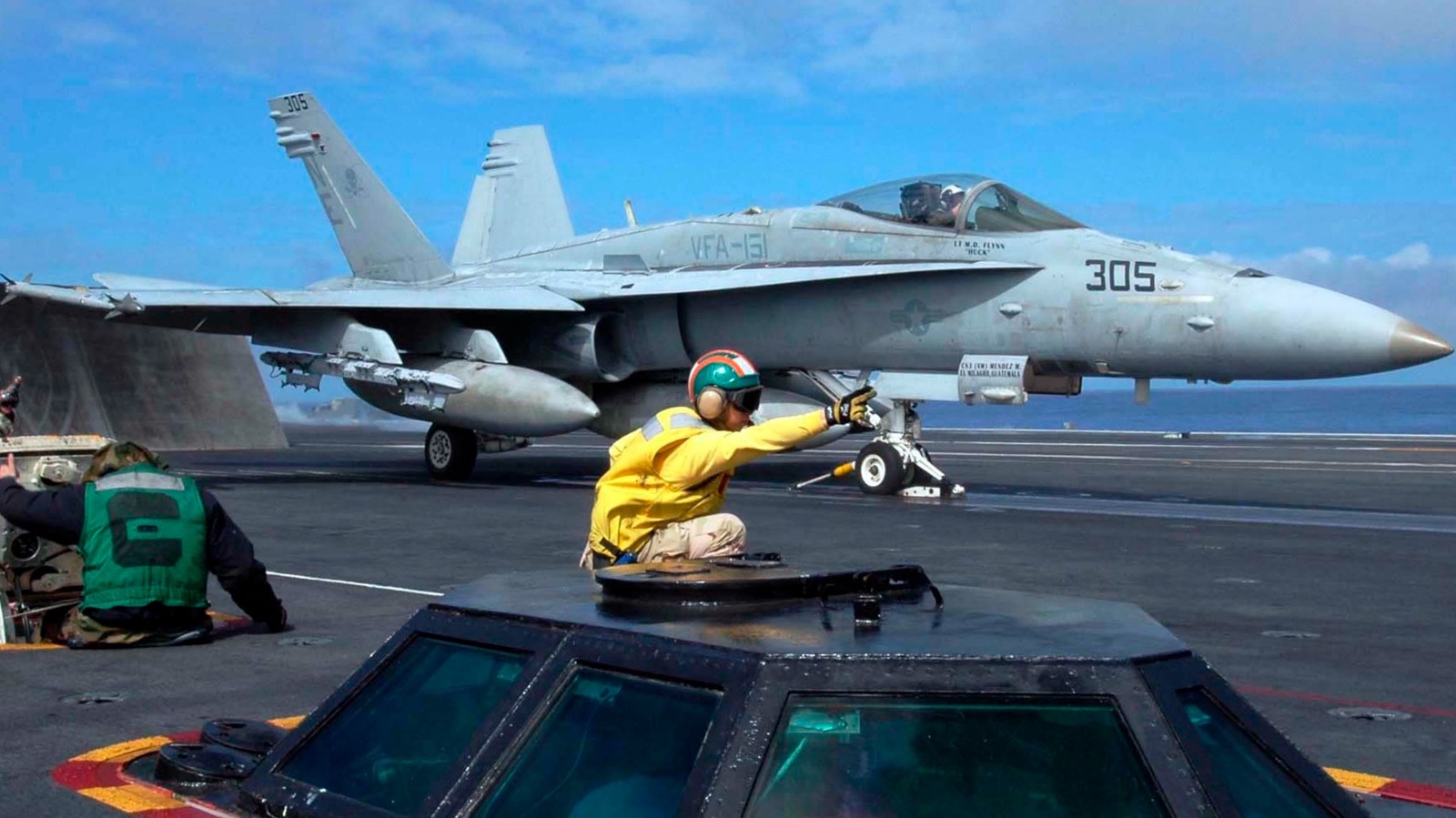
Fighter jets enable an aircraft carrier to extend its reach well beyond a coastline. Carriers have been in operation since World War I, and in the years and conflicts since, the mighty vessels have grown into the core of a blue-water navy’s strength. That’s certainly true of the United States Navy, which builds up massive fleets surrounding its flat tops with Carrier Strike Groups. One of the most impressive feats of any aircraft carrier is its ability to quickly launch and recover its aircraft.
Launching an aircraft like a fighter jet requires the use of a catapult, and there are two types: steam-powered and electromagnetic. For the vast majority of carrier operations, steam-powered catapults were used to launch fighters quickly, but the times have changed. The USS Gerald R. Ford (CVN-78) is the world’s largest aircraft carrier and the first outfitted with an electromagnetic catapult system, which is far more energy efficient and capable than its steam-powered predecessors.
Each type launches fighter jets at different speeds, but generally, taking off from a carrier requires around 165 mph of catapult-provided speed. This comes from a full stop, so the pilots are literally thrust off the carrier at 165 mph in under two seconds. That’s a lot of stress on the human body, but Navy aviators do it repeatedly throughout their careers. While aircraft with short take-off and vertical landing are available, it’s unlikely that catapult-powered fighter jet launching will ever become a thing of the past.
Launch speeds for steam and magnetic catapults
There are several factors to take into consideration when determining the speed at which a catapult launches a fighter jet into the sky, including weight, type of catapult, and launch rate. It’s slightly different for each aircraft and shipboard system, but generally speaking, both types need to accelerate aircraft to that 165-mph target. For a steam-powered catapult like those installed on Nimitz-class aircraft carriers, it works using 1,200 lbs. of steam per launch.
While that technology has been around for decades, a new system outperforms it. The EMALS, which aptly stands for Electromagnetic Aircraft Launch System, pushes a fighter jet from 0 to 180+ mph using a linear induction motor. Only two U.S. ships feature EMALS, including the aforementioned Ford and the forthcoming USS John F. Kennedy (CVN-79). Both systems can launch an aircraft every 20 seconds when pushing to the fastest operational tempo required.
The force each pilot undergoes upon launch is between 3 and 4g for a period of 2 to 3 seconds. Each system has its pros and cons, though EMALS reduces the need for a great deal of equipment housed below the flight deck, it lowers costs, has reduced energy requirements, and increases the ability to launch a wider range of heavier aircraft. As the U.S. produces more Ford-class aircraft carriers, it will retire its existing Nimitz-class carriers.