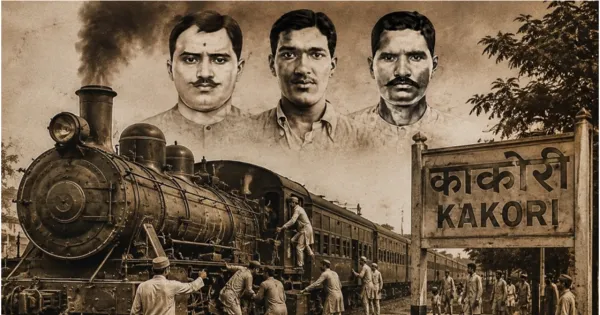
Lucknow: Three major currents of revolution emerged in the nationwide struggle for independence. The second of these currents was led by the Shahjahanpur district. This wave arose after Gandhiji withdrew the Non-Cooperation Movement and peaked until Bhagat Singh’s martyrdom. Later, with the martyrdom of Surya Sen of Chittagong, this revolutionary era reached a crucial stage.
Three young revolutionaries from Shahjahanpur—Pandit Ramprasad Bismil, Ashfaqullah Khan, and Thakur Roshan Singh—were prominent figures in this movement. Pandit Ramprasad Bismil was born on June 11, 1897, at his maternal home in Mainpuri. Influenced by Arya Samaj and revolutionary ideas, Bismil founded the Matridevi Sanstha under the inspiration of Gendalal Dixit. In the Mainpuri Conspiracy of 1918, he was accused of distributing banned books. During Gandhiji’s Non-Cooperation Movement, he participated wholeheartedly, but was disappointed by the withdrawal of the movement, and he embarked on the path of armed revolution.
Ashfaqullah Khan was born on October 22, 1900. He came into contact with Bismil through his elder brother, who was Bismil’s classmate. A passion for poetry brought them together, and Ashfaq soon became an active participant in the nationalist movement. Thakur Roshan Singh was born on January 22, 1892. He was active in taking the Non-Cooperation Movement to rural areas and during this time served a six-month sentence in Bareilly Central Jail.
Following the withdrawal of the Non-Cooperation Movement, Bismil and Sachindranath Sanyal, inspired by Lala Lajpat Rai, founded the Hindustan Republican Association in Kanpur in October 1924. Its objective was to overthrow British rule through armed revolution. The organization’s network soon expanded to Bengal, Maharashtra, Punjab, and northern India.
Kakori Train Action: Funds were needed to run the organization. It was decided to loot the government treasury. The Kakori Train Action was carried out on August 9, 1925. The Saharanpur-Lucknow passenger train was stopped by pulling the chain near Kakori, and the government treasury chest was removed and broken. Pandit Ramprasad Bismil led this action. Other revolutionaries, including Ashfaqullah Khan and Chandrashekhar Azad, were also involved. A passenger named Ahmed was killed by a bullet during the action.
The Kakori incident shook the British government. The police intensified the investigation and, using the mark of a dhobi from Shahjahanpur on a sheet, led them to Banarasi Lal. A series of arrests began. Bismil was arrested on September 26, 1925, while Ashfaq was caught in Delhi. Thakur Roshan Singh was charged in the Barmauli robbery case.
Trial and Martyrdom: Bismil, Ashfaq, and Rajendra Lahiri were sentenced to death in the Kakori trial. Thakur Roshan Singh was also sentenced to death in the Barmauli case. Many national leaders attempted to have the sentence commuted, but the British government remained unmoved.
December 19, 1927, is a day in Indian history when three great revolutionaries were hanged in different prisons. Pandit Ramprasad Bismil was hanged at 6:30 am in Gorakhpur Jail. Nearly 150,000 people attended his funeral procession. He was cremated at Rajghat on the banks of the Rapti River.
On the same day, Ashfaqullah Khan was hanged in Faizabad jail. His body was brought to Shahjahanpur and buried in the Jalal Nagar Bajariya area near his family home. Thakur Roshan Singh also accepted the gallows in Naini Jail, Allahabad. Before his execution, he recited the Gita, chanted “Vande Mataram,” and with complete confidence kissed the noose and placed it around his neck.
Revolutionary legacy
Even after the martyrdom of these three martyrs, the revolutionary movement did not end. Bhagat Singh and Chandrashekhar Azad further developed the Hindustan Republican Association into the Hindustan Socialist Republican Association. This revolutionary stream gave rise to actions such as the bombing of the Central Assembly and the assassination of Saunders. Bhagat Singh also honored the role of these three martyrs of Shahjahanpur in his writings.
The contribution of Shahjahanpur’s youth in the Kakori train raid is etched in golden letters in the history of the Indian freedom struggle. The martyrdom of Bismil, Ashfaq, and Roshan Singh energized the revolutionary movement.