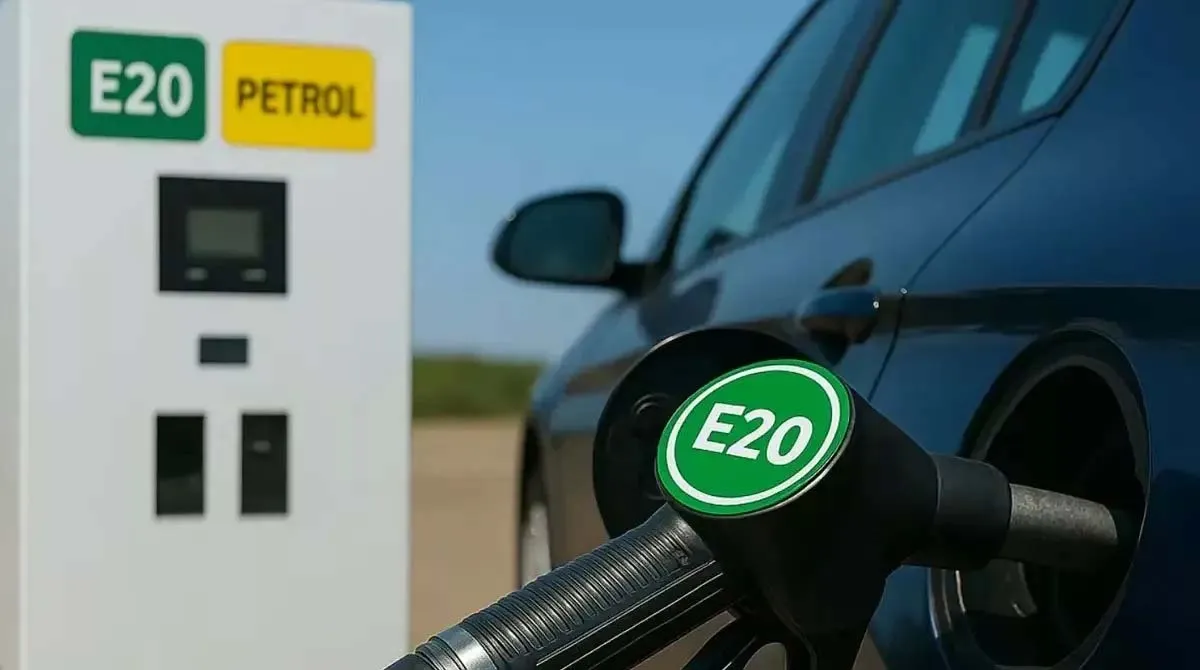
The ongoing debate in India over 20% ethanol-blended petrol, or E20, now appears to be directly impacting the automobile market. The latest data from July 2026 shows a significant decline in the market share of petrol cars, while demand for CNG, electric, hybrid, and diesel vehicles is rapidly increasing.
Car dealers clearly state that the fears and apprehensions customers have about E20 petrol could be the primary reason for this significant change. This issue has also sparked a political firestorm, with Aam Aadmi Party convener Arvind Kejriwal criticizing the central government.
Share of petrol cars declined to 41.68% in July
According to data released by the Federation of Automobile Dealers Associations (FADA), the overall share of petrol vehicles declined to just 41.68% in July. Meanwhile, the combined share of CNG, electric, and other alternative fuel vehicles increased to 40.59%.
This clearly means that the gap between petrol and alternative-fuel cars has now narrowed to just 1.1 percent. FADA officials say that if this trend continues, alternative-fuel vehicles will surpass petrol vehicles in the future. There was once a significant 13 percent gap between the two, but that now appears to be completely eliminated.
Are E20 really changing consumer preferences?
For the past few months, a heated debate has raged among car owners and new vehicle buyers regarding E20 petrol. People are raising questions about the potential for reduced fuel economy, the impact of E20 on older vehicles, and the potential for increased ethanol blending in the future.
This is why many customers are now opting for CNG, EV, or hybrid models instead of petrol cars. Furthermore, there seems to be a resurgence in interest in diesel cars. However, experts believe it would be premature to single out the E20 as the sole reason for this decline, as other factors such as rising fuel prices, the SUV craze, and on-road costs also influence customer decisions.
Dealers are getting huge discounts and old stock is increasing.
The direct impact of changing customer preferences is now clearly visible on showroom and dealership inventory. According to a FADA report, more than 25 percent of dealers now have inventory holdings of 60 to 70 days or more, compared to a typical 30 to 33 day cycle.
In the month of July, companies dispatched around 4.69 lakh vehicles to dealers, while retail sales were only 4.16 lakh units. In this way, a huge difference of around 52 thousand vehicles has been seen in wholesale and retail sales. To clear out this old petrol stock, companies and dealers are now offering bumper discounts on many popular models. Huge discounts are being offered on luxurious vehicles like Hyundai Grand i10, i20, Tata Nexon, Kia Sonet and Carens Clavis. The discount on old 2025 model year vehicles has reached from Rs 1.5 lakh to Rs 3.5 lakh on Tata Curvv.
Why is there a sudden surge in demand for diesel cars?
After getting disillusioned with petrol vehicles, the demand for diesel cars has once again started returning in the market. In the month of July, the share of diesel vehicles increased to about 17.73 percent. Auto industry experts believe that due to the immense popularity of SUVs, better torque and low running cost, people are getting attracted towards diesel again. Apart from this, the uncertainty surrounding E20 has also forced buyers to choose diesel vehicles. Tata Motors has also admitted in its portfolio that diesel SUVs with a budget of around Rs 15 lakh are getting a great response from the customers.
Arvind Kejriwal surrounded the government, then the Petroleum Ministry gave clarification
The Aam Aadmi Party (AAP) is taking an aggressive stance regarding the E20 controversy. Sharing reports of declining petrol car sales, AAP national convener Arvind Kejriwal has demanded that the central government immediately reconsider its ethanol policy. Kejriwal argues that if people abandon petrol cars and turn to alternatives, it will have a devastating impact on the automobile sector and the country’s economy as a whole. The party has previously demanded that customers should be offered alternatives to regular petrol like E10 and E0 in addition to E20.
On the other hand, the central government has made it clear that it will not back down from its E20 policy. The Petroleum Ministry states that this policy was implemented only after lengthy discussions and extensive testing with auto companies. According to the government, this reduces crude oil imports from abroad, reduces pollution, and increases the income of our country’s farmers. The ministry claims that there is no concrete evidence of engine damage due to the use of E20, and this standard fuel is now being made available across the country.