The strong July performance pushed total export turnover for the first seven months to $27.02 billion, a 2.7% annual gain. The numbers reflect the industry’s push to lock in orders, diversify markets, and optimise production to keep Vietnam locked on the global export map.
In July, apparel exports alone hit an estimated $3.74 billion, up 8.9% month-on-month and 2.1% year-on-year. Across the January-to-July stretch, apparel shipments totaled $21.13 billion, a modest 0.70% uptick from the same period in 2025.
A standout in the seven-month export picture was the powerful growth of upstream products and garment inputs. Fiber and yarn exports generated an estimated $2.730 billion during the period, soaring 11.34% year-on-year. Textile and garment accessories posted a similarly strong 11.18% jump, bringing in $929 million in export revenue.
|
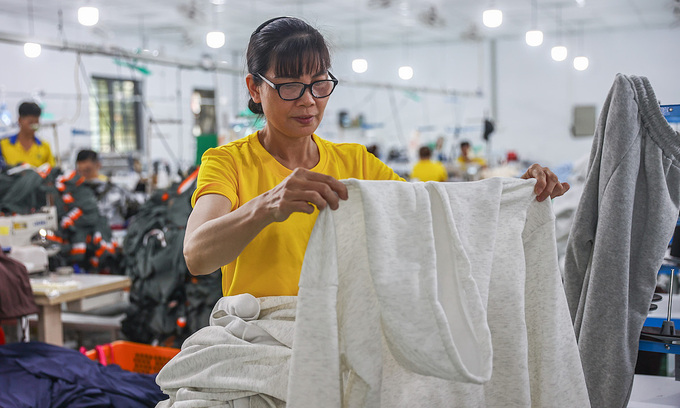
A worker is seen in a garment factory in HCMC, August 2025. Photo by Read/Quynh Tran |
Fabric exports stood at $1.763 billion, up 9.57%, while non-woven fabric exports totaled $471 million, a 6.56% year-on-year increase.
Vietnam’s textile and garment imports hit $2.231 billion in July, down 6% from June but up 8.0% year on year. For the seven months, it reached $15.255 billion, a 3.27% year-on-year rise.
Within that total, fabric imports reached $8.936 billion, up 2.08%; textile and garment accessories totaled $2.605 billion, up 3.60%; and cotton imports stood at $1.885 billion, up 1.02%.
Commenting on the seven-month performance and the outlook for the remainder of 2026, Vice Chairman of the Vietnam Textile and Apparel Association (VITAS) Truong Van Cam said major import markets are increasingly tightening requirements on sustainable development, raw material traceability, carbon emission reductions, and social responsibility.
The strong growth in fiber, fabric, and accessory exports over the past seven months shows that Vietnamese enterprises have grown more proactive in the supply chain and less dependent on imported raw materials, he said.
To reach the full-year target, they were advised to speed up the green transition, invest in energy-efficient technologies, diversify into niche markets, and fully exploit incentives built into next-generation free trade agreements, Cam said.
To sustain growth through the rest of 2026, economists recommended that companies proactively keep abreast of changes in international trade policies, especially stringent European regulations tied to the circular textile and garment economy.
They said that creating eco-friendly fashion items, using recycled fibers, and meeting environmental standards will be key to gaining greater access to premium market segments.
Alongside corporate efforts, VITAS will continue pushing State management agencies to complete planning for centralised textile and garment industrial parks equipped with standardised wastewater treatment systems. That would help attract investment into weaving and dyeing while clearing bottlenecks in the supply of raw materials and supporting inputs.