Trump Signs Executive Order Calling for Spacing Out Childhood Vaccines/ TezzBuzz/ WASHINGTON/ J. mansour/ Morning Edition/ Trump signed an order promoting separate appointments for childhood vaccines and splitting the combined MMR shot. Medical experts warn the approach could leave children vulnerable and say extensive research supports the existing schedule. The order renews debate over vaccine policy, autism misinformation and the authority of the newly confirmed CDC director.

Quick Look
- Trump wants childhood vaccines administered at separate appointments when possible.
- The order calls for separating the MMR vaccine into three shots.
- Single-disease measles, mumps and rubella vaccines are not currently available in the U.S.
- Medical groups say the existing schedule is extensively studied and safe.
- Experts warn delaying shots could leave children vulnerable to preventable diseases.
- Trump again suggested a vaccine-autism connection rejected by scientific evidence.
- Sen. Bill Cassidy, a Republican and physician, criticized the order.
- States retain authority over school vaccination requirements.
- A judge has blocked earlier Trump administration changes to vaccine guidance.
- CDC Director Erica Schwartz could face an early leadership test.
- HHS Secretary Robert F. Kennedy Jr. has pursued restrictive vaccine policies.
- Studies suggest combination shots improve vaccination completion rates.
- U.S. kindergarten vaccination rates have been declining.
- The order comes during a measles outbreak and back-to-school season.


Deep Look
Trump promotes spacing out childhood vaccines
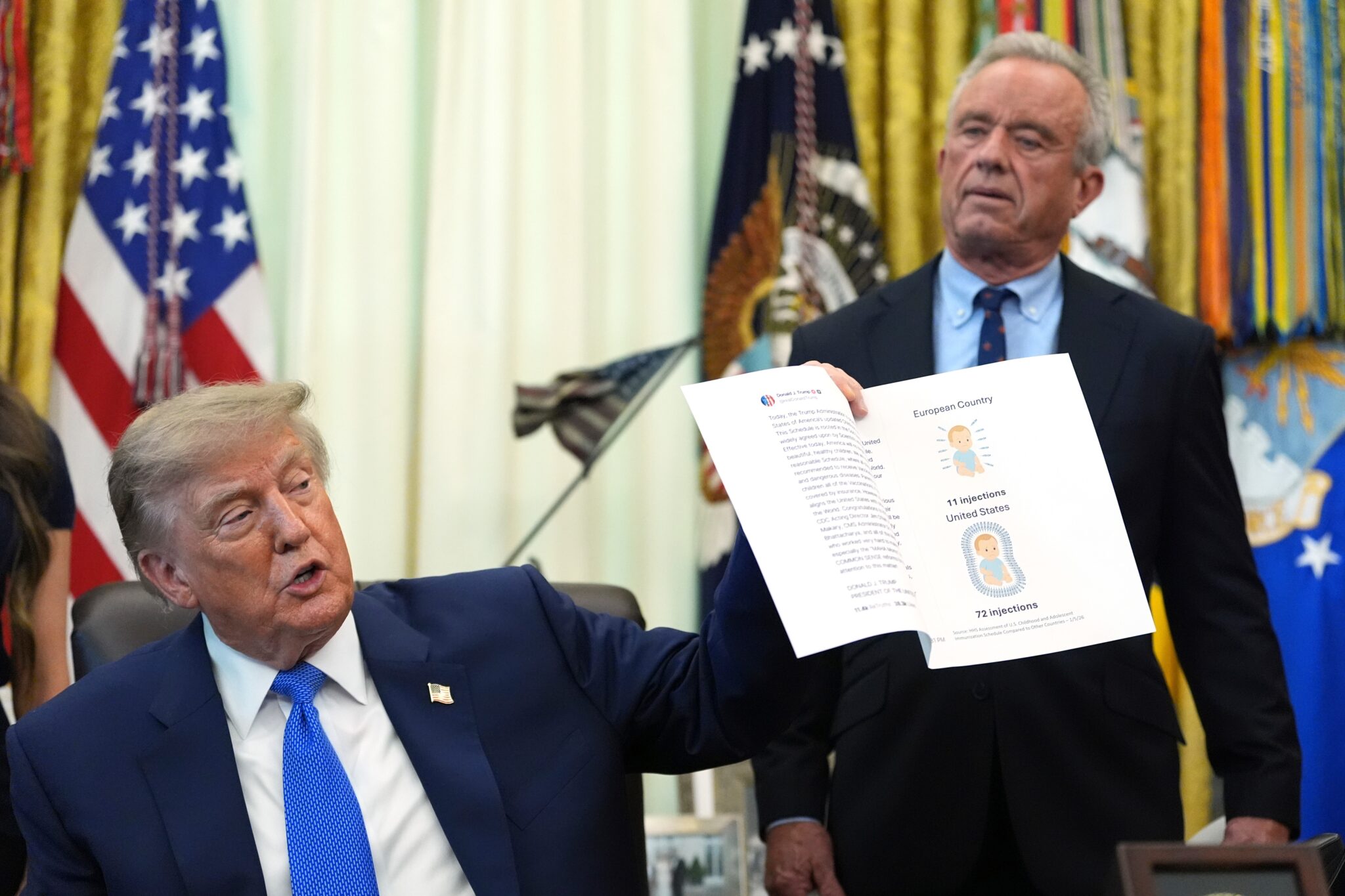
WASHINGTON — President Donald Trump signed an executive order Monday calling for new childhood vaccination recommendations that would spread immunizations across separate medical appointments.
The order promotes Trump’s long-held but scientifically discredited theory that children should receive vaccines individually rather than in combinations or during the same visit.
It calls for the measles, mumps and rubella vaccine, commonly known as MMR, to be divided into three single-disease shots.
The administration also recommends that childhood immunizations be administered during separate appointments whenever possible.
Public health organizations oppose that approach, warning that it could delay protection and increase the chance that children contract preventable diseases while waiting for later visits.
Order seeks separate measles, mumps and rubella shots
The Department of Health and Human Services must produce a plan for making individual measles, mumps and rubella vaccines available to children.
Those separate shots are not currently offered in the United States.
The order also directs the department to expand vaccine research, even though childhood immunizations and the timing of combined doses already undergo extensive testing.
Studies evaluate vaccines before approval, while federal safety monitoring continues for years after they enter widespread use.
Trump described the order as a “major victory for parents rights, religious and constitutional rights, and for the gold standard science.”
Experts warn against delaying protection
Public health specialists say spacing vaccines across additional appointments can increase the time children remain unprotected.
It also creates more opportunities for families to miss appointments and fail to complete the recommended schedule.
Childhood vaccines are studied to determine whether they can be administered safely and effectively together.
Researchers have found that babies and toddlers receiving combination vaccines are more likely to complete all recommended immunizations by age 2 than children receiving individual shots.
The additional office visits promoted by Trump could also increase costs and create practical burdens for parents, doctors and clinics.
American Academy of Pediatrics rejects changes
Dr. Andrew Racine, president of the American Academy of Pediatrics, said Trump’s announcement creates unnecessary uncertainty about established medical guidance.
He said it spreads fear and confusion where “there doesn’t need to be any of that.”
“Science about vaccines and their efficacy has not changed,” Racine said. “The distribution of viruses and other pathogens in our environment has not changed. Children in this country have not changed in the last 48 hours.”
Racine said the existing childhood vaccination recommendations should remain in place.
The American Academy of Pediatrics and other medical organizations base their schedules on studies measuring disease risks, vaccine effectiveness, side effects and the timing required to protect children.
Trump repeats unsupported autism claims
During an Oval Office event, Trump repeatedly suggested that the number or timing of childhood vaccines could contribute to rising diagnoses of autism spectrum disorder.
Decades of research and broad scientific consensus have found no connection between childhood vaccines and autism.
The claim originated partly from a discredited study that was retracted because of serious ethical and methodological problems.
Researchers in multiple countries have repeatedly examined the question using data involving millions of children.
Racine said the alleged relationship has been evaluated in “over 40 methodologically well-designed studies in over seven countries involving over 5 million children.”
“I’m not sure that there is anything that has been as thoroughly looked at as this question,” he said. “And the answer is unequivocally no.”
Republican physician criticizes Trump’s order
Sen. Bill Cassidy of Louisiana, the Republican chairman of the Senate Health, Education, Labor and Pensions Committee, publicly condemned the executive order.
Cassidy is a physician and has previously challenged some of the administration’s vaccine policies.
“I’m a doctor. This executive order is wrong,” Cassidy wrote on social media. “The President does not have the expertise to make these changes.”
Cassidy emphasized that vaccines are safe and do not cause autism.
His criticism illustrates the extent to which the order conflicts not only with medical groups and Democrats but also with some Republicans who have health care expertise.
States control school vaccine mandates
The federal government issues vaccination recommendations, but states have primary authority to establish immunization requirements for students.
Trump’s executive order cannot directly rewrite every state’s school vaccination laws.
A White House fact sheet advises states with school vaccine mandates to consider revising their laws to match the administration’s preferred schedule.
Any such changes would require action by governors, state legislatures, health departments or other authorized state bodies.
State requirements typically allow limited medical exemptions, while rules governing religious or personal exemptions vary.
Earlier schedule changes blocked in court
Trump directed HHS in December to review how peer countries structure their vaccine recommendations and consider changing U.S. guidance.
The department responded by reducing the number of vaccines recommended for every child.
A federal court subsequently blocked that action.
Monday’s order includes several changes the administration already attempted through the health department but could not implement because of the judge’s ruling.
A White House official, speaking anonymously to brief reporters, said Trump was entitled to issue his own recommendations through executive action.
The official maintained that the executive order and the lawsuit blocking HHS changes were separate matters.
New CDC director faces immediate test
Changes to the federal childhood vaccine schedule traditionally require the approval of the director of the Centers for Disease Control and Prevention.
Dr. Erica Schwartz recently received Senate confirmation to lead the agency after nearly a year without a permanent confirmed director.
Schwartz previously promoted vaccination among service members while serving in a leadership role at the U.S. Coast Guard.
Lawrence Gostin, a Georgetown University public health law expert, said the Supreme Court’s broad interpretation of Trump’s executive authority may allow the president to overrule Schwartz if she refuses to approve the changes.
“This is clearly the first test for Dr. Erica Schwartz,” Gostin wrote in an email. “The President is placing her in an untenable position.”
Schwartz may have to choose between defending established scientific guidance and complying with the president who nominated her.
White House offers no supporting studies
During a call with reporters, the anonymous White House official was asked why Trump supports separating the MMR vaccine.
The official did not cite studies supporting that decision.
Instead, the official said separating the vaccines has long been Trump’s position and noted that some countries use individual measles vaccines in limited circumstances.
Trump spokesperson Kush Desai said the president is “one of countless parents who have voiced questions and concerns about the combined MMR vaccine.”
Desai said developing separate vaccines would “give parents more options on timing and frequency for their children,” potentially increasing vaccine participation.
Existing U.S. research, however, indicates that combination vaccines increase the likelihood that young children finish the recommended schedule.
Kennedy has pursued vaccine policy overhaul
Health Secretary Robert F. Kennedy Jr., who was a prominent anti-vaccine activist before joining the administration, began overhauling federal vaccination policy during Trump’s first year back in office.
Kennedy dismissed all 17 members of a vaccine advisory committee and replaced them with members who issued more restrictive recommendations.
A federal judge later halted those recommendations.
Kennedy also personally directed the CDC to abandon its longstanding statement that vaccines do not cause autism.
He did not provide new evidence supporting that change.
Those actions have increased concern among public health specialists that federal health guidance is being shaped by political preferences rather than scientific evidence.
Trump pressures Kennedy for autism answer
Trump has repeatedly focused on finding a connection between autism and vaccines during his second term.
Kennedy previously promised that new research would identify the cause of autism, and Trump pressed him for an update during a Cabinet meeting in July.
“How are you doing on the autism research?” Trump asked.
“We will have an answer for you,” Kennedy replied.
During Monday’s Oval Office event, Kennedy repeated his belief that an unidentified environmental factor is causing rising autism diagnoses.
He said HHS would release its findings “as soon as they are ready.”
Researchers say the increase in diagnosed cases is influenced by factors including greater awareness, broader diagnostic criteria and improved identification, although research into autism’s causes continues.
Order arrives amid measles outbreak
The executive order comes as students return to classrooms and the United States confronts a measles outbreak.
Experts warn that continued transmission could cause the country to lose its measles elimination status.
Measles is highly contagious and can produce serious complications, particularly among young children and people with weakened immune systems.
Doctors worry that Trump’s false claims about vaccines could increase hesitancy and cause additional parents to delay or reject immunizations.
Federal data shows that vaccination rates among U.S. kindergarten students have declined.
The proportion of children receiving exemptions reached a record high during the 2024-25 school year.
Public health experts warn that further reductions could allow measles and other diseases once controlled through widespread vaccination to spread more easily.
More on US News