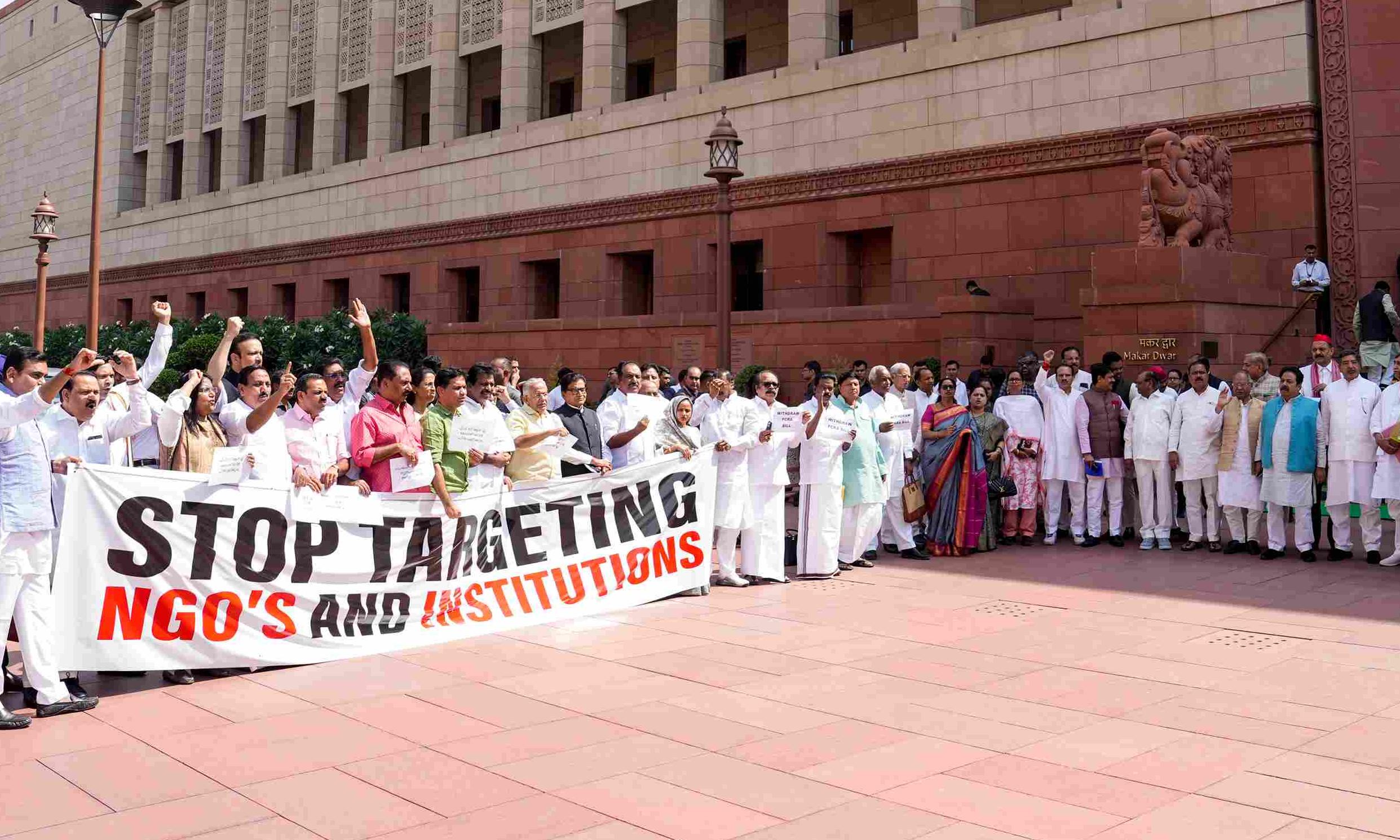
The Centre, on Wednesday (August 12), referred the controversial Foreign Contribution (Regulation) Amendment Bill to a Joint Committee of Parliament (JCP). The reference came in the wake of strong pushback against the Bill by Opposition parties, minority religious bodies, civil society groups and even a Republican member of the US Congress.
The Centre’s decision may be seen by many as a climbdown. After all, unlike in the case of constitutional amendments, which the government can’t pass without a two-thirds majority, the FCRA Bill could have been bulldozed through both Houses of Parliament by a simple majority, irrespective of the Opposition’s stance.
Also Read: ‘FCRA Bill referral to JPC meaningless; Opposition will have no say’
Unsurprisingly then, Union Minister of State (Home Affairs) Nityanand Rai’s resolution to send the Bill to a JPC amid the Opposition’s demand for its complete withdrawal afforded the Centre a chance for political grandstanding.
Asserting that “there is not a single provision in the proposed FCRA Bill targeting any minority institution”, Union Parliamentary Affairs Minister Kiren Rijiju said in the Lok Sabha that the government was “prepared for a detailed scrutiny” of the Bill and called the proposed law “important for the security of the country”.
Why Opposition is wary
Yet, if the Opposition is, as Rijiju said, unhappy, it isn’t without reason. Opposition MPs who have been part of different JPCs constituted over the last few years told The Federal that their experience with these panels had left them convinced that what was being passed off by the Centre as an exercise for “widest possible consultations” was actually “an eyewash”.
Aldo Read: FCRA Bill: India hits back at US Congressman over ‘churches takeover’ remark
Congress MP Mohammed Jawed, who was part of the JPC that examined the government’s controversial Waqf Amendment Bill (now an Act) recalled how “as high as 90 per cent of depositions made during the committee’s deliberations were against most provisions of the Bill but since the committee chairperson (BJP MP Jagdambika Pal) and other MPs from the ruling side constituted a majority, they ignored these and went purely by views that aligned with the government’s version, forcing all Opposition MPs to submit a dissent note when the committee adopted its final report”.
Another Opposition MP, who did not wish to be named as the JPC he is part of was given an extension of tenure during the Monsoon Session, said, “The consultative process is a farce…excellent depositions are made, very well-reasoned, but if these do not reflect the view of the government or expose legal loopholes in the Bill, the entire effort of the chairperson is to drive the discussion to negate such depositions”.
JPCs vs Standing Committees
The MP added that the Centre’s preference for sending Bills to JPCs over the conventional Department Related Standing Committee (DRSC) of Parliament is “intended to either avoid uncomfortable situations that may arise in Standing Committees that may be headed by an Opposition MP or simply to bide time when it feels a Bill is too controversial or won’t get the votes required for passing it”.
Also Read: Will FCRA vote expose TMC rebels’ fragile identity as NCPI MPs?
Ordinarily, successive governments have followed the convention of referring Bills to the DRSCs concerned or, at times, to select committees of either House of Parliament.
JPCs, on the other hand, were constituted to examine financial scandals (stock market scam in 2002, the Bofors contract, securities and banking irregularities in 1993, etc.), issues of constitutional propriety (the office of profit row in 2006) and matters of larger public concern (pesticide residue in beverages and packaged fruit juice in 2004) as these committees have additional investigative powers, including those for summoning evidence and documents.
Decline of committee scrutiny
The past 12 years of Prime Minister Narendra Modi’s regime have, however, turned these set parliamentary conventions on their head. Modi’s first stint in office from 2014 to 2019 saw the number of Bills referred to DSRCs and select committees drop drastically to just 26 per cent as opposed to 71 per cent such referrals during Manmohan Singh-led UPA-II government (2009 to 2014) and 60 per cent during UPA-I (2004 to 2009).
The second Modi government sent only 10 per cent of all Bills enacted between 2019 and 2024 to DSRCs or select committees.
Also Read: FCRA Amendment Bill 2026: Shashi Tharoor warns of threat to civil society
This sharp and visible aversion of the Prime Minister to refer Bills to conventional parliamentary committees for further scrutiny during his previous two tenures was coupled with a proclivity for proclamation of ordinances.
There is no doubt that successive governments have used the ordinance route to enact laws when Parliament is not in session. What stands out about the Modi government’s previous two tenures, though, is the sheer number of times it went down this route despite enjoying a majority that made its legislative agenda practically unstoppable in Parliament between 2014 and 2024, unlike his current term when the strength of the NDA combine remains far short of a two-third majority in Lok Sabha.
Ordinance route under focus
Simply consider this: the UPA-era saw promulgation of 59 ordinances over 10 years (over half of these in the second term when Parliament was almost permanently paralysed due to disruptions) while the 2014 to 2024 Modi-era saw 84 ordinances promulgated despite the NDA’s brute majority.
Also Read: Why NGOs operating on foreign funds are opposing new FCRA Amendment bill, rules
Several ordinances issued under the Modi government may violate the constitutional requirement that such measures be driven only by issues of public importance that require immediate legislative action.
In fact, the very first ordinance that his cabinet moved for Presidential assent within a fortnight of Modi taking charge as Prime Minister was to amend the Telecom Regulatory Authority of India (TRAI) Act to facilitate the appointment of ex-TRAI chief Nripendra Mishra as Principal Secretary to the Prime Minister. Mishra is now chairperson of the Ayodhya Ram Temple Trust, which is currently in the news for alleged mass embezzlement of donations.
Third-term shift
Modi’s fondness for setting up jumbo JPCs to scrutinise legislation emerged only in his third term when the BJP returned to power with far fewer MPs than it had in the previous two Lok Sabhas. The 2024 Lok Sabha result also saw the emergence of a more emboldened and fierce Opposition with the 234-MP INDIA bloc (now shrunk to about 210 due to defections) almost at par with the 240-member BJP in Lok Sabha.
Also Read: CIC raps Home Ministry over ‘blanket denial’ of FCRA renewal RTI
The increased strength of the Opposition also meant greater representation for them in various DSRCs and more vocal resistance to Modi’s legislative agenda on the floor of Parliament. The shift in the government’s praxis was almost instant.
Ordinances became a rarity (only four since May 2024) as did the perverse proclivity of bulldozing legislation in Parliament, either after orchestrating mass suspension of Opposition MPs or amid din without discussions (the just-concluded Monsoon Session was an exception and saw 11 Bills passed in Lok Sabha without any debate).
Growing JPC numbers
Instead, what the government evolved was a system of frequently referring Bills to JPCs instead of DSRCs. It must be noted here that nine of the 24 DSRCs, including those examining departments of Home Affairs, External Affairs, Health, Education, Rural Development and Commerce, are headed by Opposition MPs.
In the little over two years since it returned to office for a third term, the Modi government has constituted five JPCs as opposed to 10 such committees it had set up in its preceding decade of power. With the FCRA Bill’s referral, this number will go up to six once the new JPC is constituted. Interestingly, only two JPCs constituted in Modi’s third term – one examining the Waqf (Amendment) Bill and the other to examine the Corporate Laws (Amendment) Bill – have concluded their assigned task till date. All others have been given repeated extensions.
These include, among others, the JPC examining the Constitution (129th Amendment) Bill, which proposes conducting Lok Sabha and all assembly polls simultaneously, the JPC scrutinising the Constitution (130th Amendment) Bill that vests powers in the President/Governor to sack a Prime Minister, Chief Minister or any minister who has failed to secure bail within 30 days of being arrested. The Viksit Bharat Shiksha Adhishthan Bill is also under examination of a JPC.
How non-partisan are JPCs?
Instances that highlight the Opposition’s lack of faith in the ability of JPCs to put aside partisan politics and foster deliberations – and conclusions – unpalatable to the regime aren’t hard to find.
Also Read: FCRA amendment gives Centre sweeping powers over NGOs, with no oversight built in
In October 2024, a meeting of the JPC examining the Waqf (Amendment) Bill saw heated arguments between the Trinamool Congress’s Kalyan Banerjee and the BJP’s Abhijit Gangopadhyay, while a subsequent meeting saw the entire Opposition walk out of the discussions alleging lack of confidence in Pal’s stewardship.
In August 2025, when the Centre decided to refer the Constitution (130th Amendment) Bill to a JPC, most INDIA bloc constituents decided to boycott it, publicly conceding lack of trust both in the government’s intent and in the committee’s ability to take an impartial view of the proposed law.
'Eyewash' charge
The FCRA Bill’s referral to yet another JPC has evoked similar views. The Congress and the Samajwadi Party, which want the Bill withdrawn, have already declared that they would submit dissent notes against the conclusions reached by the panel.
“The intent of the Bill is to target and harass institutions run by religious minorities or civil society groups that are not aligned with the ideology and politics of the BJP,” Congress MP Imran Masood told The Federal.
“The past experience of the Opposition has been that these JPC referrals are merely eyewash to fool people into believing that the government has held wide discussions when in reality what happens in these committees is that the ruling side, because it has a majority, bulldozes all contrary shades of opinion,” he added. “When the end result is decided even before the committee is constituted, what trust can we have in these committees?”