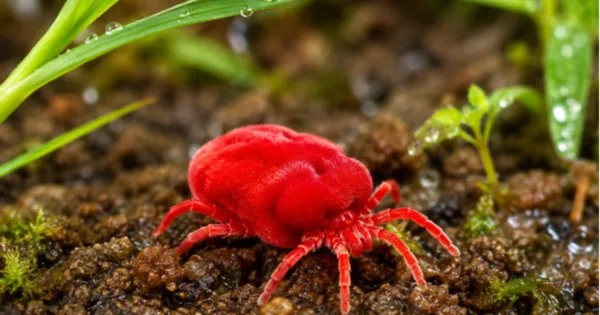
Veerbahuti, descending to the earth with the showers of Sawan, is not just a living being, but a velvety expression of folk culture, memories of child's mind and the subtle balance of nature. As attractive as it is in public life, it is equally important from scientific point of view. Here its biological nature, ecological contribution and current environmental challenges are highlighted.
With the end of Ashadh, when the first spray of Sawan soaks the dry earth, then small pieces of red velvet are seen dancing on the sandy sand and green grass with the sweet smell of soil. This scene compels the innate curiosity of the child's mind and the nature-loving heart to pause for a moment. This is this little creature – 'Veerbahuti'.
Known as 'Sawan ki Dokri', 'Teez', 'Budhi Mai', 'Budhi Nani' or 'Mamolya' in Rajasthan, this creature is not just an insect but a captivating work of nature's elegance. This statement of the Italian thinker Dante seems to be fully realized here – the pinnacle of beauty lies in the innermost part of natural beauty.
Shy bride settled in public life
When Veerbahuti slowly moves forward on the rain-soaked soil, her appearance gives the impression of the hesitant gait of a newlywed bride. It has also been called 'Indravadhu' in Hindi literature and folk. Its nature is also like that of Lajwanti plant – as soon as it gets a light touch, it gathers its eight legs and becomes round.
In different regional areas of the country, it is called 'Rani Keeda', 'Birbahuti' or 'Veerbahuti'. The name 'Bir Bahuti' carries within itself a beautiful cultural meaning of 'new bride'. Its presence is very intimate in the folk life of Rajasthan, Haryana and Uttar Pradesh. Due to its appearance around Teej in Haryana, it is called 'Teej', which reminds rural women of the love and swings of Pehar. In the Braj and Awadh regions, there is a popular belief that this is 'Ramji's doll' – as if it is a soft artifact that has descended from the blue sky for children to play with.
This creature has always been the center of curiosity in childhood memories. During rainy days, children carry them around in their palms. They used to catch them and keep them in glass bottles and make them have 'races' while sitting on the soil with bare feet. This pure joy is indicative of man's initial and intimate relationship with nature.
in the mirror of biology
Scientifically known as 'Red Velvet Mite', this organism is a member of the Trombobididae family and its scientific name is 'Trombidium grandissimum'. It is an invertebrate of Arthropoda phylum, which does not have a backbone.
Physical appearance: This eight-legged creature, approximately one centimeter in size, is covered with a layer of red, extremely soft velvety fur, while its tiny feet are equipped with fine white fur.

Warning color: Its bright red color is a self-defense mechanism provided by nature. This gives a silent signal to potential predators that it may taste unpleasant or astringent.
Life cycle and routine: It is mostly Lives deep in the soil. During the rainy season, it comes to the surface with the morning sunlight and in the evening it again sinks into the soil. It also lays eggs inside the soil, where its babies develop.
protector of ecological balance
Despite being extremely tiny in size, Veerbahuti plays the role of a silent guardian in keeping the ecosystem of forests, fields and woodlands in balance:
Helpful in decomposition cycle: It accelerates the process of decay and decomposition of organic matter in the soil.
biological control: Veerbahuti neither bites nor stings humans. It is a very useful predatory insect, which controls the population of underground harmful insects by eating their eggs and micro-organisms.
Soil Health: It contributes to maintaining the natural fertility of the soil by supporting organisms dependent on fungi and bacteria.
Crisis looming between superstition and concrete
Veerbahuti may have few natural enemies in nature, but man's misconceptions and his continuous interference have posed a serious threat to its existence. In the illusion of traditional medicinal use and alleged aphrodisiac properties, this innocent creature is being commercially slaughtered on a large scale without any scientific basis. The irony is that the same misconception which gave it the symbolic respect of a 'new bride' is today becoming the cause of its destruction. Additionally, its natural habitats are rapidly shrinking due to rapid urbanization, indiscriminate spraying of chemical pesticides and expanding concrete forests.
As a result, today's new generation is being deprived of the pleasure of seeing this velvety miracle with their own eyes. The showers of Sawan still rain, but the 'Dokri of Sawan' that used to dance on the wet soil is now disappearing. Conservation of Veerbahuti is not just the protection of an organism, but an essential resolution to safeguard our rich folk culture, sweet memories of childhood and balanced environment.
-Dr. Kailash Chand Saini, Jaipur