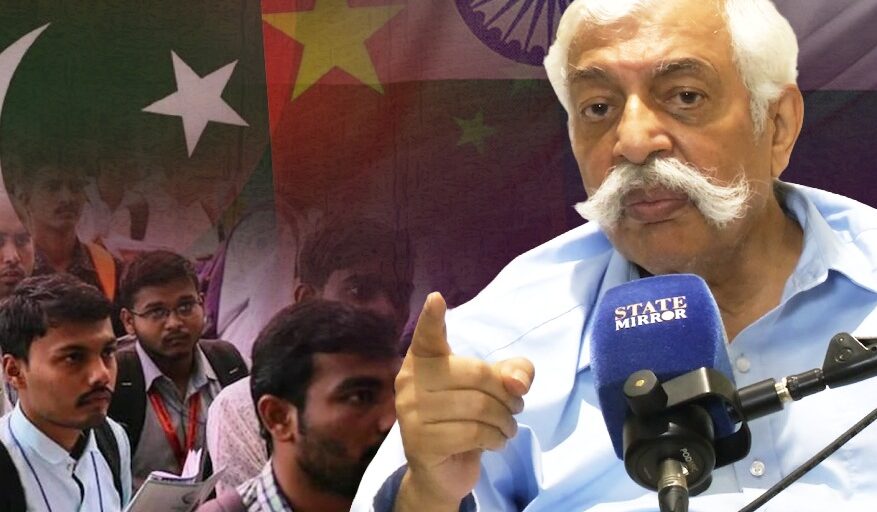
Amidst the country’s 80th Independence Day and India’s progress, a question has arisen which can create a stir from power to streets. The country is strengthening its place among the world’s major economic and military powers, but the question of employment still stands in the hands of crores of youth. Retired Major General GD Bakshi has given such a warning on this issue, which has heated up the debate. He claims that if India does not create jobs on a large scale and the dissatisfaction of the youth increases, then the situation can reach an explosive point like Bangladesh.
If we believe GD Bakshi, then the question is simple – can employment become India’s biggest weak link despite economic strength?
Retired Major General GD Bakshi Gave this statement at a time when questions were asked on India’s strength, China’s challenge, Pakistan’s condition and youth employment before August 15. Retired Major General GD Bakshi expressed his opinion in a frank manner. He warned that along with increasing economic strength, creating employment should be the biggest priorities for India.
Is India’s biggest challenge not on the border but on the employment front?
Just before Independence Day, during the discussion on India’s security and geopolitics, retired Major General GD Bakshi gave a very sharp warning regarding employment. He said that India has made huge leaps in areas like economy, IT, space, AI and strategic capabilities, but the question of employment in a country with such a large population cannot be ignored. According to him, if adequate opportunities are not created for the youth then dissatisfaction can take a serious form.
The size of India’s economy has now reached the level of about 4 trillion dollars. In IMF’s 2025 assessment, India’s nominal GDP was estimated at around $4.125 trillion. But economic size and per capita opportunity are not the same thing. The real challenge is how fast economic growth translates into productive and sustainable employment on a large scale.
Can the anger of youth become the biggest challenge of the future?
This is the point where Bakshi’s warning can be linked to the developments in Bangladesh in 2024. The student movement that started against reservation in government jobs in Bangladesh later turned into a broader political movement. Citing recent reports, he said that employment and economic pressures were also present in the background of that dissatisfaction.
Although the political, economic and social circumstances of India and Bangladesh are different, one lesson is clear – ignoring the aspirations of the youth and the question of employment for a long time can pose a risk to any country. In India too, government figures show that in 2025 the unemployment rate for youth aged 15-29 years was 9.9 percent under normal circumstances. For urban youth this rate was 13.6 percent.
Is Agniveer Yojana also at the center of employment debate?
Referring to the Agniveer scheme, Bakshi raised the question that if a large number of youth have to return to civilian life after four years of service, then how will adequate opportunities be ensured for them. Officially, there is a provision in the Agneepath scheme to include a maximum of 25 percent of the Agniveers of each batch in the regular cadre after four years.
However, on the recommendation of the Army, the government has now indicated to retain 50 to 75 percent of Agniveers in service, which is commendable. In March 2026, the government also said that arrangements are being made to provide opportunities for these youth in central and state governments, defense public sector undertakings and other sectors. In July 2026, the government also announced reservation of 50 percent vacancies for Ex-Agniveers in the constable/rifleman recruitment of CAPF and Assam Rifles.
Will China step back from war with India?
Regarding China, Bakshi said that India is no longer the India of 1962 and China also understands India’s growing military capability. This comment points towards the changing balance of military power in India-China relations. India has increased emphasis on border infrastructure, defense production and military modernization over the years.
But security is not determined only by weapons. Economic potential, technological strength, industrial production and ability to employ young population are also part of the long-term national strength of a country. This is the reason why the question of employment becomes important from the economic policy as well as national security perspective. China has overcome this problem. His problem is beyond India.
What did GD Bakshi say about Pakistan?
During the discussion on Pakistan, Bakshi used very aggressive words and even called it a ‘furnished country’. His argument was that India cannot be compared with Pakistan because there is a huge difference in the economic potential, market and strategic position of the two countries.
Pakistan’s economic challenges are real, but the full picture of a country cannot be understood from just one statement or derogatory adjective. While comparing India-Pakistan, it would be more appropriate to look at concrete indicators like GDP, foreign exchange, military capability, population, industrial base and fiscal position.
Can the question of employment become the biggest message on August 15?
For India, Independence Day is not just an opportunity to showcase military power, but it is also a time to ask questions about how much opportunities are being created for the next generation. India’s youth population can become its biggest strength, but only when education, skills and employment are linked with each other.
Bakshi’s sharpest warning is on this very point: In the race to become an economic superpower, India will have to win not only on the GDP front but also on the employment front. The experience of Bangladesh certainly shows that ignoring the aspirations of the youth for a long time can increase the risk of political and social instability.
Therefore, on the occasion of August 15, the real question is not just how powerful India has become – the question is also how quickly the next opportunity will arise for crores of youth of India.