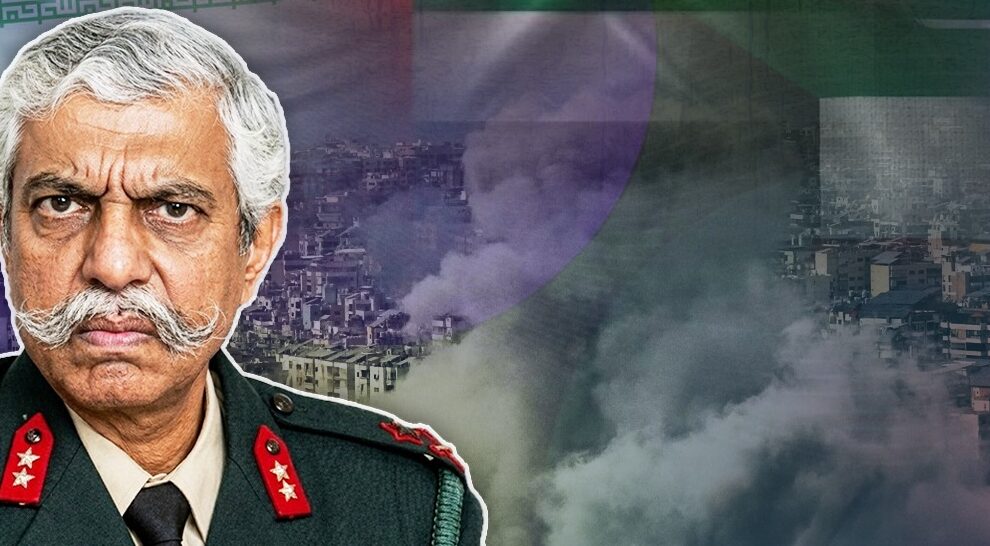
On one hand, India is celebrating its 80th independence day on 15th August, on the other hand, the end of the ongoing war between America and Iran in West Asia still seems far away. Negotiations regarding ceasefire till August 14, 2026 have stalled, the US has said that the naval blockade of Iran will continue indefinitely and the movement of ships in the Strait of Hormuz remains much below normal. At such a time, retired Major General GD Bakshi has pointed towards an aspect of this war which is more related to post-war politics than the battlefield.
The important question is – if the war stops, will the people of OIC countries demand accountability from their rulers?
Will the pent-up anger in OIC countries come out on the streets as soon as the war ends?
The biggest claim of retired Major General GD Bakshi is that in many Muslim countries the public dissatisfaction is buried under the questions of war and security. After the war is over, when the noise of missiles and military attacks will subside, the real questions before the public will be – what was gained from this war, how much did the country’s economy lose and what did the governments do for the interests of their citizens?
According to Bakshi, this will be the phase when distance can be seen between the public and the government. He argues that during the war, governments could justify many difficult decisions citing national security, but after the war, it would not be easy to respond to unemployment, inflation, decline in trade and the impact on development projects. After all, people cannot remain silent forever in front of mindless rulers. This is because everything has a limit.
However, this cannot be called the fact of any widespread public rebellion that has started in the OIC countries at present. But the economic impact of war is real. He said that in the July survey, an 8.1 percent decline in the economy of Kuwait and Qatar by 2026 was estimated. That is, behind the economic uneasiness that Bakshi is talking about, there is real pressure on the regional economy.
Have Gulf countries paid the price of America’s strategy?
The most sharp attack on America’s role in Bakshi’s statement is at this point. He says that the entire region is paying an economic and strategic price in the conflict between America and Israel. His question is that if Iran suffered huge losses, did Saudi Arabia, Kuwait, Qatar, UAE, Oman and other countries get any real benefit from the war?
The biggest fact here is the Strait of Hormuz. About 20 percent of the world’s oil and LNG shipments pass through this sea route. There has been a huge decline in traffic here due to war and blockade. On August 14, news agency Reuters reported that due to increasing tensions, ship traffic from Hormuz was well below normal levels and oil prices were rising again.
That is, Bakshi’s economic argument is not just a political statement. The longer the war continues, the greater the pressure on energy, shipping, investment and trade. The question is whether governments will have to pay its political cost in the long run?
Are Saudi Arabia, UAE, Qatar and Kuwait also real casualties of the war?
Bakshi says that this war has caused great harm not only to Iran but to all Muslim countries. But here the picture is different from country to country. The Reuters survey predicted the biggest economic decline for Kuwait and Qatar, while Saudi Arabia and Oman were seen as relatively better off due to alternative export routes.
That is, the stronger part of Bakshi’s argument is that the war has hurt the regional economy, but the injury is not the same for every country. This difference may be important in future politics.
If oil is being sold in any country but citizens are facing the brunt of inflation and employment, then the question will be to the government. If the economy of any country starts shrinking, then the question will become bigger. This is the political equation towards which Bakshi is pointing.
Did Iran maintain its stand even after suffering the heaviest losses?
This is the most important part of GD Bakshi’s statement. His assessment is that Iran refused to back down from its stance despite heavy military and economic pressure from America. Therefore, according to him, after the war is over, the people of Muslim countries will compare which country changed its course under pressure and which continued resistance. Who truly worked in the interest of Islam?
In the current developments, the pressure on Iran is very serious. The US said on August 13 that it could continue the naval blockade of Iran indefinitely, while Iran has kept its conditions regarding Hormuz. Meanwhile, UAE has blamed Iran for the attack on its two oil tankers, which is also being seen in the context of the displeasure of Gulf countries over Tehran’s strategy.
It is this paradox that is important to Bakshi – Iran itself is paying a heavy price, but is still not backing down. According to him, this is what can differentiate its political image from other Muslim countries in the future.
Is China strengthening Iran’s game behind the scenes?
China’s role in the war also cannot be separated from Bakshi’s argument. China has not openly entered into military conflict with America, but it has strong economic relations with both Iran and the Gulf.
China has two interests. First- to save energy and trade relations with Iran. Second- Supply of oil from Gulf and keeping our maritime trade safe. Therefore, for China, this war is not just an Iran-America conflict, but also a question of its energy security and strategic competition with America.
According to the former Major General, instead of entering into direct war, China wants to maintain influence through diplomacy and economic relations. The “game behind the scenes” that Bakshi talks about can be understood in the context of this strategic balance.
After the war is over, will the public ask – who fought for the Muslims?
GD Bakshi says that after the war is over, the people of Muslim countries will ask their rulers what they did during the crisis and with whom they stood.
According to him, at that time Iran will be compared with other countries. His conclusion is that Iran resisted instead of bowing to America and hence it will be seen as a country fighting for Muslim interests.
But there is also an important contradiction here. OIC had strongly condemned the attacks carried out by Iran on member countries like Saudi Arabia, UAE, Bahrain, Qatar, Kuwait, Oman and Jordan on 27 February and 11 July 2026. Therefore, “Iran is the representative of Muslim interests” is a political assessment on which there is no consensus within Muslim countries. This contradiction makes this entire statement more interesting.
Will the real test come after the war?
The basic message of GD Bakshi’s statement is that war is not decided only on the battlefield. The real decision comes later – when governments have to give an account of the economic cost of the war, public resentment and the political consequences of their decisions.
If after the end of the war, economic pressure remains in the Gulf countries, employment is affected and the public feels that their country paid the price of the war but got nothing in return, then Bakshi’s prediction may find political ground.
But if governments quickly manage the economy, regional trade is restored and the public prefers stability over war, the picture could be different.
At present, it is clear that the war has shaken the economic and strategic system of the entire region. The movement of Hormuz, the price of oil, the pressure on Gulf economies and the stuck ceasefire between America and Iran – all these indicate that the impact of the war has gone far beyond missiles.
In such a situation, GD Bakshi’s question becomes important – the anger which is currently suppressed in the noise of war, will the same anger be visible on the streets of OIC countries after the war is over? And if that happens, will the world then understand afresh the importance of Iran’s current stand?