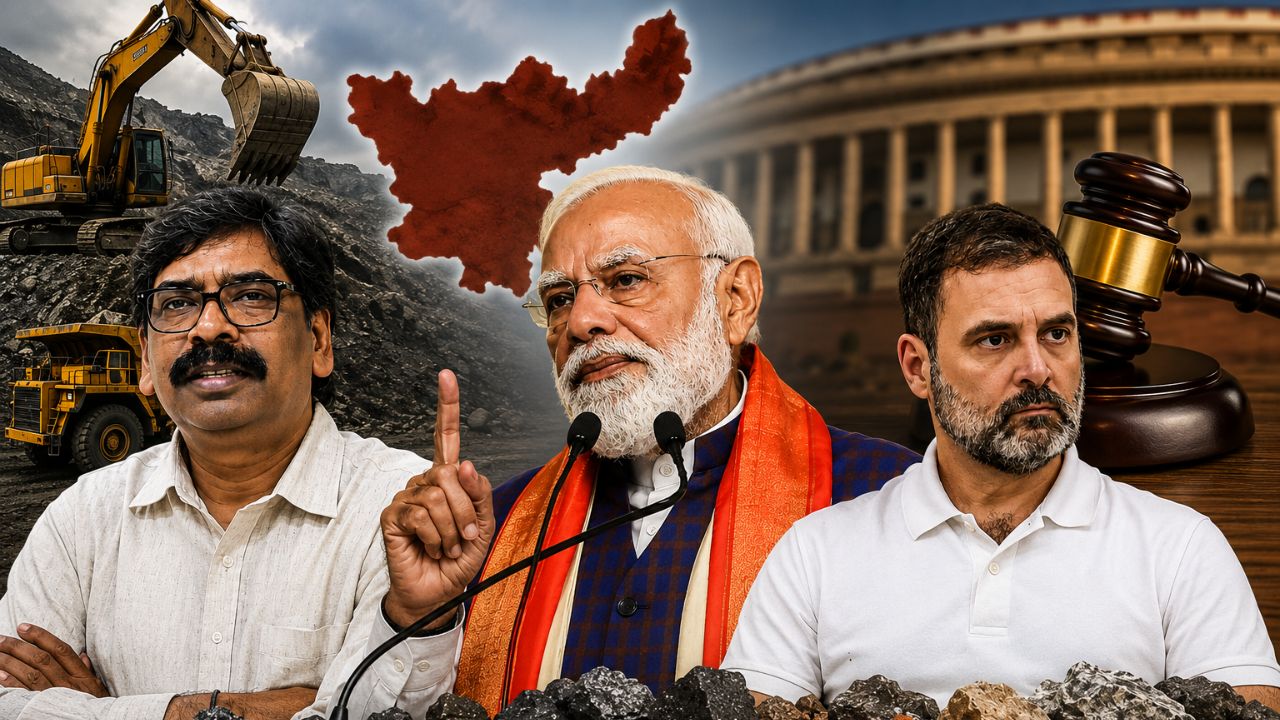
The dispute seems to be increasing between Jharkhand Chief Minister Hemant Soren and the Central Government regarding the recently passed new mining law. CM Hemant Soren has written a letter to President Draupadi Murmu, Prime Minister Narendra Modi and Leader of Opposition in Lok Sabha Rahul Gandhi regarding this law. Let us tell you that the Mines and Minerals (Development and Regulation) Amendment Bill, 2026 has been passed by both the Lok Sabha and Rajya Sabha houses. Now this bill will become law as soon as it gets the approval of the President. This bill limits the power of states to tax mineral lands. Due to this, mineral rich states like Jharkhand may suffer loss of revenue worth thousands of crores of rupees.
CM Hemant Soren, in a letter written to Rahul Gandhi, has also appealed to intervene on this issue and cooperate in the protest. In the letter written to the President and the Prime Minister, Hemant Soren has expressed his views through figures. Earlier, CM Hemant Soren termed this bill as a 'black law' and termed it an injustice to Jharkhand and its people.
Also read: From ban to mining, how India's 'Samudra Manthan' policy changed, what are the expectations?
Why so much controversy over this new law?
Let us tell you that the root of controversy is the new section 9-D added in this bill. Under this, state governments will now be able to impose tax, cess or any other levy on mineral rights or mineral-bearing land only as per the conditions set by the Central Government. Now this right of the states will go directly into the hands of the central government. This issue is big for Jharkhand because about 85% of the state's non-tax earnings come from mining. The state earns about ₹11,000 crore every year from cess on mineral lands.
In such a situation, if this tax right is limited, it could lead to a loss of thousands of crores of rupees to the state as well as a direct impact on welfare schemes like Mainiyan Samman Yojana, Abua Awas Yojana, pension and health. This bill of the government also seems to weaken the decision of the Supreme Court in July 2024. On this basis, Jharkhand had made its own cess law in 2024. CM Hemant Soren had also posted in his X post expressing strong objection to this.
Jharkhand will start such a big movement that the entire country will see… Minerals belong to Jharkhand, land belongs to Jharkhand, then why should Delhi decide on our rights and entitlements? The Central Government hastily passed the 'Mines and Minerals (Development and Regulation) Amendment Bill, 2026' in both the Lok Sabha and the Rajya Sabha, which has tied Jharkhand's hands and feet. This black law is injustice to Jharkhand and its people; This is a blow to their development and future. Jharkhand will not tolerate this step-motherly behaviour. Jharkhand Mukti Morcha strongly opposes this. If the central government does not withdraw this black law, then Jharkhand will start a big movement which the entire country will see. Hemant Soren (Chief Minister, Jharkhand)
What was the court's decision?
Hemant Soren says that the new bill weakens the decision of the Supreme Court. In fact, while giving the verdict in the case of Mineral Area Development Authority vs Steel Authority of India Limited, a bench of 9 judges of the Supreme Court had said that the states have the right to impose tax or cess on mineral land. This tax can be decided on the basis of price or production of the mineral. Based on this authority of the Supreme Court, Jharkhand had made its Mineral Cess Law in 2024. Its objective was not only to raise money, but also to raise resources for development and welfare schemes in mining affected areas.
What happened when?
- July 2024: In one case, a bench of 9 judges of the Supreme Court gave the states the right to impose tax on mineral land.
- Based on this decision in 2024 itself, Jharkhand passed the Mineral Bearing Land Cess Act, 2024.
- 12 August 2026: Lok Sabha passes the Mines and Minerals Amendment Bill, 2026
- 13 August 2026: Rajya Sabha also approved the bill, Parliament process completed
- 13 August 2026: Hemant Soren through X post called the bill a black law and warned of a big movement.
- 13 August 2026: Soren wrote a letter to President Draupadi Murmu and PM Modi, appealing for reconsideration of the bill, also wrote a letter to Rahul Gandhi.
- At present, the approval of the President is awaited. After this it will become law
What will change with the new bill, what is the loss to Jharkhand?
In his letter, CM Soren, citing Jharkhand's Economic Survey 2025-26, said that in 2024-25, 84.9% of the state's non-tax revenue came from mining. The money received from minerals is very important for the state. A major decrease in this may affect the development, welfare and social security schemes of the state. Additionally, the Bill also provides that cess claims not already recovered will be considered invalid, whereas the Supreme Court had ordered payment for such outstanding claims in 12 annual installments from April 1, 2026.
The new bill can change this system also. Soren says that this will not only affect Jharkhand but also mineral rich states like Odisha and Karnataka. He has demanded from the Center to create a system of dialogue like GST Council with the mineral producing states. Soren said that if needed, Jharkhand will adopt every legal means including the Supreme Court.
Protest in Odisha too, Naveen Patnaik wrote letter to CM
This issue was not limited to Jharkhand only. Leader of Opposition in Odisha Assembly and BJD chief Naveen Patnaik has written a letter to CM Mohan Charan Majhi asking him to oppose the bill. He said that this bill is a big threat to the monetary rights and constitutional rights of Odisha. He said that three things about this bill are of most concern, the first is that now the Center has control not only over the mining site but also over the entire mineral land. Second, now state governments will be able to impose tax on minerals only when the Center gives permission. Third, the right to make all the rules related to this is now left only with the Centre. This means that now this fight is not just about Jharkhand, Odisha is also involved in it.
Also read: 'Naxalites and madmen in BJP itself…', Tej Pratap Yadav got angry on what PM Modi said?
Jharkhand is the country's mineral reserve
Let us tell you that Jharkhand is called the mineral reserve of the country, about 40% of all the minerals extracted in India come from Jharkhand alone. More than 30 types of minerals are found here. It has the country's largest coal reserves, apart from this iron ore, mica, bauxite and limestone are also available in large quantities. Most mining takes place in Singhbhum and Dhanbad districts, from where most iron and coal are extracted.
Will common people also be affected?
Currently, the Jharkhand government collects about ₹11,000 crore every year by taxing mineral-bearing land, which is 84.9% of the state's non-tax revenue. Under Section 9-D of the new bill, this tax will now be levied only on the conditions of the Centre, which means this big revenue source may be limited. CM says that this will have a direct impact on facilities like Maiya Samman Yojana, Abua Awas Yojana, pension, school-hospital, on which lakhs of poor and tribal families depend. This may also affect the compensation given to people already facing displacement and pollution in mining areas like Singhbhum and Dhanbad.