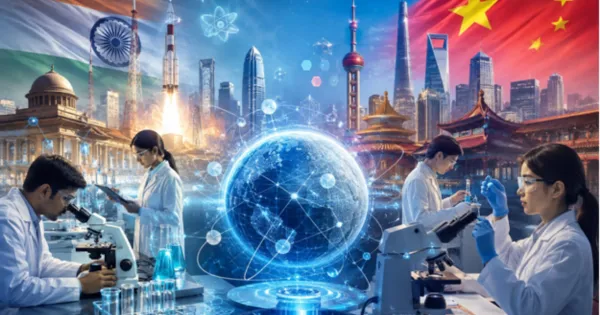
Now gone are the days when it was said that America is the birthplace of modern scientific research and America's scientific research base is the contribution of European scientists. In the changing global scenario, the center of scientific research is gradually moving beyond America and looking towards countries like India and China. There are many reasons behind this like scientific talent, institutional capacity, government investment and technological self-reliance.
The temperament and policies of US President Donald Trump have angered a large section of the American scientific community. A large number of scientists from foreign countries work in many institutions and universities of America. Many of them also have American citizenship. Despite this, these scientists remain under surveillance by American spy agencies and the Federal Police, especially regarding their relations with Russia, North Korea and China and foreign travels.
Recently Nobel Prize winner Omar Yaghi has expressed his intention to leave America and settle in China. There are a large number of scientists and researchers of Chinese origin in America. Some of them were shown the door and some had to face cases on charges of sending or taking scientific material to China. The world's prestigious scientific journals have been publishing such news prominently. There is commotion for some time and then things calm down. But Omar Yaghi's decision to go to China has come at a time when there is talk of cutting funding for science in America and China is busy attracting the best scientific talent from around the world. Yaghi has accepted a full-time job as a researcher at Tsinghua University in Beijing.

China has currently become a leading country in the field of scientific research. The government there is making huge investments in rare earth materials, cutting-edge semiconductor technology and other strategic sectors. For this it needs thousands of scientists and researchers. Scientists like Omar Yaghi may signal the beginning of this process. If this trend continues, it is not clear what America's administrative policy will be. But such migration of high level talent is a matter of concern for any country.
Omar Yaghi is a professor of chemistry at the University of California, Berkeley. They were jointly awarded the 2025 Nobel Prize in Chemistry for their outstanding work on metal-organic frameworks. He is also the founding director of the Berkeley Global Science Institute. Their objective is to establish research centers in developing countries. Apart from this, he has also been associated with many important scientific and technical institutions. Such a scientist finding his future in China cannot be considered a normal phenomenon for America.
If we look at the context of India, there was a numerical increase in brain drain between 1960 and 2000 and the government was worried. Then it was also argued that 'brain drain is better than brain in the drain.' This statement may have been contemptuous of nationalist thinking, but the truth was that we had failed to establish adequate scientific institutional infrastructure to harness our talents.
Even till 1985, our scientists were struggling for indigenous availability of high level instrumentation and modern scientific equipment. Despite this, hundreds of talented scientists wanted to return to the country by staying in India and, if necessary, training for some time in foreign institutions. He wanted to do advanced research in Chemistry, Physics, Astronomy and Astrophysics and Biological Sciences.
After 1985, circumstances started changing rapidly. Government investment increased and many new scientific institutions were established. Senior and emerging scientists were given the responsibility to increase research work in the country and develop advanced technology. Even in the private sector, talented people have set up industrial institutions, which have become leading industries today. These efforts have stopped the brain drain in India to a great extent, but the concern has not completely ended.
The initial policies for regulation of scientific manpower in India began with the Council of Scientific and Industrial Research and later the Department of Science and Technology and the Office of the Scientific Advisor to the Prime Minister played an important role. There is no restriction on going abroad for higher studies, rather India has made agreements for scientific cooperation with many countries. The objective is that Indian scientists connect with global knowledge and the country also benefits from their expertise.
It takes twenty-thirty years of time, human talent and immense money to take scientific research to technology and applications. Its results are not immediate and require continuous political and institutional support. India has developed indigenous capabilities in many modern areas ranging from satellites, rockets, nuclear energy, defense technology and submarines. Now there is hardly any major field left in which Indian institutions are not in a position to compete with global institutions.
Therefore, the coming time is not only the scientific time of America or Europe. China has strengthened its position on the back of talent and investment, while India has a huge young scientific force, a growing institutional base and clear efforts towards technological self-reliance. If both the countries can provide better research environment, freedom, resources and respect to the talents, then a large part of the future scientific research can definitely take shape in India and China.
-Ranbir Singh, science writer