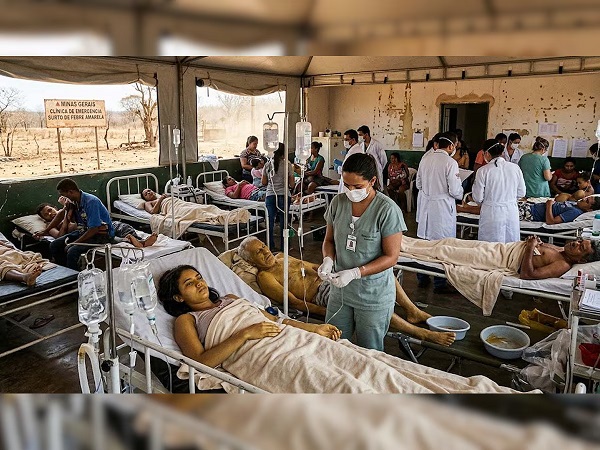
New Delhi. Diseases spread by mosquitoes are generally associated with rain and waterlogging. But an incident that occurred in Brazil forced scientists to think that Severe drought can also cause the spread of dangerous diseases. According to a study published in Science Advances, the severe drought in 2015 had created conditions for the yellow fever virus present in the forest to reach humans.
Its effect was visible after some time. From the end of 2016, cases of yellow fever started appearing rapidly in Brazilian cities. Between 2016 and 2019, more than 2,000 people were infected and about 750 died. The most shocking thing was that after almost seven decades, a major outbreak of this disease was seen in the urban areas of Brazil.
The drought of 2015 changed the entire equation of the forest.
According to researchers, the impact of El Nino in 2015 caused extremely severe drought in many parts of central South America and Brazil. This was considered an extraordinary level of drought. Small water sources of rivers and forests started drying up and lack of water and food affected humans as well as wildlife.
Monkeys started coming out of the forests and reaching around human settlements in search of water and food. Among them were some monkeys who were infected with yellow fever virus. This was the situation that paved the way for the disease that was confined to the forest to reach humans.
How did mosquitoes change their path to reach humans?
Yellow fever virus is found mainly in forests. Haemagogus Spread through mosquitoes of this species. Under normal circumstances, these mosquitoes bite monkeys living in the forests and the cycle of the virus continues among the wildlife. Humans remain largely outside this cycle.
But drought changed the circumstances. According to the study, due to lack of water, pressure on mosquitoes also increased and they showed more activity in search of food. On the other hand, infected monkeys also started leaving the forest and moving closer to cities and human populations.
In this way, both the infected wildlife and the mosquitoes spreading the virus came close to human settlements. After this, mosquitoes started biting humans and the infection of yellow fever spread from the forests to the cities.
After 1942, the outbreak returned again in the cities.
The last major outbreak of yellow fever in urban areas of Brazil was recorded in 1942. After this, the disease was controlled to a great extent in urban areas through measures like vaccination and mosquito control.
But the situation changed after the drought of 2015. Cases of infection started increasing in late 2016 and thousands of people became infected over the next few years. The impact of the disease was particularly severe in the state of Minas Gerais.
What are scientists afraid of now?
Later, efforts were made to stop the infection by running large-scale vaccination and mosquito control campaigns. But this incident has raised a big question in front of scientists-How can climate change bring diseases present in forests closer to humans?
Researchers estimate that such conditions may recur in Brazil approximately every 25 years. If another extremely severe drought occurs in the future, wildlife may flock to human settlements in search of water and food, bringing with them the risk of disease-carrying mosquitoes.
That means this matter is not limited to yellow fever only. This incident is an indication that Understanding the connections between major changes in weather, wildlife behavior, and infectious diseases will be critical to preventing new pandemics in the future.