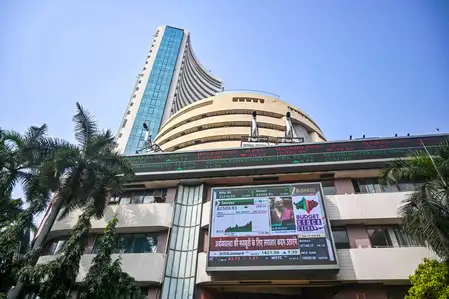
Mumbai, 18 (IANS). The Indian stock market opened in the red on Tuesday, the second trading day of the week, due to increasing tension between America and Iran in West Asia and crude oil prices reaching above $ 91 per barrel. This is the sixth consecutive day that stocking has been seen in the market. Investors adopted a cautious approach amid geopolitical uncertainty and weak signals from global markets, due to which both Sensex and Nifty were under pressure in early trade.
At the beginning of trading, BSE Sensex opened at 77,418.97, down 309.19 points or 0.39 percent from its previous close of 77,728.16. Whereas NSE Nifty 50 opened at 24,223.85 level, falling 0.26 percent from its previous closing of 24,287.65.
Till the time of writing the news, Sensex was seen trading at 77,464.18 with a decline of 263.98 points or 0.34 percent. In the day's session, it made a high of 77,575.21 and a low of 77,362.19, which shows a decline of 365 points or 0.47 percent.
Whereas Nifty 50 was seen falling 42.40 points or 0.17 percent and trading at around 24,245.25 level. In the day's session, it made a low of 24,211.10 and a high of 24,269.65.
In the broader market, Nifty Midcap fell 0.08 per cent and Smallcap rose 0.27 per cent.
On the sectoral front, the most pressure was seen in the Nifty IT index, which fell by more than 1 percent. Apart from this, Nifty Midsmall IT & Telecom fell by 0.62 per cent and Nifty Realty fell by about 0.4 per cent. There was also a selling trend in Nifty Financial Services, Private Bank, Media, Metal and FMCG stocks.
However, strength was also seen in some areas. The Nifty Auto index rose nearly 0.40 per cent, while the PSU Bank index gained 0.29 per cent. This indicates that buying continues in select sectors in the broader market.
According to market experts, pressure on equity markets has increased due to Brent crude rising above $ 91 per barrel in the international market and US 10-year treasury bond yield rising to 4.73 percent. Higher US bond yields may make investments in emerging markets less attractive for foreign institutional investors (FIIs).
Analysts believe that high crude oil prices may limit the rise of the Indian market in the near term. India imports a large part of its energy needs, so a rise in oil prices could have an impact on inflation, current account deficit and corporate costs.
However, market experts also believe that signs of strength of the Indian economy and improvement in corporate earnings can support the domestic market. He says that domestic institutional investors (DIIs) have enough cash and they can buy if there is a big fall. Also, retail investors can also use the weakness in the market as an opportunity to increase investment in good stocks for long term.
The pressure in the market comes at a time when reports indicate that Iran may adopt a more aggressive strategy, while US President Donald Trump has ruled out the possibility of extending the ceasefire arrangement. Due to this, concerns about global energy supply have increased again.
After these developments, Brent crude rose by about 0.60 percent from the previous closing level to above $ 91 per barrel. At the same time, American West Texas Intermediate (WTI) crude also increased by more than 1 percent and was seen trading at $ 85.37 per barrel.
Experts say that until the tension in West Asia does not subside and the oil market becomes stable, the global and Indian stock markets may remain volatile. At present, investors are keeping an eye on crude oil prices, US bond yields and geopolitical developments.
–IANS
DBP