By Hemant Parmar
Crores of citizens of united India, who were celebrating independence on 15th August, had no idea that just two days later their land, their homes and their fortunes were to be divided forever. On 17 August 1947, the “Radcliffe Line” was declared, determining the official border between India and Pakistan. With this announcement, there has been such an uproar in the subcontinent, which has started the biggest displacement and bloody massacre in human history.
What is Radcliffe Line?
This border was named Radcliffe Line after the name of British lawyer Sir Cyril Radcliffe. This historic and controversial border line determined the boundaries between India and Pakistan (then West Pakistan and East Pakistan) by dividing India's two largest and richest provinces under British rule, namely Punjab in the west and the two Bhagla districts of Bengal in the east. This line was not just a part of the land, but had become a wall of distrust between people living together for centuries.
Who was Sir Cyril Radcliffe? Responsibility handed over to a person unknown from India
Sir Cyril Radcliffe was made the Chairman of the Boundary Commission (Sarhad Panch) by the British Government. The surprising and shocking thing is that Sir Cyril Radcliffe was a general lawyer of London and he had never come to India before for this work. He did not have the slightest knowledge of India's complex geographical location, social structure, language, culture or local sentiments.
The British government had presented the logic behind this strange decision that being completely unaware of the situation in India, they would be able to assess the border neutrally without any bias. However, this so-called neutrality proved disastrous for millions of people.
fled the country in just five weeks
Sir Cyril Radcliffe was given a very short period of only 5 weeks (36 days) to determine the boundaries of an area covering an estimated area of 450,000 square kilometers and a human population of more than 88 million.
In such a short time, decisions about the future of crores of innocent people were taken without checking the facts on the ground. Radcliffe's team had never gone to the ground level and conducted a survey. They divided the country into pieces just by sitting in closed government offices and using pen and paper based on old and inaccurate maps and old religious population census data.
Why was the border declared two days after independence?
The map of the Radcliffe Line was completely ready by 12 August 1947. Nevertheless, Lord Mountbatten, the last Viceroy of India, instead of making it public till 15 August, deliberately kept it under wraps till 17 August.
The main reason behind this delay was the crooked policy of British imperialism. Mountbatten knew very well that as soon as this unnatural border was revealed, terrible violence would erupt. He did not want the blame for the riots and massacres that broke out on the historic day of independence on 15th August to fall on the British rule. He wanted to save Britain from this bloody controversy and responsibility and go away safely.
Chaos and pain created overnight
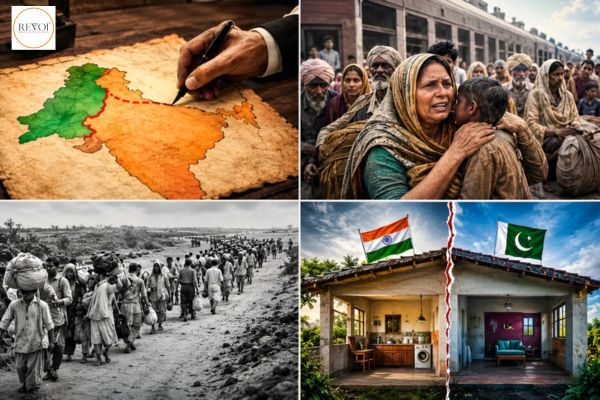
When the map was officially announced on 17 August, crores of people were shocked and helpless. The people who were enjoying the tricolor joy of being in India on 15th August suddenly became a part of Pakistan on 17th August. Similarly, lakhs of Hindu and Sikh families living in Pakistan became refugees in their own country overnight.
The map was prepared with such carelessness and haste that at many places the international border passed through people's homes. In some houses, the kitchen was in one country and the living room was in another country. Fields were divided on one side and wells on the other. Villages, railway stations and police stations were also divided in half.
The largest migration and spine-chilling violence in human history
As soon as this announcement was made, the largest, most painful and blood-drenched migration in human history began. More than 1.5 crore people left behind their centuries-old land and property, their grandmothers' houses and memories and set out on foot in the form of a caravan just to save their lives.
Horrible Komi riots broke out on the roads of Punjab and Bengal. The trains passing through the stations were filled with dead bodies. Innocent children, old people and lakhs of women were becoming victims of inhuman atrocities and violence. According to estimates, 5 lakh to 20 lakh people lost their lives in this man-made disaster.
This one thoughtless line drawn on paper has left a permanent wound on the heart of the Indian subcontinent, whose pain will continue to be felt for many generations to come.