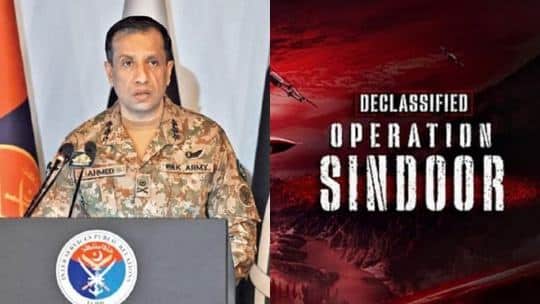
The Pakistani Army has criticised a recently released documentary on Operation Sindoor, describing it as a “highly dramatised” and one-sided portrayal of the military operation carried out by India in May 2025.
The response came after Discovery’s Declassified: Operation Sindoor premiered on August 15, India’s Independence Day. The docuseries features senior Indian security and military officials recounting the events surrounding the operation and the decisions that led to it.
Pakistan’s military media wing, the Inter-Services Public Relations (ISPR), reportedly objected to the documentary’s depiction of Operation Sindoor and its characterisation of the mission as a military success.
What Pakistan Army said about the documentary
According to news agency PTI, the ISPR described the documentary as a “highly dramatised” account presented in India’s “preferred hues”.
The Pakistani military wing also rejected the portrayal of Operation Sindoor as a military success.
The comments represent Islamabad’s response to the documentary, which largely presents the Indian military and security establishment’s account of the operation. There was no immediate response from the Indian government to the ISPR statement.
What is Operation Sindoor?
India launched Operation Sindoor on May 7, 2025, following the April 22 Pahalgam terror attack in Jammu and Kashmir, in which 26 people were killed.
The operation involved India’s Army, Navy and Air Force and targeted terrorist infrastructure in Pakistan and Pakistan-occupied Kashmir (PoK), according to the Indian government.
The documentary features accounts from several senior officials involved in the operation, including then-Director General of Military Operations Lt Gen Rajiv Ghai, Air Marshal AK Bharti and other senior military leadership.
National Security Adviser Ajit Doval also appears in the documentary, giving his first interview about the operation.
Ajit Doval recalls PM Modi’s response
Doval recalled the events following the Pahalgam attack and said Prime Minister Narendra Modi sought immediate information about those responsible.
According to Doval’s account in the documentary, Modi wanted clarity on who was behind the attack before deciding on India’s response.
Doval also said the operation was intended to make clear that India’s willingness to exercise restraint should not be mistaken for weakness.
The NSA said India was prepared to take risks to protect its national interests and sovereignty.
The documentary also recounts the military’s instructions to focus on terrorist infrastructure and avoid civilian casualties.
'Bullet from the left, gola from the right'
National security analyst Nitin Gokhale, who also features in the documentary, recalled the approach attributed to Prime Minister Modi regarding India’s response to terrorism.
The phrase “Udhar se goli, idhar se gola” — referring to bullets from one side and bombs from the other — is presented in the documentary as an illustration of India’s intended response.
The documentary follows the operation from its planning stages through the military strikes and subsequent developments that eventually led to a ceasefire request from Pakistan’s side, according to the Indian account presented in the series.
Diplomatic measures also followed
Operation Sindoor was accompanied by diplomatic and other measures against Pakistan.
India placed the Indus Waters Treaty in abeyance following the Pahalgam attack and took several other steps as tensions between the two countries escalated.
The Indian government has continued to maintain a policy of zero tolerance towards terrorism and has warned that future terror attacks against India could invite a strong response.
Meanwhile, Pakistan has consistently disputed India’s narrative surrounding Operation Sindoor and its outcome, setting the stage for another round of competing claims following the release of the documentary.