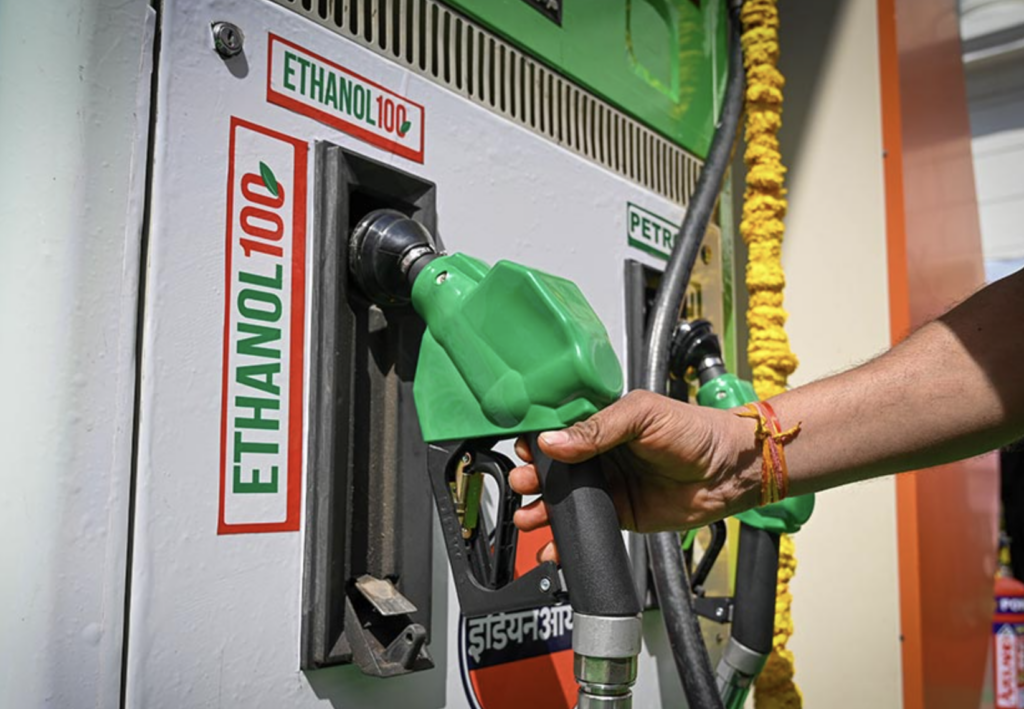
Call For Lower-Ethanol Petrol
India’s Chief Economic Adviser V. Anantha Nageswaran has called for the government to bring back a petrol option with a lower ethanol blend, such as E10alongside the existing E20 fuel.
The suggestion comes amid growing concerns from vehicle owners about the impact of E20 petrol on older cars and two-wheelers.
Nageswaran made the recommendation in an opinion piece co-authored with Department of Economic Affairs consultant Akash Poojari. They stressed that the views expressed were their own.
E20 Is Currently The Standard
E20 petrol contains 20% ethanol and 80% petrol.
Since April 1, 2026, E20 has been the only petrol blend available for sale at fuel stations across India as part of the government’s strategy to reduce crude oil imports, cut pollution and increase the use of domestically produced ethanol.
The policy has nevertheless triggered considerable debate among motorists, particularly owners of older vehicles.
CEA Suggests E10 Alongside E20
Nageswaran’s proposal is not to abandon E20 altogether.
Instead, he has suggested restoring E10 petrol alongside E20giving motorists a choice based on the compatibility of their vehicles.
The proposal could particularly benefit owners of older two-wheelers and vehicles that were not designed to operate with higher ethanol concentrations.
According to Nageswaran, offering a lower-blend option could help address public concerns while India’s vehicle fleet gradually transitions to newer, ethanol-compatible technology.
75-80 Million Older Two-Wheelers
One of the biggest concerns highlighted by the CEA relates to India’s enormous fleet of older two-wheelers.
Nageswaran and Poojari estimate that India has around 75 million to 80 million older two-wheelers.
The concern is not necessarily that E20 will automatically damage every older vehicle.
Instead, the authors point to components such as older rubber seals that may not have been designed for higher ethanol concentrations.
Replacing or retrofitting such components across such a huge vehicle fleet would take considerable time.
Retrofit Programme Could Take Years
The CEA’s argument is that India’s transition to higher ethanol blends should account for the vehicles already on the road.
Newer vehicles are increasingly designed to handle higher ethanol blends, but millions of older vehicles will continue operating for years.
A nationwide retrofit programme could therefore take considerable time to reach the entire existing fleet.
Providing E10 alongside E20 during this transition could offer an interim solution.
Government Previously Ruled Out E10 Return
The proposal puts the CEA’s position at odds with the government’s earlier stance.
The government had previously said there was no proposal to bring back E0 or E10 petrol alongside E20.
Officials have also pointed to the logistical difficulties of maintaining multiple petrol grades across the country’s fuel-station network.
Introducing separate fuel variants would require additional storage, transportation and dispensing arrangements.
E20 Debate Has Intensified
The E20 controversy has grown significantly in recent weeks.
Vehicle owners have complained about mileage and performance, while concerns have also emerged regarding fuel quality and potential contamination.
Indian automakers have privately raised concerns about contamination found in fuel samples, although an industry association later withdrew a formal complaint after it attracted significant attention.
The government has maintained that E20 is part of India’s broader energy strategy.
CEA Says Engine-Damage Fears Are Not Fully Supported
Importantly, Nageswaran’s argument does not endorse claims that E20 universally damages vehicle engines.
The opinion piece acknowledges that available evidence does not support broad fears of engine damage.
The concern is more specifically about the existing older fleetincluding components that may not have been designed for higher ethanol concentrations.
That distinction is important because it shifts the debate from whether E20 is inherently harmful to whether consumers with older vehicles should have an alternative.
Why India Wants More Ethanol
India’s ethanol-blending programme has strategic objectives.
Greater ethanol use can reduce the amount of crude oil India needs to import while creating additional demand for domestically produced agricultural feedstock.
It is also intended to reduce emissions associated with conventional petrol.
However, increasing ethanol consumption also creates questions about agricultural resources, fuel infrastructure and compatibility with the existing vehicle fleet.
A Choice-Based Approach
The CEA’s proposal effectively calls for a transition strategy rather than an immediate reversal of India’s ethanol policy.
E20 could remain available for compatible vehicles, while E10 would provide an alternative for older vehicles during the transition period.
Such a system could also reduce the pressure on motorists who are currently concerned about switching entirely to E20.
Will E10 Return To Petrol Pumps?
For now, the proposal remains a recommendation rather than a government decision.
The Petroleum Ministry has not announced a reversal of the current E20 policy, and logistical challenges surrounding multiple fuel grades remain.
However, the fact that India’s Chief Economic Adviser has publicly advocated offering E10 alongside E20 gives the debate a new dimension.
It also highlights the challenge facing policymakers: India’s move towards cleaner and more domestically produced fuel must happen without leaving millions of existing vehicle owners behind.
Summary
Chief Economic Adviser V. Anantha Nageswaran has recommended bringing back E10 petrol alongside E20 to address concerns surrounding India’s older vehicle fleet. He highlighted the estimated 75-80 million older two-wheelers whose components, including rubber seals, may not be designed for higher ethanol blends. The proposal does not call for abandoning E20 but for giving motorists a choice while older vehicles are gradually retrofitted. The government had previously ruled out bringing back lower ethanol blends, citing logistical challenges.