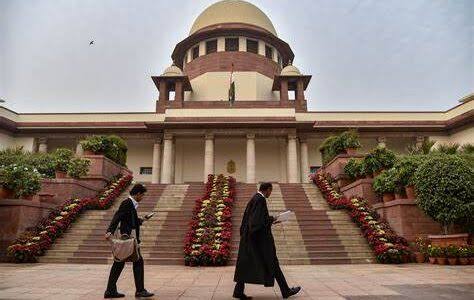
The Supreme Court on Tuesday said the State, even when authorised to take away life, cannot do so in a manner that is arbitrary, excessive or incompatible with human dignity.
A bench of Justices Vikram Nath and Sandeep Mehta said the method of execution must satisfy the constitutional requirements that it minimises suffering and preserves, to the greatest extent possible, the inherent dignity of the condemned.
The bench made the observations while dismissing a petition seeking abolition of the practice of executing a death row convict by hanging and replacing it with methods such as intravenous lethal injection.
In its verdict, the top court said among all punishments permitted by the law, death penalty stands apart in its severity and finality.
“When a court of law, upon due adjudication, imposes a sentence of death for a crime, the State, through its constitutional machinery, is called upon to carry out a punishment of the gravest nature, one that, once executed, is incapable of being undone,” it said.
The bench said if an error occurs, whether in the process or the proportionality of punishment, the consequences cannot be undone.
“It is this final and irreversible character of death penalty that has placed it at the centre of continuing debate in constitutional law, criminal jurisprudence and moral philosophy, both in India and across jurisdictions,” it said, adding that legitimacy of the death penalty has been debated over centuries.
It said that in India, the question of legality of capital punishment has been examined through the prism of constitutional scrutiny, beginning with a decision of the top court that affirmed that death penalty did not violate the guarantees under Articles 14, 19, or 21 of the Constitution, provided it was imposed upon conclusion of a lawful trial with robust procedural safeguards.