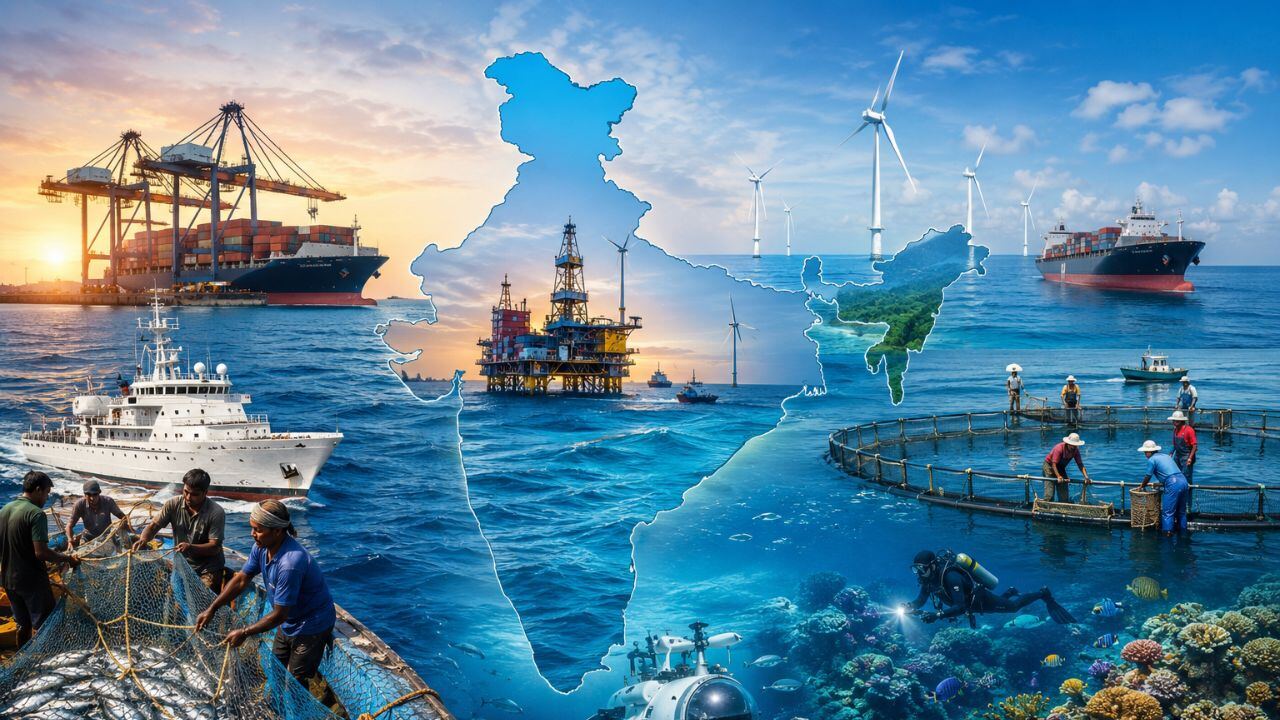
Blue economy is also a part of the 'Saptdhara' powers with the help of which the Central Government is aiming to reach a developed India by 2047. Prime Minister Narendra Modi had called it the seventh power from the ramparts of the Red Fort. He had said that India is making rapid progress in many areas of blue economy. Proper utilization of marine resources will become the new engine of development. The biggest challenge in the path of the blue-green economy on which the government is emphasizing is India's foreign dependence.
From shipping to minerals, we are dependent on foreign help on many matters. Prime Minister Narendra Modi visited Nordic countries in May 2026, some agreements related to green-blue economy were signed with many countries. With the help of these agreements, India was dreaming of shaping its future in this sector of the economy. Now the government has changed its stand regarding blue economy.
Also read: There was a lot of noise but where did the Bharat Taxi get stuck?
What could be the path to blue economy?
The Ministry of Earth Sciences, in collaboration with 'Ernst & Young', had prepared a report titled 'Transforming India's Blue Economy' in May 2025. In this report, a complete outline of the current status, challenges and future prospects of India's marine resources-related economy was prepared. India has a coastline of 11,098 km long and a vast Exclusive Economic Zone (EEZ) of 24 million square kilometers, which gives it an opportunity to be among the leading countries of the world in terms of maritime economy. Now the Central Government has opened these areas for research, which can create new possibilities. If the expected results are achieved then the country's dependence on Nordic countries will reduce.
What is blue economy?
The Ministry of Earth Sciences looks at it from the perspective of marine economy in the Indian context. It is the part of the national economy that includes marine resources and resources produced in coastal areas. Not only the Ministry of Earth Sciences, but also 24 other ministries are involved in this area. Ministry of Ports, Shipping and Waterways (MoPSW), Ministry of Fisheries, and Ministry of Environment. Apart from this, 9 coastal states and 4 union territories are also running schemes at their own level.
What is the purpose of the government?
The government aims to increase the blue economy to $100 billion by 2030. It is one of the 10 main pillars of India's 'Developed India 2047' vision. India had pledged to make the maritime economy sustainable by adopting the 'Chennai High Level Principles' during its G20 presidency in 2023.
Also read: From production to reaching your car, what is the story of ethanol? answer to every question
In which sectors work is being done?
According to the report of 'Ernst and Young', fish production in the fisheries sector has increased to 17.25 million metric tonnes through schemes like Pradhan Mantri Matsya Sampada Yojana. About 48 lakh fishermen have benefited from this, of which 30 percent are women. 155 projects have been completed under the Sagarmala program in the maritime transport and shipping sector. Cargo capacity has reached 1,534 million tons per year. Immense possibilities are emerging in the field of renewable energy from offshore areas, which are called 'offshore'. 36 gigawatt wind energy potential has been detected by surveying the Gujarat coast. A target of 30 gigawatt offshore wind energy has been set by 2030.
The report of 'Ernst and Young' shows that the government is hoping for a better future for coastal tourism by the year 2025 through the Swadesh Darshan scheme. 15 coastal circuits have been developed which have attracted 1.25 crore tourists and generated about 81 lakh jobs. New compounds are being discovered under the Deep Ocean Mission in Marine Biotechnology, and 30 startups have received support. In the mineral resources sector, 28 offshore blocks have been allocated which have attracted investments worth Rs 50,000 crore.
Successful models that can be replicated
Women-led seaweed farming takes place around Chilika Lake in Odisha. Amid dwindling fishing opportunities here, more than 200 self-help groups are now earning livelihood by growing algae. This is providing additional income to more than 10,000 coastal families. It is also beneficial for the environment because algae absorbs carbon. 'Digital Twin' model of Kochi Port, with the help of sensors and artificial intelligence, a complete virtual copy of the port has been created. The waiting period of ships has reduced and operations have improved.
The circular economy model of shipbreaking industry has improved in Alang, Gujarat. Once infamous for pollution, Hong Kong is now following Convention standards. Steel and other metals are being recycled so that they can be used in new ways. Adopting sustainable tourism model for Andaman and Nicobar Islands, revenue of Rs 800 crore from 5 lakh tourists in 2023. 90 percent of the coral reef was protected. Tourism took place but the bio-ecology and structures present within the sea were not touched.
Also read: Neither films, nor any big work, how are film stars earning lakhs just by looking?
What are the challenges?
According to the report of 'Ernst and Young', fish stocks are decreasing due to overfishing and pollution in fishing areas. Lack of cold chain facilities is leading to post-harvest losses. It is difficult for small fishermen to get loans, they have nothing to pledge. Logistics costs in the shipping sector are high and shipbuilding capacity is limited. Offshore energy projects have high costs due to dependence on imports and a severe shortage of trained technicians.
Coastal tourism lacks basic facilities like sanitation and transportation at many places. The slow pace of research and dependence on imported equipment is a major problem in marine biotechnology. The same problems appear in every sector: lack of private investment, technical weakness, shortage of skilled workers and limited participation of women and local communities. The blueprint for how the government will deal with this has not been prepared yet.
Where will the money come from?
The methods have also been discussed in the 'Ernst and Young' report released by the Ministry of Earth Sciences. In this, the target can be achieved with the help of blue bonds, public-private partnerships and financial development institutions like National Bank for Financing Infrastructure and Development (NaBFID).
Currently, only 15 percent of Sagarmala's projects involve private investment. This is a weak advance towards a maritime economy. The report suggests that there is a need to adopt new financial instruments such as 'debt-for-nature swaps' in areas like the Sundarbans.
Also read: Journey from steam to hydrogen, how far has Indian Railways reached in 173 years?
What are the expectations?
A roadmap has been prepared in the report till 2035. The report has suggested that the 'Inter-Ministerial Coordination Council' should work better for coordination between ministries from the year 2026. The Digital Blue Economy Dashboard should be made successful by the year 2027. A 'National Blue Skills Programme' should be launched to train 50,000 workers by 2028. The target is that the contribution of blue economy should reach Rs 5 lakh crore by 2035.
The report says that India has immense ocean-related potential, but to fully exploit it, better coordination, more investment and modern technology are needed. It can also be linked to local development with the participation of coastal communities, women and tribal groups. If this target is to be achieved by 2047, then work will have to be done in this direction.