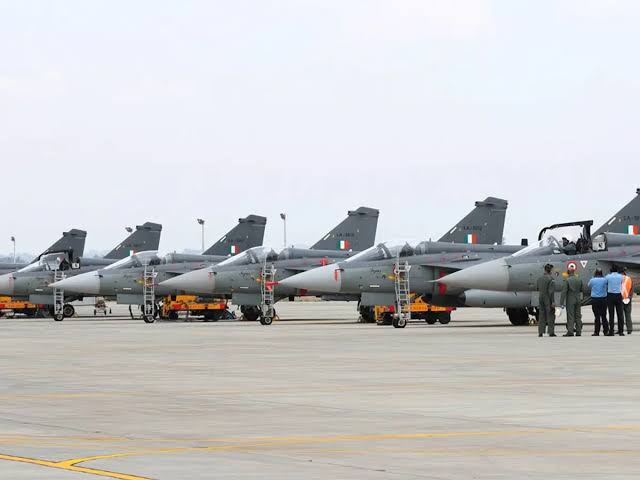
A former senior Indian Air Force officer has raised concerns over whether India’s Tejas Mk-2 fighter jet will remain operationally relevant by the time it enters service in significant numbers, pointing to rapid advances in Chinese fifth- and sixth-generation combat aircraft.
Air Marshal Nagesh Kapoor, who retired as the IAF’s Vice Chief less than two months ago, made the remarks while discussing India’s fighter aircraft requirements and the pace of indigenous development.
Asked whether it made sense for India to induct a fourth-generation fighter around 2035 when China is progressing towards more advanced platforms, Kapoor was categorical.
“No, operationally, definitely no,” he said.
Tejas Mk-2 could still fill capability gaps
Despite his criticism, Kapoor said fourth-generation fighters such as the Tejas Mk-2 could continue to have a role in the IAF.
He argued that even if India eventually operates fifth- and sixth-generation aircraft, the country would not be able to deploy such expensive and technologically advanced platforms everywhere.
As a result, aircraft such as the Tejas Mk-2 could potentially fill capability gaps and perform missions that do not necessarily require cutting-edge technology.
The concern, therefore, is not simply whether the Tejas Mk-2 has a role, but whether its capabilities will be sufficient for frontline operations when it becomes available in large numbers.
China’s growing fighter capability adds urgency
Kapoor’s comments come against the backdrop of China’s rapid development of advanced combat aircraft.
Fifth-generation fighters such as China’s J-20 combine stealth, advanced sensors and sensor fusion with internally carried weapons. Sixth-generation concepts are expected to add capabilities such as artificial intelligence, autonomous systems, drone wingmen and networked “system of systems” operations.
India currently does not operate a fifth-generation fighter, while its indigenous Advanced Medium Combat Aircraft (AMCA) programme is still under development.
Some estimates cited in the report suggest China could have hundreds of J-20 fighters in service by 2030.
Ex-Air Marshal questions HAL’s urgency
Kapoor also criticised what he described as a lack of urgency at Hindustan Aeronautics Limited (HAL), particularly over delays in delivering the Tejas Mk-1A.
He questioned why the IAF continues to face delays in receiving aircraft that were promised with specific capabilities.
The former Vice Chief said that while indigenous fighter development remained essential, India could not indefinitely wait for delayed programmes.
“Indigenous is the way to go without a doubt but how long do we keep waiting?” he said.
Tejas Mk-1A deliveries remain a concern
The Tejas programme has faced several delays, including difficulties in obtaining GE F404-IN20 engines for the Mk-1A variant and reported integration challenges involving radar, avionics and weapons systems.
The IAF ordered 83 Mk-1A aircraft in 2021 in a deal worth around ₹46,000 crore. A further order for 97 aircraft was announced in September 2025 for ₹62,370 crore.
Meanwhile, development of the more advanced Tejas Mk-2 has also experienced repeated schedule changes.
The prototype was originally expected to roll out earlier, but the timeline slipped repeatedly. According to the latest update cited by NDTV, the first flight is now expected between March and July 2027.
Kapoor said the urgency displayed by HAL did not match the urgency felt by the IAF.
Should India join a sixth-generation fighter programme?
Kapoor also suggested that India consider joining international next-generation fighter programmes rather than relying exclusively on an indigenous development pathway.
He specifically pointed to FCAS, the Future Combat Air System being developed by France, Germany and Spain, and GCAP, the Global Combat Air Programme involving the UK, Italy and Japan.
Both programmes are aimed at developing next-generation combat aircraft alongside supporting unmanned systems and networked warfare capabilities.
Kapoor argued that partnering with established international programmes could help India access advanced technologies and avoid spending too much time moving sequentially through fourth- and fourth-plus-generation platforms.
AMCA faces its own challenges
The former Air Marshal’s concerns extend beyond Tejas.
India’s AMCA stealth fighter is expected to take years of development and testing before induction. Kapoor warned that the aircraft could also face the risk of falling behind technological benchmarks by the time its initial variants enter service.
The debate highlights the challenge facing India’s fighter fleet: balancing the need for rapid numbers with the long-term requirement to develop increasingly sophisticated combat platforms.
For the IAF, the question is no longer simply about building fighters domestically, but how quickly India can develop and field aircraft capable of keeping pace with rapidly evolving air-power technology.