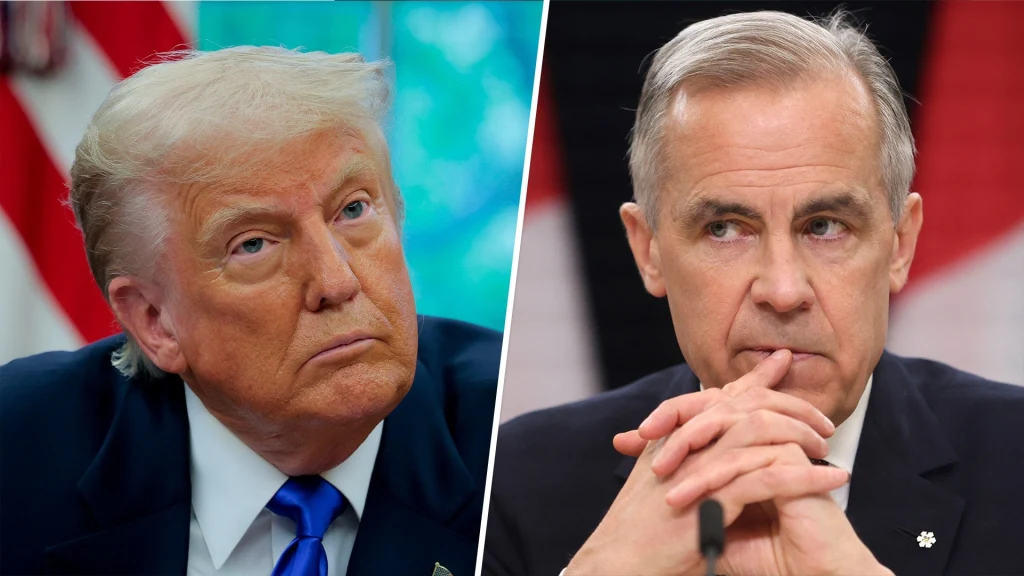
Trump Imposes New 50% Canada Tariffs as Carney Announces Retaliation/ TezzBuzz/ WASHINGTON/ J. Mansour/ The United States imposed 50% tariffs on $20 billion worth of Canadian products after last-minute negotiations collapsed. Canada plans retaliatory measures beginning Sept. 8, while Prime Minister Mark Carney accused Washington of using economic ties as a weapon. The escalating dispute threatens consumers, businesses and the future of the US-Mexico-Canada Agreement.

Quick Look
- The U.S. imposed 50% tariffs on $20 billion in Canadian goods.
- The affected products represent about 5% of Canada’s annual exports to the United States.
- Canada’s retaliatory penalties are scheduled to begin Sept. 8.
- Products affected range from hockey sticks to tongue depressors.
- Canada plans targeted protection for steel and other vulnerable industries.
- Carney said the United States made “unacceptable” last-minute demands.
- U.S. Trade Representative Jamieson Greer blamed Canadian retaliation.
- No additional negotiations are currently scheduled.
- The countries exchanged $880 billion in goods and services last year.
- The dispute creates uncertainty over the future of the USMCA.
- Trump used a previously untested provision of the Tariff Act of 1930.
- Businesses warn that the tariffs will raise costs in both countries.


Deep Look
US and Canada descend further into a trade war
WASHINGTON — The United States and Canada plunged deeper into a trade war Saturday after negotiations collapsed and both governments blamed the other for failing to reach an agreement.
The United States imposed 50% tariffs on approximately $20 billion worth of Canadian goods. Canada announced that its retaliatory penalties would begin Sept. 8.
The new U.S. tariffs cover about 5% of Canada’s annual exports to the American market, affecting products ranging from hockey sticks to tongue depressors.
The measures are expected to raise costs for consumers and businesses on both sides of the border.
No further negotiations were scheduled, and the increasingly bitter dispute has damaged trust between two countries with historically close diplomatic, military and commercial ties.
Canada promises protection for vulnerable industries
Prime Minister Mark Carney said Canada would introduce targeted tariff protections for industries exposed to the new American duties.
He identified steel, dairy products, appliances, agricultural equipment, pulp and paper, and electronics as sectors requiring support.
Carney accused Washington of using “economic integration as a weapon” and said “its signature was written in pencil.”
Using the language of armed conflict, the prime minister said Canada had been “attacked” by the tariffs.
“You’re at war when you get attacked,” Carney said, adding that Canada had the reserves, resilience and strategy needed to respond.
US says tariffs protect American workers
U.S. Trade Representative Jamieson Greer said Washington acted after Canada spent a year retaliating against American trade policies.
“We’ve said enough, and so we’ve taken countermeasures. Our interest is in protecting American workers and protecting American supply chains,” Greer told “Fox & Friends Weekend.”
Greer said the Trump administration had offered Canada favorable terms, including reductions in tariffs on steel, automobiles and lumber.
The administration was offering concessions on “things that are sensitive for them. And they’ve always had the best deal, and they still would have an even better deal, but they didn’t want that,” Greer said.
“As a result,” he added, “We’re moving forward with measures that respond to Canadian retaliation.”
Carney rejects US demands
Carney said Canada had been prepared to remove its remaining retaliatory tariffs on steel, aluminum and automobiles if the United States substantially reduced its own duties.
Ottawa was also willing to encourage Canadian provinces to resume sales of American alcoholic beverages.
However, Carney said the United States added last-minute conditions that went beyond what Canada could accept.
“They asked too much and offered too little,” he said.
According to Carney, the U.S. demands would have reduced tariff relief for vehicles manufactured in Canada, limited Canada’s ability to negotiate trade agreements with other countries and weakened protections for Canadian language, culture and sovereignty.
He described those demands as “unacceptable.”
The breakdown marked a sharp reversal from two days earlier, when officials from both countries suggested they were approaching a compromise.
Ontario backs Carney’s rejection of the deal
Ontario Premier Doug Ford praised Carney for rejecting the American proposal.
Ford said accepting it would have damaged Ontario’s automobile, steel and manufacturing industries.
He urged the Canadian government to use “every tool in our toolbox” to fight the new U.S. tariffs.
The dispute also raises questions about the survival of the North American trade framework connecting the United States, Canada and Mexico.
Historic alliance suffers major damage
The political effects of the trade war could ultimately exceed its immediate economic impact.
The United States and Canada exchanged approximately $880 billion worth of goods and services last year.
The new U.S. tariffs were initially scheduled to begin Wednesday. Trump delayed them for three days to give negotiators additional time, but talks ended without an agreement late Friday.
The two countries have clashed for decades over issues including Canadian softwood lumber and access to Canada’s protected dairy market. Those disputes did not previously prevent them from maintaining a close alliance.
Canadian troops served alongside American forces in Afghanistan following the Sept. 11, 2001, terrorist attacks.
The countries share a 5,525-mile undefended border. Nearly 330,000 people and $2 billion worth of goods cross it each day, while approximately 800,000 Canadians live in the United States.
Carney says America has changed
Trump’s approach represents a sharp departure from the traditionally cooperative relationship between Washington and Ottawa.
The president has imposed tariffs on Canadian products as part of his campaign to move manufacturing back to the United States.
He has also repeatedly made provocative remarks about making Canada the 51st American state.
Carney said Canada now recognizes that “America has changed” and warned that the two countries would “not return to our old relationship.”
Canadian frustration targets US ambassador
Public anger toward the United States has intensified in Canada.
A petition seeking the expulsion of U.S. Ambassador Pete Hoekstraa Trump ally and former Republican congressman from Michigan, has collected nearly 248,000 signatures since July 21.
The petition accuses Hoekstra of having “normalized” Trump’s comments about annexing Canada, among other complaints.
Both countries nonetheless face strong economic incentives to find a compromise.
Nearly 72% of Canada’s goods exports went to the United States last year. At the same time, the Trump administration risks raising prices for American consumers shortly before November’s midterm elections.
U.S. importers pay the tariffs and often attempt to transfer those costs to consumers through higher prices. Americans are already expressing frustration over the cost of living.
Pressure could build for an ‘off-ramp’
Ryan Majerus, a partner at King & Spalding and a former U.S. trade official, said the precise reason for the collapse remained unclear.
“Canada likely wanted further sector-specific relief than the U.S. was willing to offer, or Canada’s concessions did not go far enough,” Majerus said.
“Either way, I think both sides will be under immense pressure in the coming days to still find an off-ramp. But if Canada has agreed to also impose tariffs, the off-ramp may be even harder to find.”
Candace Laing, president and CEO of the Canadian Chamber of Commercedescribed the tariffs as “a body blow to North American competitiveness.”
She warned that the measures would increase costs for Americans while harming Canadian customers, investment and small businesses.
Trump invokes a Depression-era tariff law
Trump has made tariffs a central component of his second-term economic agenda.
Last year, he placed double-digit import taxes on nearly every country after declaring the longstanding U.S. trade deficit a national emergency.
The Supreme Court ruled in February that Trump had exceeded his legal authority. The justices struck down those tariffs and opened the way for the federal government to refund importers.
The administration subsequently began looking for other laws that could authorize new trade penalties.
For the Canadian tariffs, Trump invoked Section 338 of the Tariff Act of 1930a Great Depression-era law that has never previously been used to impose tariffs.
The broader law is commonly associated with the Smoot-Hawley tariffs, which economists and historians blame for restricting global commerce and worsening the Great Depression.
Section 338 permits the president to impose tariffs of up to 50% on imports from countries found to have discriminated against American businesses.
The provision does not require an investigation and places no limit on how long the tariffs may remain in effect.
Trade dispute threatens USMCA negotiations
The rift comes as the United States, Canada and Mexico prepare to renew the US-Mexico-Canada Agreement.
Trump negotiated the USMCA during his first term and previously celebrated it as a major achievement.
The United States has begun formal negotiations with Mexico over revisions to the agreement. Talks with Canada have not started.
The escalating tariff conflict now raises doubts about whether Washington and Ottawa can successfully negotiate the future of the three-country trade pact.
More on US News