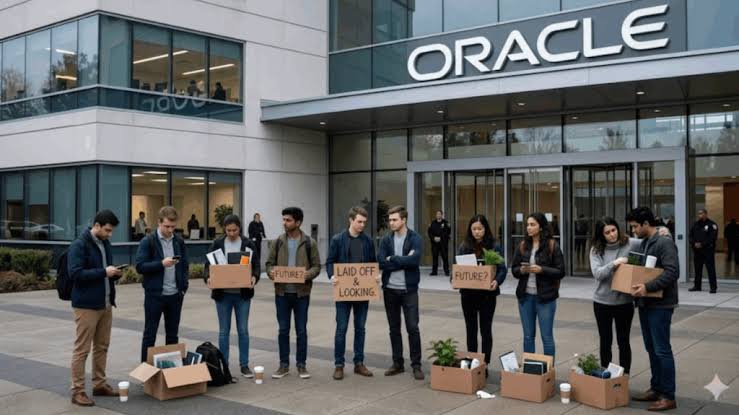
Oracle Preparing For Another Round Of Job Cuts
Oracle employees are once again facing uncertainty as the company prepares for another potential round of layoffs in August 2026.
The latest reports suggest that some teams could face cuts running into double-digit percentages, with managers reportedly asked to identify employees whose roles could be eliminated.
Oracle has not publicly confirmed the exact scale or timing of the proposed cuts, leaving thousands of employees waiting for clarity.
Why Is Oracle Cutting Jobs Again?
The latest restructuring comes after Oracle already reduced its workforce significantly during the financial year ended May 31, 2026.
The company’s employee count reportedly fell by around 21,000, or approximately 13%, during that period.
Oracle has been simultaneously increasing spending on artificial intelligence infrastructure and data centres, creating pressure to control costs elsewhere.
The company has also acknowledged that increasing use of AI across its operations has contributed to workforce reductions.
Which Employees Could Be At Higher Risk?
While Oracle has not released an official list of roles at risk, employees working in areas undergoing restructuring or experiencing changing business requirements could face greater uncertainty.
Teams where work can increasingly be automated, consolidated or moved to other locations may also be vulnerable.
However, there is currently no confirmed company-wide list identifying specific job titles or departments that will definitely be affected.
Employees should therefore be cautious about treating social-media speculation as confirmation.
Managers Have Reportedly Been Asked To Identify Roles
One of the most significant developments is the reported involvement of managers in identifying potential positions for elimination.
This suggests that the restructuring may be targeted rather than a uniform percentage reduction across the entire company.
Individual teams could therefore experience very different outcomes.
Some departments may face substantial reductions, while others could remain relatively unaffected depending on Oracle’s business priorities.
Oracle’s AI Push Is Changing Its Workforce
Oracle is investing heavily in cloud infrastructure designed to support the rapidly growing demand for AI computing.
That investment requires enormous amounts of capital.
As Oracle redirects resources towards data centres, cloud infrastructure and AI-related opportunities, it is simultaneously looking for ways to reduce operating costs.
Workforce restructuring is one way to create savings that can potentially be redirected towards those investments.
Oracle Has Already Used Early-Morning Layoff Emails
Employees affected by Oracle’s earlier layoffs received notifications through emails sent around 6 am local time in some cases.
The process reportedly involved employees learning that their roles had been eliminated before receiving extensive advance communication.
This has left employees anticipating that a similar process could be used in the latest round.
The uncertainty surrounding the timing has added to anxiety among workers.
What Could The Severance Package Look Like?
For US employees affected by Oracle’s previous layoffs, the company’s enhanced severance formula reportedly provided four weeks of base salary for the first year of employment, plus one additional week for each subsequent yearsubject to a maximum of 26 weeks of base salary.
The exact package for any new round of layoffs could depend on the employee’s location, employment terms and the specific restructuring programme.
Therefore, employees should not assume that previous terms automatically apply to future layoffs.
Why Severance Matters
Severance becomes particularly important when layoffs happen suddenly.
Employees need time to search for another job while managing rent, mortgages, healthcare costs and other household expenses.
For highly paid technology workers, the loss of salary can also mean the loss of other benefits and potentially unvested compensation.
The length of the severance period can therefore significantly affect how quickly an employee needs to find another position.
Oracle’s Layoffs Are Happening Despite Business Growth
The latest job cuts are notable because Oracle’s business has continued to grow.
Its cloud infrastructure operations have benefited from the surge in AI demand, while the company has been securing major commitments for computing capacity.
This highlights an important change in the technology industry.
A company can experience strong revenue growth in one part of its business while reducing its workforce in other areas.
AI Is Creating A Different Kind Of Tech Layoff
Earlier technology layoffs were often associated with falling demand, over-hiring or weaker economic conditions.
The current wave is increasingly different.
Companies are cutting certain roles while simultaneously hiring or investing heavily in AI, cloud infrastructure and specialised technical capabilities.
The result is not necessarily fewer technology jobs overall, but a significant shift in the types of skills companies are willing to pay for.
India Employees Could Also Be Watching Closely
Oracle has a significant workforce in India, making any global restructuring particularly relevant to Indian technology professionals.
However, the exact impact on Indian employees cannot be determined until the company announces specific details.
Employees should therefore avoid assuming that a US restructuring automatically means equivalent cuts in India.
Local employment regulations, business requirements and organisational structures can influence how workforce reductions are implemented.
What Employees Should Do Now
Employees concerned about potential layoffs should focus on practical preparation rather than rumours.
Updating a CV, refreshing professional profiles, documenting achievements and reconnecting with industry contacts can make a potential job search easier.
Workers should also review their compensation structure, including salary, bonuses, stock awards, benefits and leave balances.
Understanding the financial impact of a possible job loss can help employees make decisions before a restructuring announcement arrives.
The Bigger Problem Is Oracle’s Massive AI Spending
Oracle’s workforce restructuring cannot be separated from its enormous investment in AI infrastructure.
The company has been spending heavily to expand data-centre capacity and support customers seeking AI computing power.
That creates a difficult financial equation.
Oracle needs more infrastructure to capture AI growth, but building that infrastructure requires enormous capital.
Reducing operating expenses can help free up resources for those investments.
More Layoffs Could Follow If Cost Pressures Continue
The August restructuring may not necessarily be the final workforce reduction.
If Oracle continues expanding its AI infrastructure while trying to maintain financial discipline, additional organisational changes could occur.
However, the scale and timing of any future layoffs remain uncertain.
For employees, that means the current uncertainty could continue even after the latest round of cuts is completed.
The Real Risk Is Not The Entire Workforce
The current situation does not mean every Oracle employee is equally vulnerable.
The highest risk is likely to be concentrated in areas where work is being consolidated, automated, reorganised or considered less strategically important.
At the same time, employees working on cloud infrastructure, AI, data centres and other growth areas could potentially become more important to the company’s future strategy.
The workforce is therefore being reshaped rather than simply reduced.
Oracle Employees Are Waiting For Clarity
For now, employees are left waiting for official communication about whether another round of layoffs will actually happen and, if so, how large it will be.
The reported deadline of September 1 has increased attention on the situation.
Until Oracle provides confirmation, details about affected teams, individual roles and final severance terms remain uncertain.
The latest developments nevertheless show how dramatically the AI boom is changing employment patterns inside major technology companies.
What This Means For Tech Workers
Oracle’s situation is another reminder that job security in the technology industry is increasingly linked to business priorities rather than simply company performance.
Even a company experiencing strong cloud and AI growth can reduce headcount if it needs to redirect resources.
For technology workers, maintaining relevant skills, building financial resilience and staying prepared for changing market conditions may become increasingly important.
The Oracle layoffs are therefore not just another restructuring story. They are part of a much larger transformation of the global technology workforce.
Summary
Oracle is reportedly preparing another round of layoffs in August 2026, with some teams potentially facing significant reductions. The company has already cut around 21,000 jobs during the financial year ended May 2026 while increasing spending on AI infrastructure and data centres. Employees in restructuring or lower-priority areas could face greater risk, although no official list has been released. Previous US severance terms included four weeks of salary for the first year plus one week for each additional year, capped at 26 weeks.