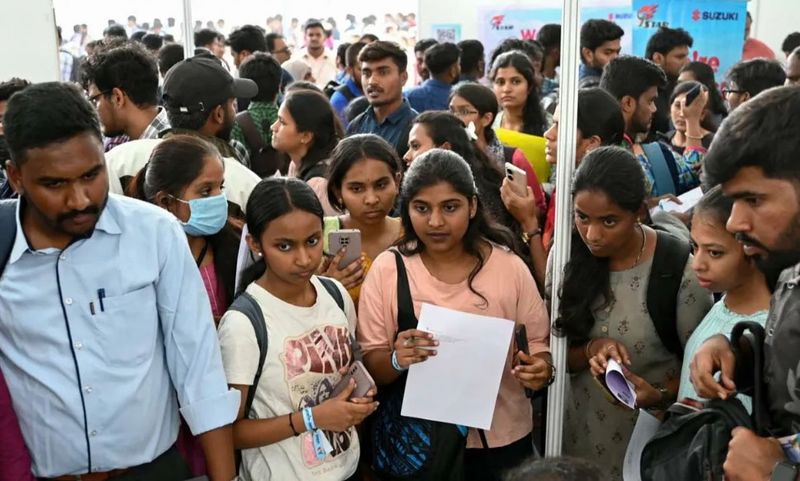
The recent youth protests triggered by the Cockroach Janata Party (CJP) in Delhi and other cities has brought to the forefront the concerns and demands of a generation now broadly labelled as Gen Z. What began as anger over examination irregularities has evolved into a wider expression of frustration over education, unemployment and lack of accountability. The movement’s ability to mobilise young people has already made its political significance difficult to ignore.
Reports of similar unrest emerging in Jharkhand raise the larger question of what lies ahead. Whether these protests remain isolated expressions of anger or develop into a sustained youth movement will depend largely on how seriously the underlying grievances are addressed.
While acknowledging their problems, RSS chief, Mohan Bhagwat, described protests as a legitimate way of dialogue and said that Gen Z agitators were not, as accused, ‘anti-nationals’ but our own people, becoming the latest saffron heavyweight to connect with the concerns of the youth. “A protest is also a way of dialogue. In a democracy, protests are also a way of building consensus”, he told a conference of around 2000 students in Mumbai recently. Further, the RSS chief stressed that protests must remain within democratic norms although he made no reference to the young demonstrators’ abusive slogans against Prime Minister Modi.
In fact, it is rumoured that he played an important role in persuading the government to accept the demands of the CJP and put an end to the protests, which were spreading like fire. Moreover, when questioned about the need for substantial reforms in education and raising educational spending to 6 per cent of the GDP, Bhagwat reportedly agreed but unfortunately just over 4 per cent is being spent by the government presently.
Modi is trying to make amends. Speaking to students a few days ago at IIT, Delhi he stated the young generation must use its knowledge and skills to build a developed and skilled India, adding that the next 30 years of the lives of today’s youth would have a major impact on the journey towards becoming a developed nation. But the question arises – are the opportunities existent at present? The gap between aspiration and opportunity is widening, and it is this gap that is fuelling much of the frustration now visible among the youth.
The demographic cohort that falls in the age bracket of 14-29 may, according to certain estimates, comprise over 35 per cent of the country’s population. Yet their cumulative representation in Parliament and legislatures reads just six MPs and 30 MLAs at present. The main reason for this may be attributed to the fact that the young generation is not interested in entering politics and is fed up with the political leaders, most of whom are enmeshed in corruption and least concerned about their welfare. Another reason is the minimum age for contesting polls in 25 years and maybe it needs to be lowered if we want more young people in the legislatures. The disparity remains even when the age bracket is raised to 40.
There are only 397 legislators who are under 40 years of age out of a total of 4000 MLAs in the country. The government’s apathy to the youth protest signifies institutional myopia. In our country, more importance is given to the experience of political leaders, and this robs parties of dynamism and energy demonstrated by the youth. The most serious repercussion arguably is the lack of an even playing field in tandem with the indifference, even occasional condescension, of senior leaders which makes youth cynical about politics and its institutions.
The CJP’s popularity amongst the youth can be attributed to their disdain for a traditional, entrenched, unresponsive political coterie. The youth is a major force in society today and their demands and necessities cannot be ignored at any cost.
The government, in evolving a future strategy, must keep in mind the concerns of the youth who have been struggling to find themselves in society. They do not have much respect for the policies of the present dispensation, as the above data will reveal and do not want to join politics, except for agitating for their demands. Meanwhile, the steady loss of autonomy of higher educational institutions has been a cause of concern as unfettered expression of views and, in fact, the whole academic atmosphere is being eroded. Further, is the deterioration of the quality of teaching at almost all levels, except for a few institutions such as the IITs, IIMs and some central universities.
It is worth noting that the international ranking by the Varieties of Democracy latest Academic Freedom Index project places India among the lowest 10 to 20 per cent of 179 countries and territories across the globe. Academic freedom today is even lower than in the years of the Emergency and the lowest since 1900. Freedom of expression is gradually being stifled as many universities and teachers have been practising self-censorship so as not to annoy the government. Analysts have repeatedly pointed out that the university is a place of free intellectual exploration through questioning, debate and discussion. There can be no place for throttling the voice of students.
In such a situation, not just the Centre but also the state governments have to deeply think on the matter and it would be prudent if they could evolve a policy aimed at understanding the problems and aspirations of the students and youth. The main focus has to be on the education sector with necessary reforms, and increasing allocation and expenditure of education from schools to universities and a level-playing field for all segments of society.
Though education is on the Concurrent List, the expenditure of the Central government in improving conditions of schools in remote and backward areas leaves much to be desired. Even public universities in big cities are facing fund shortage, research scholarships are coming down, not to speak of what is happening in semi-urban areas.
All this has been agitating the youth for quite a few years as they have been feeling helpless in such a situation. Even their teachers want a better deal for the youth community, thinking about their future as also that of the country. What will happen to the nation’s future if the youth are not geared in the right direction and proper facilities extended to them to build up their careers? Opportunities should exist not just for the rich and the upper middle class but for all sections, specially who have to struggle in rural areas to build up their career. Even a farmer or a very small trader’s son has the right to get quality education in the village school or college but unfortunately the government is oblivious to this.
There needs to be a fundamental change in the outlook of the government in its own interest. The popularity of the present government may be jeopardised if it does not respond to the young generation in a positive and judicious manner.—INFA