New Delhi: India’s debate over warning labels on packaged foods has intensified after fresh reporting highlighted major differences between products sold in India and their counterparts in European markets. A Reuters investigation reported that some products sold in India can contain considerably more sugar or use different ingredients, while substances that attract prominent warnings in Europe may appear only in small print on Indian packaging.
The issue has put the Food Safety and Standards Authority of India (FSSAI) under renewed scrutiny. The regulator had earlier considered front-of-pack colour-coded warnings for foods high in sugar, salt and fat, but has since moved away from that approach and proposed a black-and-white nutrition table instead. The Supreme Court is examining the matter after public health activists challenged the delay in introducing stronger warning labels.
At the centre of the controversy is a basic consumer question: should shoppers be given nutritional information that they have to interpret themselves, or should packaging clearly warn them when a product contains high levels of nutrients linked to health risks?
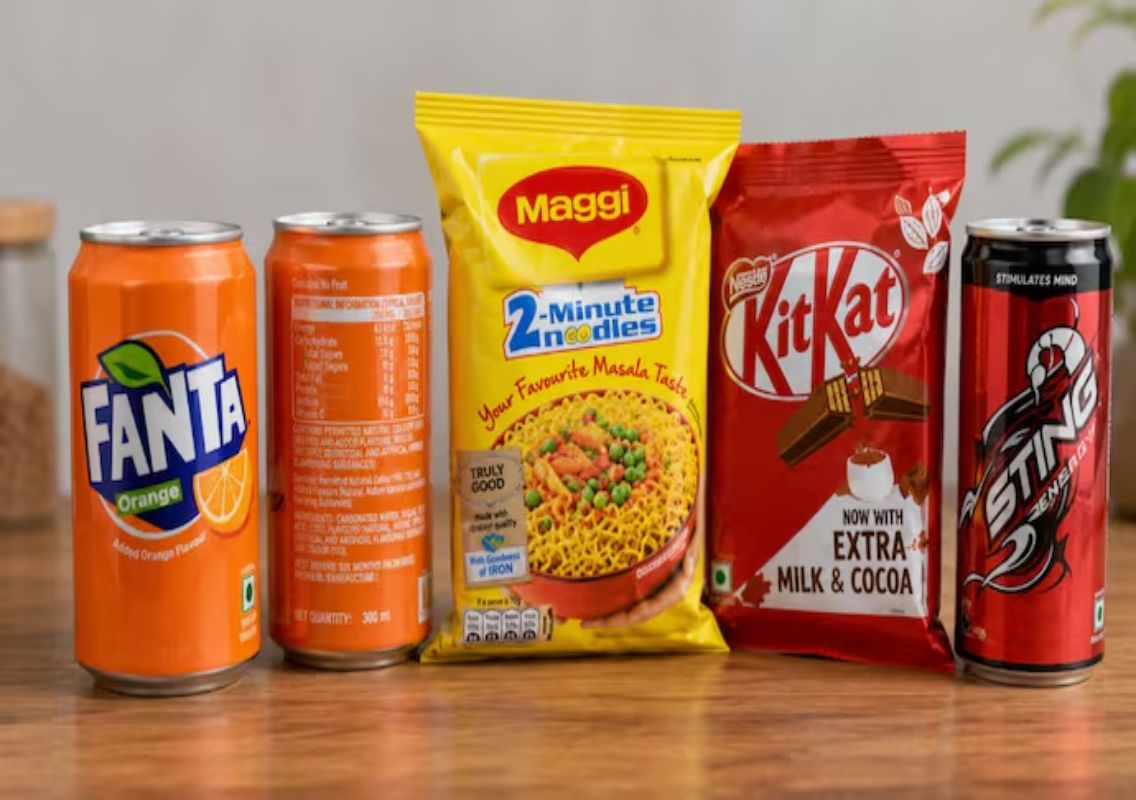
Fanta highlights the labelling difference
One example cited in the Reuters investigation is Fanta.
A can of Fanta sold in London contains 63 calories, while the Indian version reportedly contains about three times as much sugar. The Indian product also contains an artificial colourant whose presence in European food products requires a prominent health warning. In India, the colourant is disclosed in small print on the back of the can.
The difference illustrates how the same global brand can have different formulations and labelling practices depending on the market.
Food companies commonly adjust recipes because of local regulations, consumer preferences and pricing considerations. Former Mondelez executive Parul Sharma told Reuters that affordability and pricing are among the major reasons recipes can differ between countries.
However, public health campaigners argue that differences in local markets should not result in consumers receiving less prominent information about potentially concerning nutritional ingredients.
FSSAI moves away from colour-coded warnings
India has considered stronger front-of-pack labelling for several years.
The FSSAI had examined systems involving prominent colour-coded warnings and star ratings. The latest proposal, however, does not use the same interpretive warning approach.
Instead, the regulator has proposed that packaged food labels display a black-and-white table showing sugar, fat and salt content. FSSAI has argued that colour-coded warnings do not sufficiently account for Indian dietary patterns and that Indian cuisine often uses stronger flavours.
This approach would provide consumers with numerical information but leave them to determine whether the quantities represent a significant nutritional concern.
That distinction is important.
A warning label effectively tells consumers that a product is high in a particular nutrient. A conventional nutrition table tells consumers how much of that nutrient the product contains.
Health experts have argued that the first approach is easier to understand at the point of purchase, particularly for consumers who may not have detailed knowledge of nutrition.
Supreme Court questions delay
The Supreme Court has taken a close interest in the issue.
In August, the court questioned the FSSAI over its reluctance to introduce prominent warnings for packaged foods high in sugar, salt and saturated fat. The bench asked why consumer health should be compromised because manufacturers could be affected by warning labels.
The court’s intervention followed earlier proceedings concerning front-of-pack nutrition labelling.
In February, the Supreme Court had directed regulators to consider warning labels and pointed towards international approaches, including Israel’s system of red-and-green messaging.
The matter is therefore no longer simply a regulatory debate between food companies and FSSAI. It has become a broader public policy question involving consumer rights, corporate interests and public health.
Why warning labels matter
Supporters of prominent warnings say consumers should not have to perform calculations while standing in a supermarket or ordering groceries online.
A shopper looking at a packet may see information about calories, sugar, saturated fat, sodium and serving size. Understanding the health implications requires some nutritional knowledge.
A simple warning can reduce that complexity.
Interpretive labels used in several countries highlight nutritional concerns using colours or symbols. According to the Reuters report, around 20 countries have adopted such systems in some form.
The argument is particularly relevant in India, where packaged and ultra-processed foods are becoming more prominent in everyday diets.
A warning label would not prohibit consumers from buying a product. Instead, it would provide an immediate indication of its nutritional profile before purchase.
Industry argues that warnings could be misleading
Food industry representatives have pushed back against the idea of mandatory colour-coded warnings.
At a March meeting with regulators, industry executives argued that warning labels could be confusing and ineffective. Coca-Cola India executive Mili Bhattacharya reportedly questioned whether a symbol on a package would significantly change the diet of someone who did not already read ingredient lists.
Industry representatives also argued that the focus should be on portion control.
The Indian Food & Beverage Association has raised concerns about the possibility of products receiving “high sugar” warnings even when the sugar occurs naturally, such as in coconut water.
Another industry argument is that a large proportion of India’s packaged food market could potentially fall under a high-fat, high-sugar or high-salt classification.
According to industry estimates cited by Reuters, nearly 80% of products in India’s packaged food and beverages market could be regarded as high in at least one of these categories.
Critics see a conflict of interest
Public health campaigners, however, believe the industry’s concerns are closely linked to commercial interests.
If a prominent warning appears on the front of a packet, consumers may be less likely to purchase that product.
That creates a direct commercial incentive for manufacturers to oppose such labels.
Simone Pettigrew of the George Institute for Global Health told Reuters that the industry has an incentive to delay stronger disclosure requirements because warning labels could influence purchasing decisions.
The controversy therefore reflects a familiar regulatory tension: companies want rules that do not unnecessarily restrict their ability to market products, while public health advocates want consumers to receive information in the clearest possible form.
India has fewer front-of-pack requirements
At present, Indian packaged food products are generally required to provide ingredients and basic nutritional information on the back of the packaging.
That is different from systems where important nutritional characteristics are highlighted prominently on the front.
India has considered several models since 2017, including colour-coded warnings and star ratings. However, no comprehensive interpretive front-of-pack warning system has yet been implemented.
The country therefore remains at a critical point in deciding how consumers should be informed about packaged food.
The debate over Indian versus European products
The controversy has also revived concerns over so-called “different recipes” used by multinational companies.
The Reuters report cites several examples.
Indian KitKat reportedly contains 4.5% cocoa solids, while the milk chocolate version sold in Australia contains at least 22% cocoa.
Similarly, Maggi instant noodles sold in India use palm oil, while several versions sold in Britain use sunflower oil. Some Maggi packets sold in Britain also carry red front-of-pack warnings for high salt content.
Such differences do not automatically mean that a product sold in India violates Indian food safety rules. Food products are formulated according to local regulations, ingredient availability, costs and consumer preferences.
But activists argue that consumers should still be given transparent information about what they are buying.
Affordability plays a role
One reason multinational companies may use different formulations is price sensitivity.
India remains a highly price-conscious market, particularly for mass-market packaged food and beverages.
Using locally available ingredients or cheaper alternatives can allow companies to keep products affordable.
Companies also have to comply with India’s own regulatory framework rather than automatically following European standards.
This means that a product can legally contain or disclose ingredients differently in India while meeting local requirements.
The policy question is whether India’s regulatory requirements themselves should become more stringent.
Consumer awareness is growing
The debate comes as Indian consumers become increasingly interested in nutrition and health.
Social media has played a major role in this shift.
Food influencers and health campaigners have begun comparing packaged products sold in India with versions available in other countries, drawing attention to differences in ingredients, sugar content, fats and additives.
Revant Himatsingka, popularly known as Food Pharmer, is among the prominent voices campaigning for greater transparency. He has more than 5 million followers across YouTube and Instagram, according to the report.
His campaigns have also faced legal challenges from companies.
In 2023, PepsiCo successfully obtained a Delhi court take-down order concerning a video in which Himatsingka criticised the sugar and artificial sweetener content of its Sting beverage.
The episode illustrates how food labelling has increasingly become part of a wider consumer conversation online.
Companies are already changing some products
Despite the regulatory uncertainty, some manufacturers have begun changing products in response to consumer and regulatory pressure.
Nestle announced in 2024 that it would start selling sugar-free Cerelac baby food in India. The company had previously sold sugar-free versions in other markets.
Such changes suggest that consumer expectations can influence product formulations even before regulations are finalised.
However, campaigners argue that voluntary changes cannot replace mandatory standards because not every company will have the same commercial incentive to reformulate products.
What could happen next
The next major development will depend on the Supreme Court proceedings and FSSAI’s final position on front-of-pack nutrition labelling.
The regulator has told the court that matching international packaging standards is difficult, a position that has drawn criticism from the judiciary.
A stronger warning-label system could make it easier for consumers to identify foods high in sugar, salt or saturated fat.
On the other hand, the industry is likely to continue seeking a framework that accounts for serving sizes, naturally occurring sugars and the diversity of Indian diets.
The eventual regulatory model will need to balance those concerns without making nutritional information so complicated that consumers cannot use it effectively.
Conclusion
India’s packaged food labelling debate has moved well beyond the design of a symbol on a packet. It now concerns how much information consumers should receive, how clearly that information should be presented and how far regulators should go in protecting public health.
The Reuters investigation highlights significant differences between some products sold in India and their European counterparts, including sugar levels, ingredients and the prominence of health-related disclosures.
FSSAI’s decision to move away from colour-coded warnings towards a black-and-white table has intensified the debate, while the Supreme Court has questioned why stronger front-of-pack warnings have taken so long to emerge.
For consumers, the central issue is straightforward: nutritional information should be easy to understand before a purchase is made. Whether India ultimately adopts prominent warning labels or another interpretive system will determine how effectively shoppers can identify products high in sugar, salt and fat.