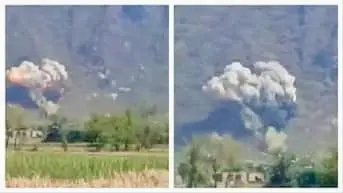
New Delhi: Did India, through actions, give an indication to Pakistan during Operation Sindoor that it can cause extensive damage to the country’s nuclear weapons storage facility at the Kirana Hills near Sargodha?
While the Indian military dismissed reports of any strike on Kirana Hills earlier, while Operation Sindoor was in progress, former chief of defence staff (CDS) General Anil Chauhan, on Tuesday, said that loitering munitions did strike there.
Speaking at an event organised by Vivekananda International Foundation, the former CDS said an Indian loitering munition had “accidentally” hit Kirana Hills while searching for Pakistani radars.
He said that India had sent numerous loitering munitions towards the Sargodha area. Kirana Hills is located about 10 km north of the Pakistani city. According to him, these munitions can loiter for roughly two hours while searching for a target. If they fail to locate one, they are designed to strike a target or designated area anyway.
One such loitering munition “must have come and hit one of those hills”, he said, as reported by The Tribune.
The news of Kirana Hills being struck first broke while the 88-hour conflict with Pakistan was in progress between May 7 and May 10, 2025. At the time, Air Marshal A K Bharti, then Director General of Air Operations, dismissed the suggestion that India had struck the site.
Responding to a question about reports that Kirana Hills housed nuclear installations, he said: “Thank you for telling us that Kirana Hills houses some nuclear installations. We did not know about it. We have not hit Kirana Hills.”
The former CDS has now confirmed that a strike apparently occurred near or on a nuclear-linked site, even if it was unintentional.
Some experts are not ready to buy the theory that the strike was unintentional. They don’t even accept that it was a loitering munition that struck the site, given the size of the hole seen on the mountainside.
“Had India sent out a strong message that it would directly strike Pakistan’s nuclear weapons facilities if Islamabad continued with the War? Did this have anything to do with Pakistan’s call for a ceasefire? Lt Gen Rahul R Singh, who was then deputy chief of the Army staff had revealed that during talks between the Director Generals of Military Operations (DGMOs) of India and Pakistan on May 10, the Pakistani officer has said: “We know your important vector is printed, and is ready for action. I would request you to pull it back”. Did this have anything to do with Kirana Hills,” one of them said.
Shortly after Operation Sindoor, the International Atomic Energy Agency (IAEA) ruled out a radiation leak or radioactive release from any nuclear facility in Pakistan.
The IAEA statement, however, addressed only the question of radiation leakage. It did not establish whether a conventional strike had physically occurred near or at Kirana Hills. In other words, the statement neither confirmed nor denied that a strike had taken place; it only indicated that no radioactive release had been detected.
The IAEA’s “no radiation leak” statement and General Chauhan’s latest admission that a loitering munition likely struck Kirana Hills are therefore not necessarily contradictory. A conventional munition could have struck near or on Kirana Hills without breaching or damaging nuclear-related facilities in a manner that resulted in a measurable radioactive release.
The former CDS’s comments about Kirana Hills also came alongside other revelations, including his assessment of Pakistan’s ability to verify Indian losses and his reference to India’s stated principle of “always delivering the last strike” in an escalation ladder.