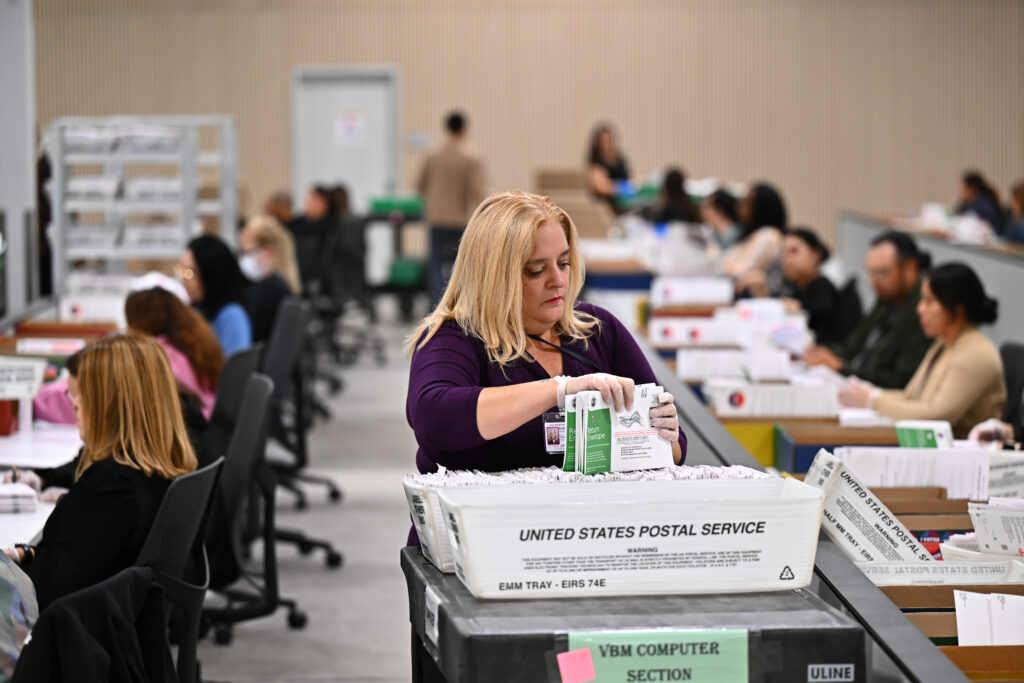
Democratic States Renew Fight Against Trump’s Mail-in Voting Rule/ TezzBuzz/ WASHINGTON/ J. Mansour/ A federal judge lifted an injunction blocking implementation of President Donald Trump’s mail voting executive order after a Supreme Court ruling found an earlier challenge premature. The administration can move ahead with Postal Service requirements governing ballot envelopes and voter eligibility lists, though a separate injunction remains in place. Democratic-led states and voting rights groups are pursuing new challenges as election officials prepare to send the first midterm ballots next week.

Quick Look
- U.S. District Judge Indira Talwani lifted one injunction against Trump’s mail voting order.
- Talwani said the Supreme Court’s decision “compelled” her action.
- She described Trump’s order as “likely unconstitutional” and warned it could cause “chaos.”
- The Postal Service rule requires federally approved ballot-envelope designs.
- States would also have to provide lists of voters eligible to receive mail ballots.
- Twenty-five Democratic attorneys general filed a new lawsuit challenging the requirements.
- The Supreme Court did not decide whether Trump’s executive order is legal.
- A separate injunction obtained by voting rights groups remains in effect.
- The first mailed ballots for the 2026 midterms are scheduled to go out next week.

Deep Look
Judge Removes One Barrier to Trump’s Mail Voting Directive
A federal judge on Wednesday lifted a major legal obstacle to President Donald Trump’s executive order restricting mail voting, allowing the administration to move closer to implementing new requirements ahead of the November midterm elections.
U.S. District Judge Indira Talwani in Boston removed an injunction that had prohibited the U.S. Postal Service from carrying out Trump’s directive. Talwani, who was appointed by former President Barack Obama, said the Supreme Court’s ruling earlier in the week “compelled” her to dismiss the injunction.
The judge nevertheless expressed serious concerns about the executive order, calling it “likely unconstitutional” and warning that its implementation could cause “chaos.”
The decision does not end the legal battle. Democratic-led states and voting rights organizations have already launched new challenges, while another injunction continues to prevent full implementation of the order.
Supreme Court Did Not Rule on the Order’s Legality
The Supreme Court’s conservative majority ruled Monday that Democratic state officials had challenged Trump’s executive order too early. The justices did not determine whether the order itself was constitutional or otherwise lawful.
The ruling overturned an injunction Talwani had issued in an earlier lawsuit brought by Democratic-led states. At the time that case was filed, the administration had not yet published specific rules implementing the order.
That changed Friday night, when the Postal Service released a detailed rule governing how mail ballots would be handled.
The newly issued rule gives election officials a concrete policy to challenge, opening another phase of litigation just as states prepare to distribute ballots.
Postal Service Rule Sets New Ballot Requirements
Under the Postal Service rule, states must follow a uniform style for envelopes containing mail ballots and obtain federal approval for their designs.
States must also provide the Postal Service with lists identifying voters eligible to receive mail ballots. Ballots from jurisdictions that do not comply could be denied delivery.
Election officials have warned that the requirements would be nearly impossible to implement before the first wave of ballots is mailed. North Carolina and other states are preparing to send ballots to military and overseas voters beginning next week.
Talwani found Tuesday that the administration technically violated her injunction by publishing the rule while the order was still blocked. She declined to impose penalties.
Democratic States Launch Fresh Lawsuit
Twenty-five Democratic attorneys general filed a new lawsuit against the Postal Service, arguing that it lacks the authority to determine who may receive a mail ballot.
“Across the country, states are already deep into preparations for the 2026 elections. Now, at the last moment, the federal government is attempting to meddle in those preparations and potentially threaten countless Americans’ right to vote,” New York Attorney General Letitia James said in a statement. “USPS has no authority to decide who can and cannot vote by mail.”
The latest case differs from the lawsuit rejected by the Supreme Court because it challenges a rule the administration has now formally issued.
National Democratic groups have also asked a federal judge in Washington to block the executive order. That judge previously declined to intervene because the administration had not yet taken concrete steps to implement it.
Separate Injunction Still Blocks Full Implementation
Although Talwani lifted the injunction obtained by Democratic states, a second injunction remains in effect.
Talwani issued that order Aug. 11 in a lawsuit brought by the League of Women Voters and other voting rights organizations. The Trump administration has asked her to rescind or suspend it following the Supreme Court’s ruling.
Until the judge acts on that request or an appellate court intervenes, the second injunction remains another legal barrier to carrying out Trump’s directive.
The administration previously prevailed in a third case filed in Washington in May, where a judge found it was too early to block the executive order. Plaintiffs in that case are now renewing their challenge based on the Postal Service’s newly published rule.
White House Defends Restrictions as Security Measures
White House spokesperson Lauren Bis described the Postal Service requirements as “commonsense measures that protect the security of mail-in ballots.”
Bis said the administration would continue working to implement the changes to improve “the safety and security of our elections.”
The Postal Service declined to comment, citing the pending litigation.
Trump Continues Campaign Against Mail Voting
Trump has repeatedly criticized mail voting and falsely blamed it for his defeat by Joe Biden in the 2020 presidential election. Mail ballots have become disproportionately associated with Democratic voters as Republican use of the method declined following Trump’s attacks.
Since returning to office, Trump has sought broader federal authority over election administration, despite the Constitution assigning significant responsibility for elections to states and Congress.
His earlier election executive order also sought documentary proof of citizenship for voter registration and other changes. Trump has separately promoted sweeping election legislation, but that measure has stalled in the Senate because of opposition from Democrats and some Republicans.
The latest court developments leave election officials facing uncertainty as ballot distribution begins and multiple legal challenges move through the federal courts.
More on US News