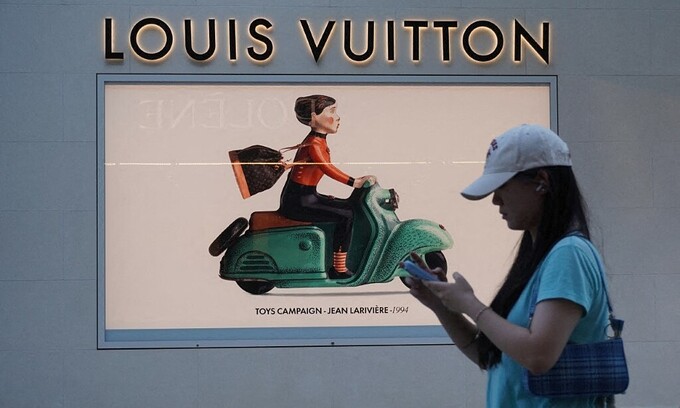
The brand’s Guiyang Jianghua store at the Lavant Center mall is set to close its doors on Aug. 31, marking the end of its four-year presence in the province, TheStreet reported.
The closure is part of Louis Vuitton’s efforts to optimize its retail network and adjust its strategy in China, where domestic spending has weakened and luxury consumption trends are changing.
Bloomberg recently reported that the 25 biggest luxury brands in China saw sales drop by over 10% in July, citing data from several research firms tracking the sector.
The decline was steeper than the slowdown recorded in June and represented a marked turnaround from the strong sales growth seen earlier in the year.
LVMH’s Louis Vuitton and Dior and Kering’s Gucci, Bottega Veneta and Balenciaga all posted double-digit sales declines. Hermès, meanwhile, saw sales shift from growth to a decline.
|
A Louis Vuitton store located in Taikoo Li Sanlitun, Beijing, China, on July 17, 2026. Photo by NurPhoto via AFP |
Louis Vuitton’s Guizhou exit also comes as the brand is facing backlash from its recent trademark disputes, especially a suit against local beverage chain Molly Tea.
The tea chain was ordered in July to pay Louis Vuitton 10.3 million yuan (US$1.5 million) over its use of a logo deemed similar to the luxury brand’s four-petal floral trademarks.
Despite the legal victory, the dispute triggered a backlash on social media, including accusations of cultural appropriation.
“We see limited short-term sales impact from the Molly Tea incident. However, the real risk lies in the long-term effect on younger Chinese consumers, who will form the future consumer base for Louis Vuitton,” Sandy Lim, director at credit rating agency S&P Global Ratings, told the South China Morning Post.
“They prioritize cultural respect and brand empathy over pure prestige-driven exclusivity. The controversy could create a higher perceived barrier for this cohort, which Louis Vuitton would need to address at some point down the road.”
Louis Vuitton, founded in Paris in 1854, operates more than 75 brands spanning fashion and leather goods to wines and spirits, perfumes and cosmetics, watches and jewelry, and selective retailing. Its portfolio includes Louis Vuitton, Fendi, Givenchy, Christian Dior and Tiffany & Co.
The luxury label has been shrinking its retail footprint in China over the past year. It shut stores in Kunming, Yunnan province, in February and at Chengdu Tianfu International Airport in Sichuan province in June, both in southwestern China.
Besides, it also shut its non-duty-free outlet in the domestic departures area of Terminal 3 at Beijing Capital International Airport earlier this year.
Nonetheless, the brand is expanding its flagship store presence in top-tier cities such as Beijing and Shanghai.
“Louis Vuitton is focusing on quality over quantity in its store network to elevate consumer experience,” Lim told SCMP. “This caters to China’s shifting luxury consumption trend, where premium pricing is increasingly justified by immersive brand experiences and high-touch VIP services.”