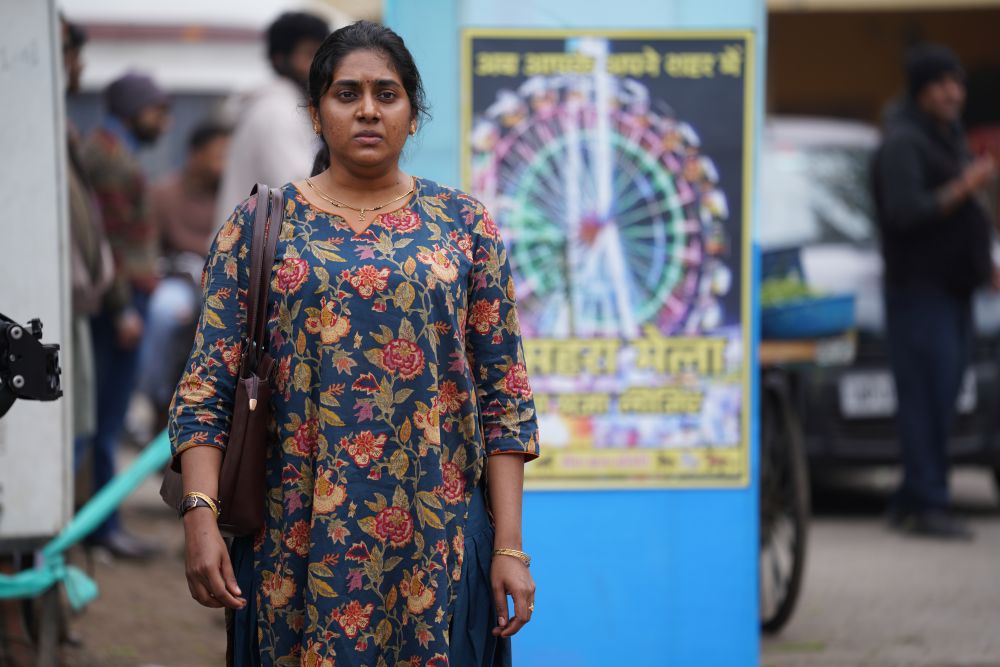
On paper, Ambiecka Pandit’s Babita Singh Reporting is a standard police procedural. The film, streaming on Prime Video, revolves around a pliant, under-confident sub-inspector who is suddenly thrust into a murder investigation in Madhya Pradesh. Again, on paper, this is a film that follows the Indian crime drama template of foregrounding the efforts of an underdog cop going against all odds to solve a crime. The identity of the killer becomes such a film’s purpose and point.
But on screen, Babita Singh Reporting is really a character study of the subservience that consumes women whole. The murder investigation happens to just be the means to an end. It is, put simply, the anti-police procedural that makes a case for a genre that has been juiced so dry by Indian streaming that it has become its own aesthetic.
In this landscape then, a film like Babita Singh Reporting is both an anomaly and a new direction forward for police procedurals.
Not identified by uniform
The action in the film starts with Babita being suspended for two weeks after she is pressured into taking the fall for a male superior. Even her nickname (‘Baby’) underscores the degree to which people around her play her down.
At home, her husband can’t seem to understand why she cares so much about the job — naturally she hides the news of her suspension from him, using it as an excuse to propose a trip back to meet his mother and pregnant sister. It’s only when she lands up there that she meets Bansi (Barun Sobti), a childhood friend whose sudden murder forces her to find her way back to herself.
Also read: Toxic Movie Review: Confused and dense film that mistakes pomposity for style
Take also the fact that Babita Singh Reporting, written by Amita Vyas, is a police procedural headlined by a female cop, a protagonist who has essentially become a placeholder in Indian streaming. Even here, the template is recognisable: a female cop is essentially a man in a uniform, displaying the kind of unbridled power that is otherwise the domain of their male counterparts. And it is this manufactured pleasure of seeing women act unruly, even unpleasant — freedom usually reserved for male protagonists — that passes off as progressive storytelling. That is to say, a female cop has turned into a male fantasy so much so that it is rare to see her be a fully realised character and not simply an idea.
A scene from Babita Singh Travel.
Babita Singh Reporting, which marks Pandit’s feature debut, puts those complaints to rest. In the film, Babita Singh (a standout Nimisha Sajayan), is written in a way that even when she wears the uniform, it never becomes her identity. Instead, her identity is shaped by her gender — she is a wife, a sister, a daughter-in-law, a sister-in-law, and a friend before she is a sub-inspector. In fact, we get to see Babita in uniform for a total of 10 minutes in the film. In that sense, Babita Singh Reporting is a gripping origin story, a two-hour film that in the hands of any other writer and director would have been afforded only the time for a flashback montage.
Makes impact without being didactic
Sajayan is an incredible casting choice for Baby, an actor so gifted and skilled that she plays Baby’s suffocation as a slow-burn. Her face effortlessly conveys pages of backstory that perhaps no number of pages can conjure.
A lifetime of giving in to the needs of everyone around her has wired Baby in such a way that even before her face can register rage, it holds space for the grief of others. There is a standout scene where Baby goes to bed angry after an argument with her husband and then, in a matter of minutes, ends up having to console him.
That the film’s actor and director are so creatively synchronised with each other’s rhythms is one of its most enjoyable flourishes. It is evident in the way that the film’s commentary about patriarchy, well-mannered misogyny, and women’s labour don’t come across as didactic despite the heavy-handed dialogue.
Also read: Dolly Parton obit: Why fans of the ‘Queen of Country’ will be singing ‘I will always love you’
Sunil Borkar’s lensing elevates the dread in interesting ways, especially whenever it gets close to Sajayan’s face. The feminine gaze is evident in even the construction of the universe. Given that the film unfolds from Baby’s perspective, we see more women than men and it is these interactions that turn a familiar setting unpredictable.
This is at once a film about murder and a film about how the politics of womanhood inside the home and at the workplace are just two sides of the same coin.