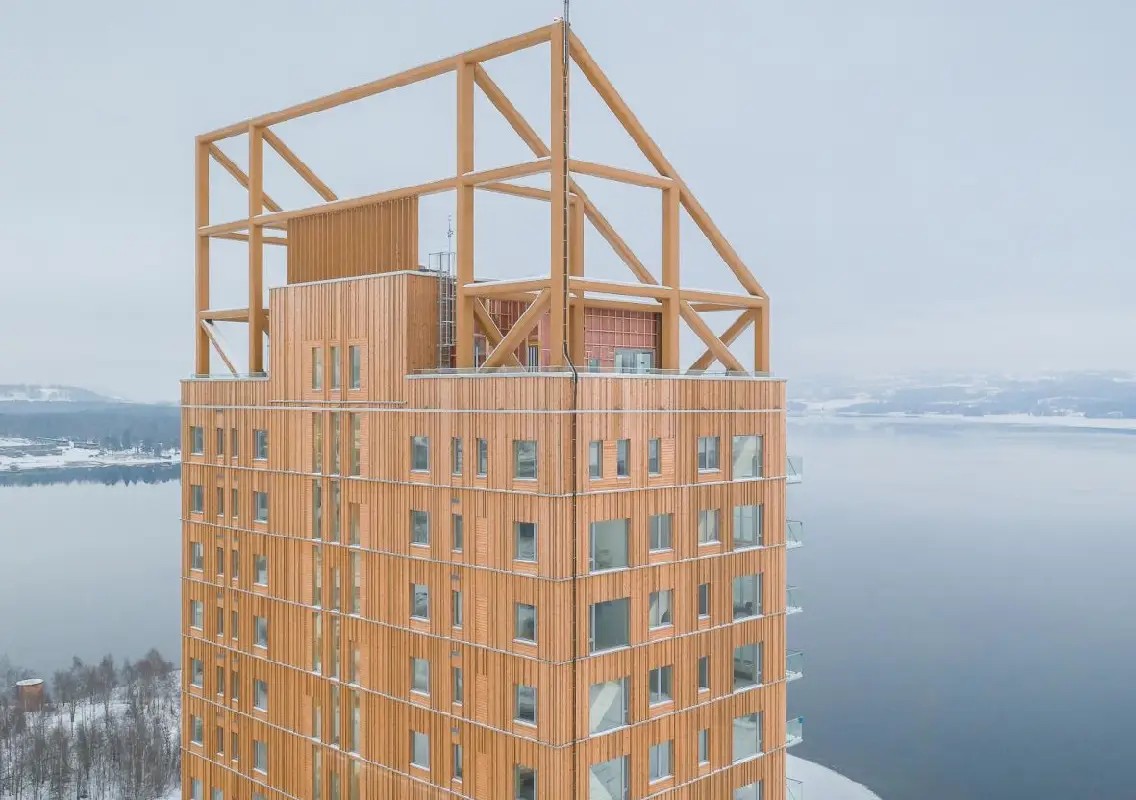
A striking wooden skyscraper beside Norway’s Lake Mjøsa is offering a glimpse of how cities could rethink the materials used to build their future.
Mjøstårnet, an 18-storey tower in Brumunddal, was designed as a demonstration of what modern timber construction can achieve. The building combines offices, apartments and a 72-room hotel, with its main structure made largely from engineered timber.
A skyscraper built from wood
The tower uses mass timber, including glued laminated timber, or glulam, in its beams, columns and structural elements. The components were precision-cut at a nearby factory and transported to the site, allowing the building to rise at almost one floor a week.
Concrete was still needed in parts of the upper floors to reduce movement caused by wind and improve comfort for occupants. Engineers also subjected the timber to rigorous fire testing before construction.
Can timber make cities greener?
The project reflects growing concerns over the environmental cost of conventional construction. Concrete manufacturing is responsible for a significant share of global emissions, while trees absorb and store carbon as they grow.
Using responsibly managed forests for construction could therefore offer a lower-carbon alternative, although timber buildings are not without environmental challenges. Large-scale adoption would require careful forest management to ensure trees are harvested no faster than forests can regenerate.
The cost also remains a barrier. Mjøstårnet was considerably more expensive to build than a comparable steel-and-concrete tower.
A new direction for urban construction
Despite these challenges, timber construction is gaining attention across Europe, Asia and elsewhere. Projects including Stockholm Wood City and proposed high-rise timber developments in Japan and Australia suggest that Mjøstårnet may have helped demonstrate a wider possibility.
The tower’s message is simple: future cities may not have to be built entirely from concrete and steel. With responsible forestry, new engineering methods and better environmental accounting, wood could become an important part of a more sustainable urban landscape.