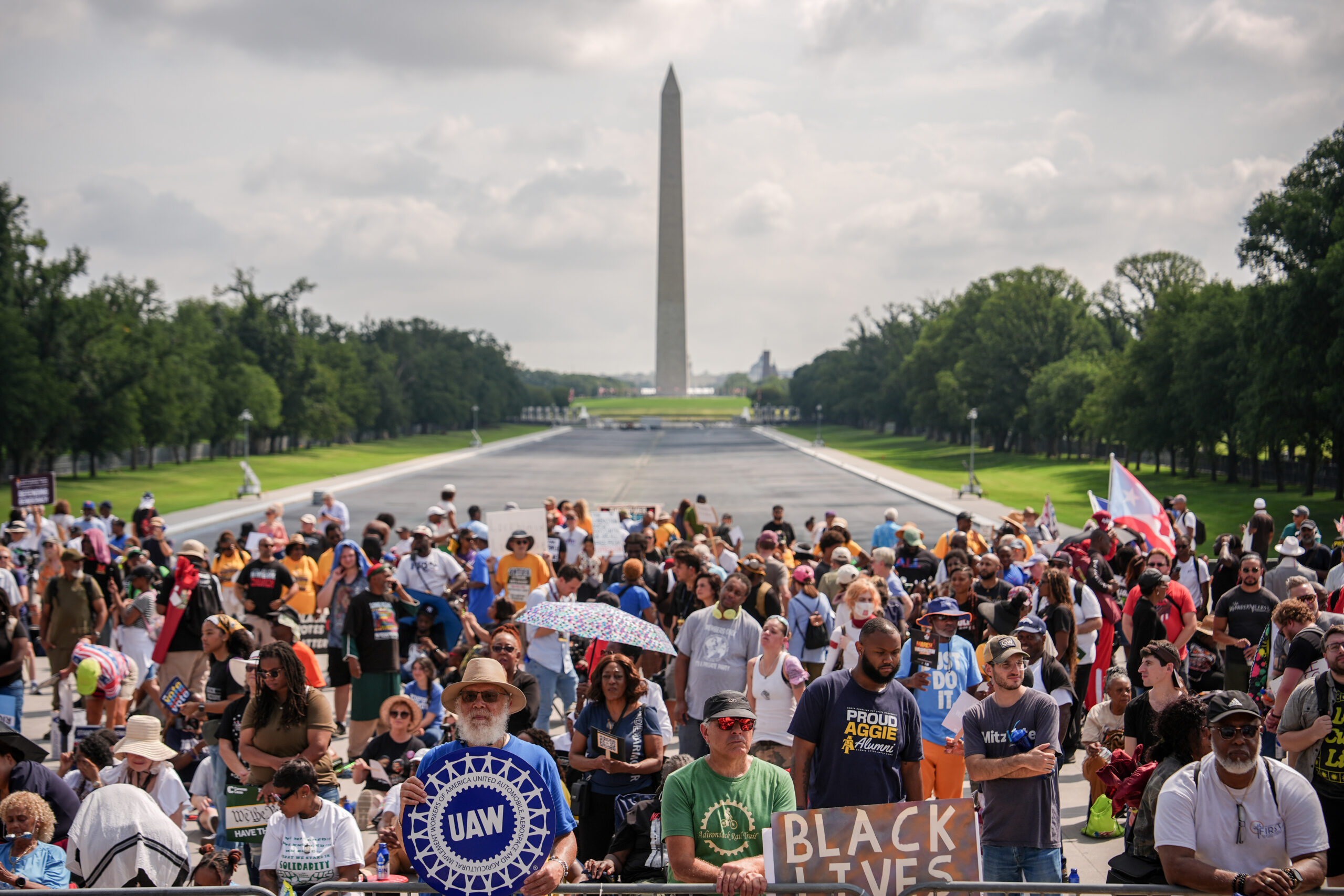
Thousands Rally in Washington to Defend Voting Rights Before Midterms/ TezzBuzz/ WASHINGTON/ J. Mansour/ Thousands gathered on the National Mall to demand voting rights and racial justice ahead of the midterm elections. Civil rights leaders warned that a Supreme Court redistricting decision and new voting restrictions could weaken Black political representation. The “Defend the Vote” march echoed the historic 1963 March on Washington led by the Rev. Martin Luther King Jr.

Quick Look
- Thousands participated in Friday’s “Defend the Vote” March on Washington.
- The Rev. Al Sharpton and Martin Luther King III organized the demonstration.
- Speakers included Bernie Sanders, Abigail Spanberger and Alexandria Ocasio-Cortez.
- Organizers condemned voting-law changes and Republican-led redistricting.
- The rally followed the Supreme Court’s ruling in Louisiana v. Callais.
- The decision allowed congressional maps to be redrawn in ways that could reduce Black representation.
- Participating groups expanded their lawsuit against Trump’s mail-voting order.
- Hakeem Jeffries said Democrats could overcome redistricting and retake the House.


Deep Look
Thousands rally for voting rights in Washington
Thousands of demonstrators gathered Friday on the National Mall in Washington to support voting rights and racial justice ahead of the midterm elections.
The 2026 “Defend the Vote” March on Washington was organized by the Rev. Al Sharpton and Martin Luther King III. It followed changes to voting laws and congressional maps that civil rights organizations say will harm Black voters and weaken their political representation.
The National Action Network, founded by Sharpton, co-hosted the event with King’s Drum Major Institute, a progressive think tank and community-action organization.
Speakers included independent Vermont Sen. Bernie Sanders, Virginia Gov. Abigail Spanberger and Democratic New York Rep. Alexandria Ocasio-Cortez.
Supreme Court decision drives organizers’ urgency
The demonstration came after the Supreme Court’s April ruling in Louisiana v. Callais, which reinterpreted significant provisions of the Voting Rights Act of 1965.
The decision allowed Southern states to redraw congressional maps in ways civil rights advocates say erode equal representation in Black communities.
“We’ve been doing these marches for years, but this is probably the most important because this is the first year we are marching that the voting rights bill has been nullified by the Supreme Court,” Sharpton told The Associated Press.
Republican-led redistricting initiatives could reduce the number of Black lawmakers serving in Congress, making the issue central to Friday’s rally.
March recalls King’s historic 1963 gathering
The event echoed the March on Washington for Jobs and Freedom, where more than 200,000 people assembled near the Lincoln Memorial in 1963.
The landmark demonstration became a defining moment in the Civil Rights Movement and occurred during a period of economic strain, civil unrest and deep political divisions.
King III said the movement’s achievements are “further eroding” following the Supreme Court ruling. He said his father would be disappointed by the country’s current direction but urged advocates not to become discouraged.
“Had he lived, we’d be on a totally different trajectory,” King III said. “These would not be issues; they would have been resolved. I don’t think he would be surprised because he understands our history and understands those who are trying to retain power. But the challenge is challenging our communities to engage even more.”
Protesters criticize Trump administration
Ray Turner, a 65-year-old Maryland retireeattended independently and sat on the steps near the Lincoln Memorial holding a sign that read, “(Puny) Hands off our elections.”
Turner said he was “disturbed” by the Trump administration’s approach to voting rights.
“The lies about the 2020 election being stolen continue to be sounded, even though they’ve been disproved,” Turner said. “Now they’re trying to use this to prevent people who are legal citizens, legal voters, from voting.”
Bill Gruen, a 75-year-old former U.S. history teacher, attended wearing an Uncle Sam costume he created 50 years ago for classroom debates.
“We got to focus on voting rights, and Trump’s desire to save America for himself as opposed to itself,” Gruen said.
Sharpton said concerns about immigration policy and cuts to programs including Medicaid and Affordable Care Act subsidies also helped unite the march’s diverse participants.
Louisiana ruling threatens Black representation
Democratic Louisiana Rep. Cleo Fields was at the center of the Supreme Court case that weakened protections under the Voting Rights Act.
“This march is about people who refuse to be counted out. When the courts and the legislature broke apart District 6, they did not just redraw lines,” Fields said in a statement. “They told hundreds of thousands of Black families from Baton Rouge up through the Delta that their voice could be taken away at any moment.”
Fields’ district was created to establish a second majority-Black congressional district in Louisiana, where Black residents account for approximately 33% of the population.
The Supreme Court ruled that the district was unconstitutional because race played too large a role in its creation. The court has previously held that congressional maps may be drawn for partisan purposes.
Louisiana lawmakers then redrew the district, shifting it toward predominantly white communities around Baton Rouge and southern Louisiana.
Fields is not seeking another term in Congress and is instead running for the Louisiana Senate.
Alabama lawmaker links march to earlier civil rights campaigns
Democratic Alabama Rep. Shomari Figures also faces a Republican-led effort targeting his majority-Black district.
Figures said the original voting-rights campaign depended on local activism, nationally recognized leaders and sustained coordination. He characterized Friday’s rally as a continuation of that work.
“My district includes Montgomery, which was the birthplace of it all. It started with a bus boycott in 1955 and that, ultimately, morphed into a broader struggle for civil rights and led to a more broad Civil Rights Movement,” Figures said.
“It led to a Civil Rights Act, led to the Fair Housing Act, led obviously to the Voting Rights Act, and the voting rights movement,” he added.
Groups expand challenge to Trump mail-voting order
Organizations participating in the march filed additional claims in their federal lawsuit challenging President Donald Trump’s executive order restricting mail-in voting.
The Supreme Court cleared a possible path Monday for parts of the order to be implemented. It remains uncertain how much of the directive can take effect before the midterm elections.
Election officials and voting-rights advocates have warned that last-minute changes could create confusion and disrupt preparations already underway.
Democrats remain confident about House prospects
House Minority Leader Hakeem Jeffries said Democrats can still win control of the House despite Republican-led redistricting in Southern states.
“We’re going to win all across the country, up and down the ballot,” Jeffries told the AP. “We only have to flip about five or six seats, and that’s really what we’re going to do. It is a call to action.”
More on US News