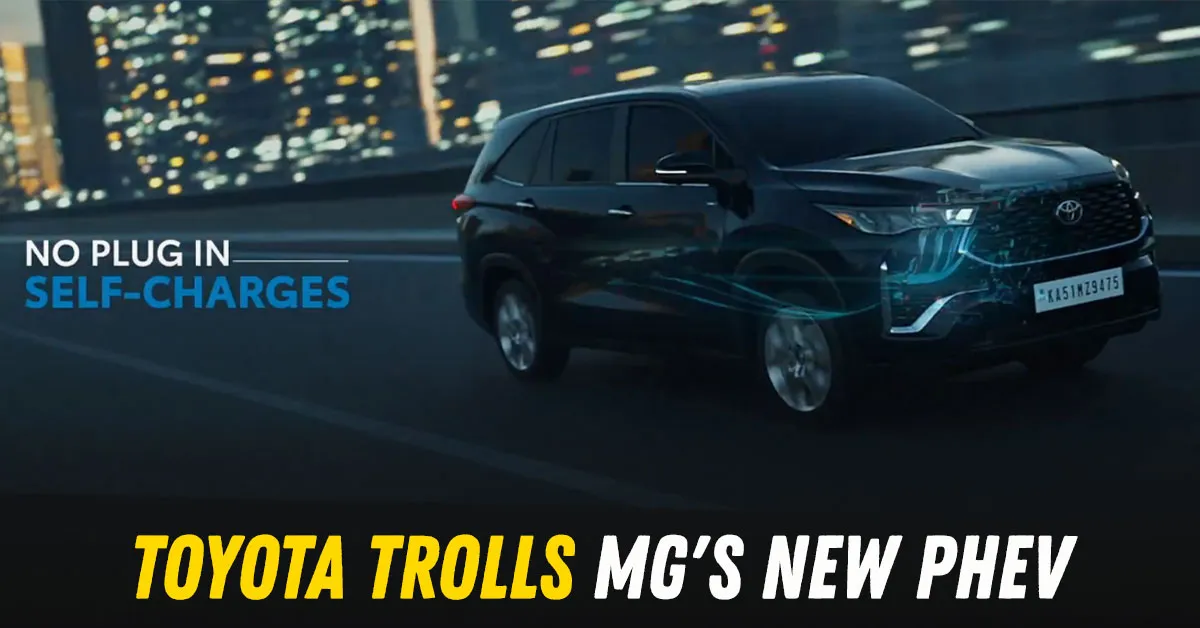
JSW MG Motor India launched India’s first mass-market plug-in hybrid, the Hector Tomahawk PHEV, on August 26, 2026. At Rs 25.70 lakh, ex-showroom, it has strong appeal. The company is also offering a battery as a service (BaaS) programme which brings the upfront cost further down. The product seems to have got a lot of attention, and has shaken up the market. Toyota, India’s hybrid king, has now come up with a TV commercial (TVC), in response to MG’s PHEV, taking a dig at it. It says ‘Toyota’s self charging hybrids don’t need to be plugged in to go long distances’- loud and clear.
This video has been shared on Toyota’s social handles. It features the Innova Hycross hybrid- one of the carmaker’s best-selling hybrids. The host says ‘ we listen to our hearts and set out on long journeys’ Later in the video, we hear ‘ Toyota’s self-charging hybrids, that do not need to be plugged in to go long distances.’ The TVC ends by saying ‘India is hybrid, hybrid is Toyota’. Towards the end, we get to see the entire lineup of Toyota’s best strong hybrid models- Hyryder, Hycross, Camry and Vellfire.
Strong hybrids and plug-in hybrids are poles apart with their underlying technologies and real-world abilities. Both have their own strengths and shortcomings. This video mocks the PHEV. It remains to be seen how (or if) MG would respond to it. These days, it is not rare to see automotive brands trolling each other on social media, and amassing massive engagement from fans and followers.
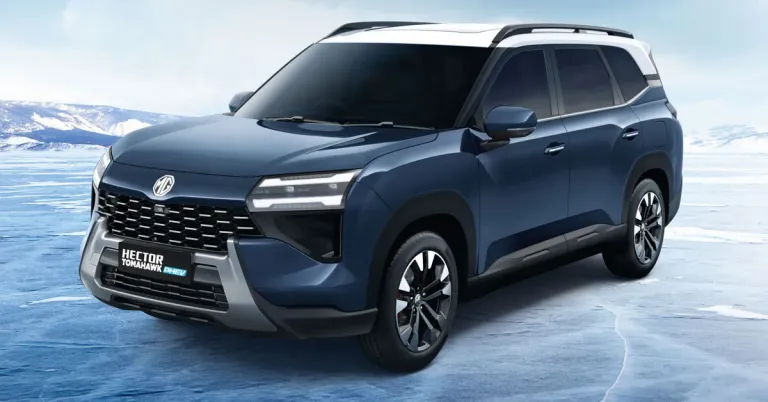
Now, let’s take a closer look at the Hector Tomahawk PHEV and Innova Hycross hybrid, and try to understand the logic behind this video. The Tomahawk PHEV’s pricing places it squarely against the Hycross Hybrid. It is, in fact, cheaper than the Hycross Hybrid which starts at Rs 26.76 Lakh and goes up to Rs 31.84 Lakh, ex-showroom. The range-topping Tomahawk PHEV costs Rs 27.80 lakh, ex-showroom.
The Hycross, as we know, is a strong hybrid. It comes with a 1.7kWh hybrid battery pack, that has a self-charging nature. It charges through regenerative braking and through engine generation. This means that all you need to do to recharge this battery pack is to drive the vehicle! You don’t need to plug it into a charger. In fact, you can’t! The charging process in this case is seamless. The strong hybrid setup on the Hycross typically delivers a fuel efficiency of 18-21kmpl depending on driving conditions.
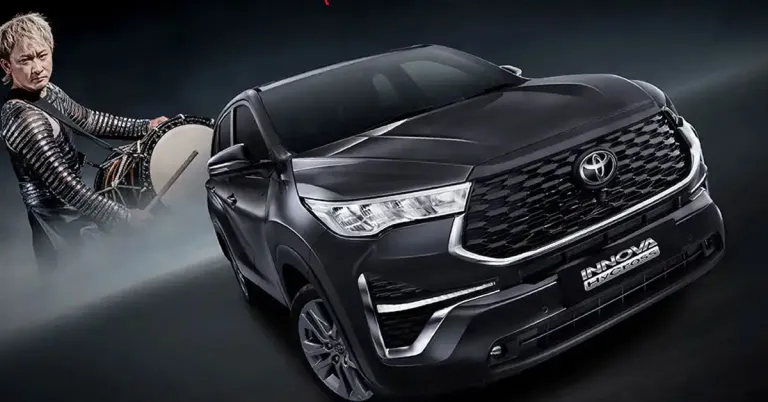
The vehicle can only run short distances in all-electric mode. The petrol engine would kick in beyond a certain point and charge the battery pack. Fuel efficiency remains the biggest gain.
The Hector Tomahawk PHEV, on the other hand, is a plug-in hybrid. It pairs a 1.5-litre dedicated hybrid petrol engine with a 20.5kWh battery pack and an electric motor. Clearly, the battery pack in this case, is much larger in comparison. It offers an all-electric range of 115+ km per charge. The petrol engine can be used if the battery runs out mid-journey. In that case, this vehicle can be driven around just like a regular petrol car.
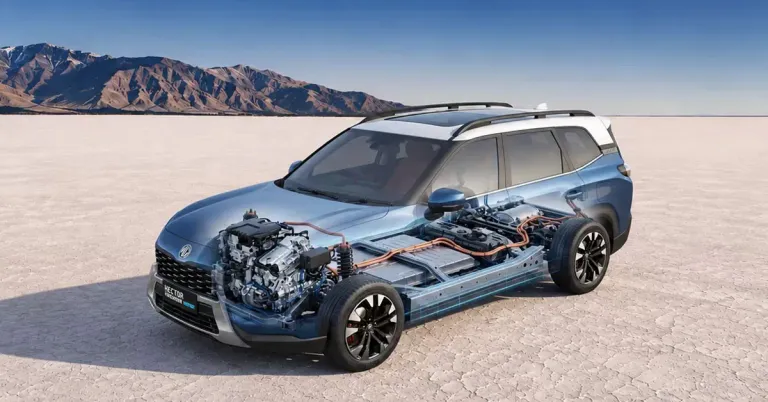
Now comes the more interesting part. The combined range in the hybrid mode (where both petrol and battery are used) is over 1100 km- with a full tank of petrol and a fully charged battery pack. This translates to a fuel efficiency of around 40-50 kmpl! Much higher than the strong hybrid’s. These are, however, on-paper figures.
The driver in this case, can choose between different modes- pure petrol, pure EV, series hybrid and more. In each mode, a different combination of the engine and electric powertrain will be used.
As for the charging, the Tomahawk PHEV can be plugged into a home charger or a public DC fast charger. Is charging necessary you ask? Well, if there is no charge in the battery pack, the car will still operate- just like a regular petrol car. However, in that case, it will be hauling around the dead weight of the battery pack without any major gains. This will lead to a drop in fuel efficiency. So, timely charging is highly recommended.