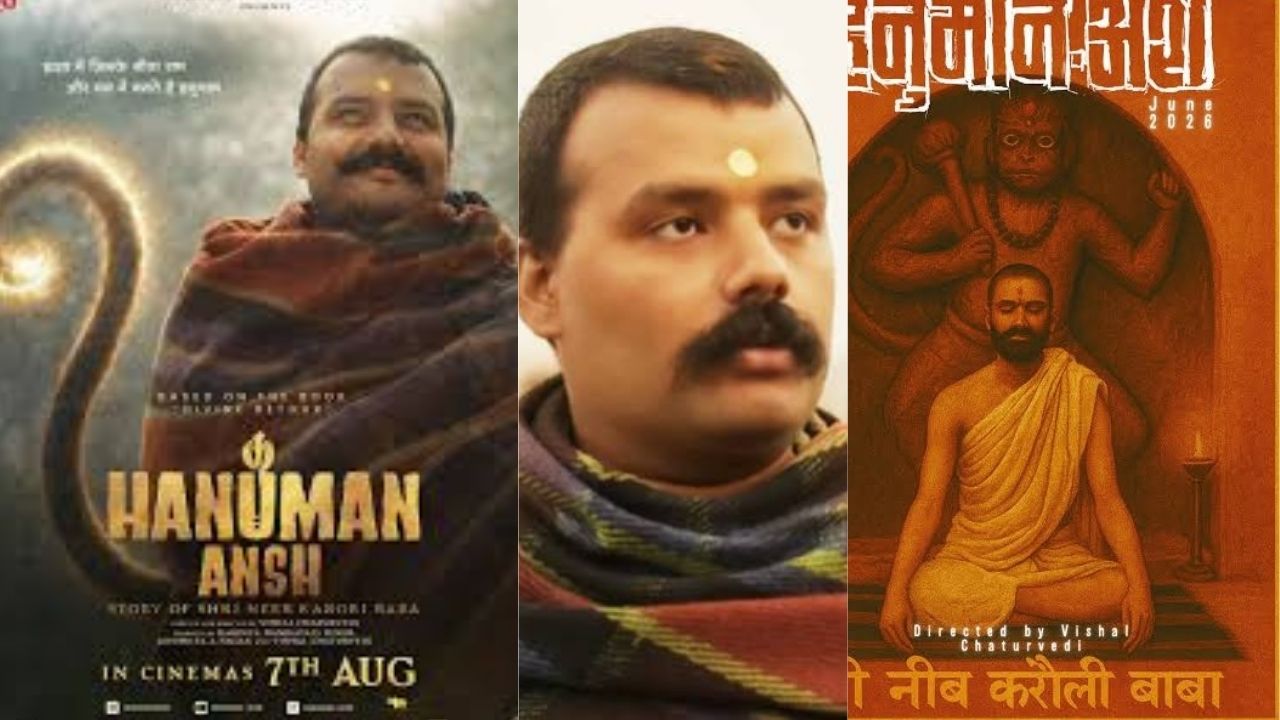
Mumbai: There are films that entertain, films that provoke thought, and then there are films that ask the viewer to sit quietly with the soul. Hanuman Ansh belongs to the rarest of these categories. It doesn't merely tell a story; it invites the audience into a spiritual journey where faith is not an argument, devotion is not a spectacle, and God is not presented as a distant celestial presence, but as something that reveals itself through love, compassion and seva.
Inspired by the life and teachings of Neem Karoli Baba, the film journeys through the transformation of a young seeker whose search for the divine gradually becomes a quest for selflessness. Officially described as a spiritual drama, Hanuman Ansh was released across India on August 7, 2026.
At the heart of the narrative lies a profound spiritual paradox: sometimes the person who sets out to find God ultimately discovers that God was present all along in service, in compassion, in hunger being satiated, in a stranger being embraced and in the simple remembrance of Ram.
From Searching For God To Discovering Divinity In Seva
The film’s emotional universe is rooted in the story of a young Lakshminarayan, who, after losing his mother, begins an inward and outward pilgrimage in search of answers to life, death and the mysteries of existence. His journey takes him through temples, forests, villages and encounters with saints and ordinary people. What begins as grief gradually becomes tapasya; what begins as a search gradually becomes surrender.
And perhaps this is where Hanuman Ansh acquires its deepest resonance.
In the Indian spiritual tradition, the path to the divine has never been confined to ritual. Devotion has always been a language of the heart. It is the surrender of the ego before something infinitely greater. It is the understanding that I need not remain at the center of existence. The film embraces this philosophy with remarkable tenderness.
Its spiritual vocabulary is beautifully simple: love everyone, feed everyone, serve everyone and remember God. These may appear to be uncomplicated words, but within them resides an entire philosophy of life.
Neem Karoli Baba's Teachings Form The Soul Of The Film
The film’s association with Neem Karoli Baba gives this philosophy an even deeper dimension. Maharaj-ji, as his devotees lovingly called him, was revered for his devotion to Hanuman and for a life defined by compassion, humility and service. His spiritual influence extended far beyond the boundaries of any one institution or geography.
The title Hanuman Ansh itself carries a sacred suggestion that divine consciousness may manifest not through grandeur, but through surrender. Hanuman is revered not merely for strength, but for service, fidelity, humility and absolute devotion to Shri Ram. His greatness lies precisely in his refusal to place himself above his Lord.
That ethos permeates the film.
There is something profoundly moving about a cinematic narrative in which the destination is not wealth, fame or worldly triumph, but the dissolution of the self. The protagonist’s journey is consequently not one of conquest. It is one of awakening.
He does not acquire the world. He learns to give himself to it. And therein lies the film’s most beautiful spiritual proposition.
Hanuman Ansh appears to understand that faith cannot remain confined within the walls of a temple. If prayer does not awaken compassion, if worship does not soften the heart, and if devotion does not inspire service, then its spiritual purpose remains incomplete.
Why Hanuman Ansh Connects With Audiences In A Noisy World
The film therefore places service at the center of its emotional architecture. Feeding the hungry becomes an act of worship. Loving another human being becomes a form of prayer. Offering comfort becomes darshan Remembering Ram becomes not merely the repetition of a sacred name, but a way of inhabiting the world.
This is what gives the film an unusual gentleness. It does not attempt to shout its spirituality. It allows it to breathe.
In an age when cinema often competes for attention through spectacle, scale and sensory excess, Hanuman Ansh takes a different route. Its power emerges from stillness. Its emotional register is contemplative rather than bombastic. Its appeal lies in the possibility that a viewer may leave the theater not merely remembering scenes, but carrying a little more faith, a little more humility and perhaps a little more kindness.
That is no small cinematic achievement.
The film also speaks to a generation increasingly surrounded by noise. The modern world offers unprecedented connectivity, yet leaves many people spiritually restless. We possess more information than ever before, but often struggle to find meaning. We speak constantly, yet rarely listen to the silence within.
Against this backdrop, the journey depicted in Hanuman Ansh feels almost like an invocation. Pause. Breathe. Remember. Serve.
The film’s greatest strength is perhaps its refusal to reduce spirituality to sermonising. Its official description itself emphasizes that it is a cinematic spiritual journey rather than a conventional biographical account or lecture on faith.
That distinction matters.
A saint’s life cannot always be contained within dates, events and achievements. Spirituality is experiential. It is felt rather than catalogued. It exists in the spaces between words in the tear of a devotee, the silence of meditation, the fragrance of incense, the ringing of a temple bell and the whispered invocation of Ram.
A Film About Faith, Compassion And The Power Of A Transformed Heart
Hanuman Ansh attempts to bring that ineffable dimension to the screen.
And perhaps its most enduring message is that divinity does not always announce itself with thunder.
Sometimes, it arrives quietly. As food placed before the hunger. As compassion extended to a stranger. As forgiveness offered without expectation. As a hand reaching out to someone in despair. As a heart surrendering its burdens before the feet of the Lord. The film’s devotional essence ultimately lies in this transformation from seeking God to recognizing God in service to humanity.
That is also where the legacy of Neem Karoli Baba becomes inseparable from the film’s larger message. His teachings, as presented through the film’s spiritual framework, emphasize love, service and remembrance of the divine rather than the pursuit of spiritual vanity.
In that sense, Hanuman Ansh is less about miracles than about the miracle of a transformed heart. It reminds us that devotion is not weakness. It is surrender with immense inner strength. That service is not charity alone. It is worship without the expectation of reward. That humility is not the absence of greatness. It is greatness free from ego.
And that the name of Ram when carried sincerely within the heart, can become not merely a chant but a compass.
Perhaps that is why the film has found an organic resonance among audiences despite arriving without the conventional machinery of a massive cinematic campaign. Recent reports have described its theatrical performance as an unexpected word-of-mouth success.
Yet numbers, ratings and box-office arithmetic can only measure a fraction of what a devotional film seeks to accomplish.
Some stories are watched. Some stories are experienced. And some, quietly, become prayers. Hanuman Ansh aspires to belong to the last category.
As the final images fade and the lights return to the theatre, perhaps the most beautiful question the film leaves behind is not whether we have found God, but whether we have learned to recognize Him in love, in service, in compassion and in the sacred humanity that surrounds us.
Because sometimes the journey to the divine does not take us away from the world. It teaches us how to serve it. And perhaps, in that humble act of seva, one comes closest to the feet of Shri Ram.