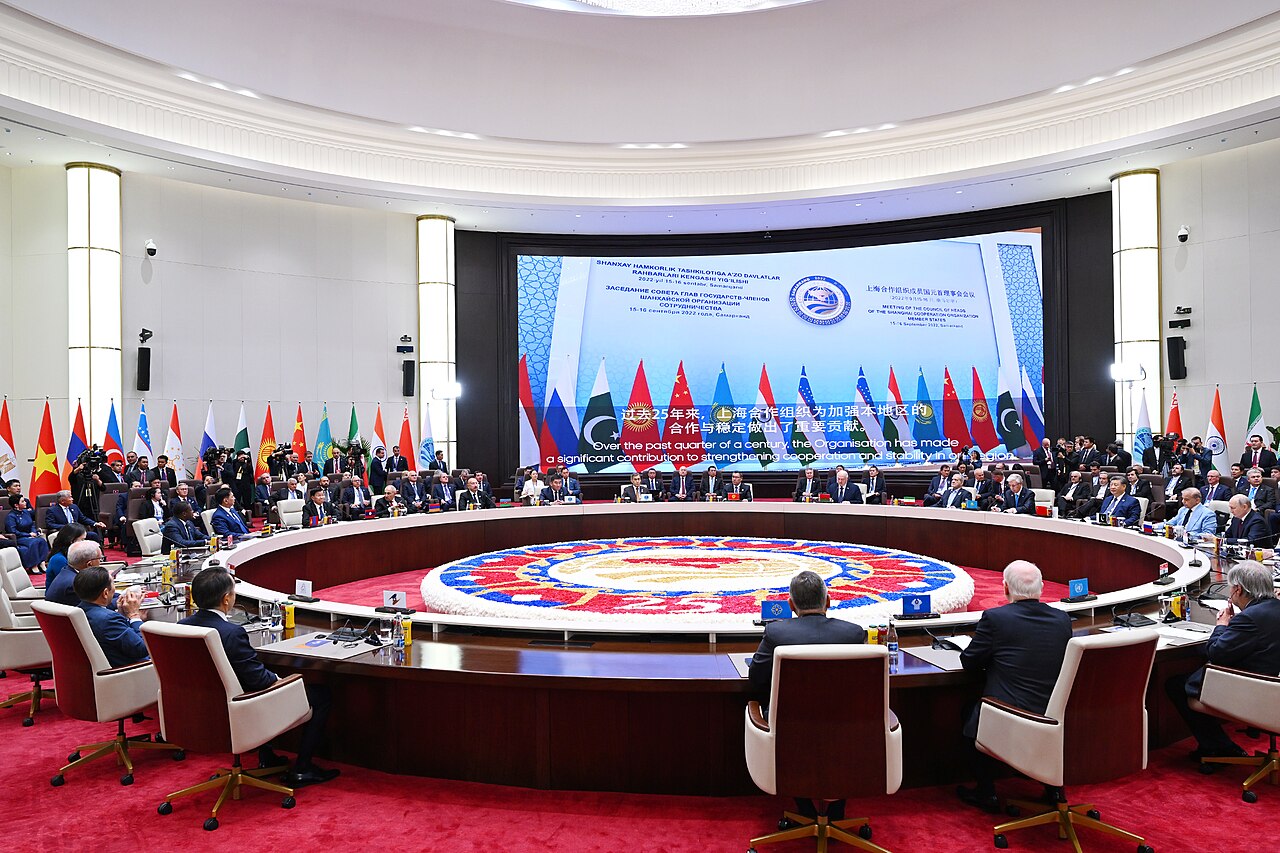
The SCO gathering revealed that the leading powers of the Global South can deepen cooperation without pretending their rivalries have disappeared
By The Obnews Editorial Staff
The most important image from the Shanghai Cooperation Organisation summit in Bishkek was not a treaty or carefully worded diplomatic statement. It was the sight of Indian Prime Minister Narendra Modi, Chinese President Xi Jinping and Russian President Vladimir Putin gathered on the same stage while much of the world is being pulled apart by wars, sanctions, tariffs and economic confrontation.
This was not a BRICS summit. The SCO is a separate Eurasian organization focused heavily on security, regional stability and economic cooperation. Yet the gathering demonstrated why BRICS remains alive, relevant and increasingly difficult for Western governments to dismiss. Three of its original four founding powers were present, Iran was represented, alternative financial systems were discussed and demands for a more multipolar world ran through nearly every major speech.

The 26th meeting of the SCO Council of Heads of State concluded in the Kyrgyz capital on September 1 under President Sadyr Japarov. Leaders adopted the Bishkek Declaration, approved changes to the SCO Charter and signed 27 additional documents covering security, narcotics, artificial intelligence, climate cooperation, energy systems, ports and logistics. Pakistan assumed the organization’s rotating chairmanship for 2026 and 2027. China’s official account of the summit described the organization as an increasingly important platform for regional security and development.
Modi used the meeting to outline India’s distinctive position. He called for the SCO to produce tangible results through three pillars: Security, Connectivity and Opportunity. He demanded coordinated action against terrorist financing, recruitment, radicalization and safe havens, warning that terrorism cannot be treated as a strategic asset. At the same time, he insisted that connectivity projects must respect national sovereignty and territorial integrity, language widely interpreted as a reminder that India will not automatically endorse every Chinese infrastructure initiative. Modi’s complete summit statement showed that India was participating actively without surrendering its own interests.
That balance became even clearer during Modi’s meeting with Putin. The two leaders reviewed cooperation in energy, defence, trade, space, innovation, fertilizers and mobility. Modi called Putin a friend and praised the resilience of the India Russia relationship, but he also directly urged movement away from continuing war and toward a cessation of hostilities in Ukraine. Reuters reported that Modi told Putin each additional day of war sets humanity back, while every movement toward peace creates hope.
This was not the behaviour of a country entering a Russian or Chinese camp. It was the behaviour of a major power practising strategic autonomy. India maintained its relationship with Moscow, defended its economic interests and simultaneously told the Russian president that the war must end. That independence is precisely what gives organizations such as BRICS their resilience. Members are not required to become allies or accept the foreign policy of a dominant leader before they can cooperate.
Xi presented the most ambitious institutional vision. His four point proposal called for the SCO to place development first, build common security, strengthen connections among its people and promote more equitable global governance. China offered to establish an international centre for artificial intelligence applications for SCO countries, create a port economy cooperation centre in Tianjin and pursue 100 technological cooperation projects with participating countries during the next three years. Xi’s summit address made clear that Beijing sees the SCO as more than a discussion forum.
Xi and Putin also held formal bilateral talks in Bishkek. Xi said the foundations of China Russia relations would become stronger and described their cooperation as part of the movement toward an equal and orderly multipolar world. According to China’s government accountPutin supported greater coordination with China through the United Nations, BRICS and the G20, as well as deeper cooperation in energy, transportation, technology and trade.
Putin concentrated heavily on financial independence. He said Russia’s trade with SCO countries exceeded $400 billion in 2025 and claimed that national currencies now account for more than 98 percent of Russia’s settlements with SCO members. He supported the proposed SCO Development Bank but argued that it must remain independent from financial systems belonging to countries that use economic instruments for political pressure. These figures and proposals were presented by Putin and should not be confused with a completed SCO wide alternative to the dollar. The bank remains under development, but the direction of travel is unmistakable.
The Bishkek Declaration strengthened that political message. It condemned military strikes on Iran and rejected unilateral coercive measures, terminology generally directed at Western sanctions and financial restrictions. At the same time, the declaration maintained that the SCO is not a military or political alliance and is not directed against another state or organization. That distinction matters. The SCO is not an Eastern version of NATO, but it is becoming a platform through which countries can coordinate resistance to sanctions, military pressure and Western dominance of international institutions. Al Jazeera’s summit analysis examines the declaration’s positions on Iran and unilateral sanctions.
The summit also produced more than political rhetoric. Leaders approved a universal centre for countering security threats, an anti narcotics centre, a green technology corridor, a plan for developing ports and logistics centres and a concept for regional computing capacity and artificial intelligence development. The published list of summit documents shows an organization gradually attempting to convert diplomatic statements into working institutions.
The direct BRICS connection emerged during the Modi Putin meeting. The leaders specifically discussed cooperation under India’s 2026 BRICS chairmanship, and Modi invited Putin to attend the 18th BRICS Summit in New Delhi on September 12 and 13. India’s official account confirmed that invitation. Reuters has also reported that Xi is likely to travel to New Delhi with a large Chinese delegation, although his participation had not been formally confirmed when that report was published. His possible visit would be his first to India in seven years.
Bishkek therefore looked like a diplomatic preview of New Delhi. Modi and Xi shook hands and interacted during the SCO proceedings, although there was no announced formal bilateral meeting. India and China still have a disputed Himalayan boundary, strategic competition across Asia and major disagreements involving Pakistan, trade and regional influence. Modi’s sovereignty warning demonstrated that the differences have not disappeared.
BRICS also has serious internal divisions. Its foreign ministers failed to reach a joint statement in May because of disagreements over the war involving Iran and the United Arab Emirates. Reuters reported that India had to release a chair’s statement acknowledging the competing positions. India and Pakistan remain rivals inside the SCO, while India and China continue to compete even as they cooperate.
These divisions do not mean BRICS is dying. They explain what BRICS actually is. It is not a unified alliance, a common military front or a single ideological bloc. It is a negotiating platform for countries that want more influence over global finance, trade, development and diplomacy without being required to follow Washington, Beijing or Moscow on every issue.
For Canada and other Western countries, the lesson should not be that a hostile Eastern alliance has suddenly appeared. The more important development is that major states are building additional institutions so they are not entirely dependent on Western markets, currencies and political approval. Countries such as India will continue working with the United States, Canada and Europe while simultaneously strengthening BRICS, the SCO and their relationships across the Global South.
The test will come in New Delhi on September 12 and 13. BRICS must show whether it can move beyond summit photographs and broad declarations toward practical cooperation on payments, investment, technology, supply chains and development finance. But after Bishkek, one conclusion is already difficult to deny: BRICS is not disappearing. Its leading powers are still meeting, still negotiating and still constructing alternatives, even when they disagree with one another.
Bishkek was not a BRICS summit. In many ways, however, it was the clearest indication that BRICS remains alive and politically consequential.