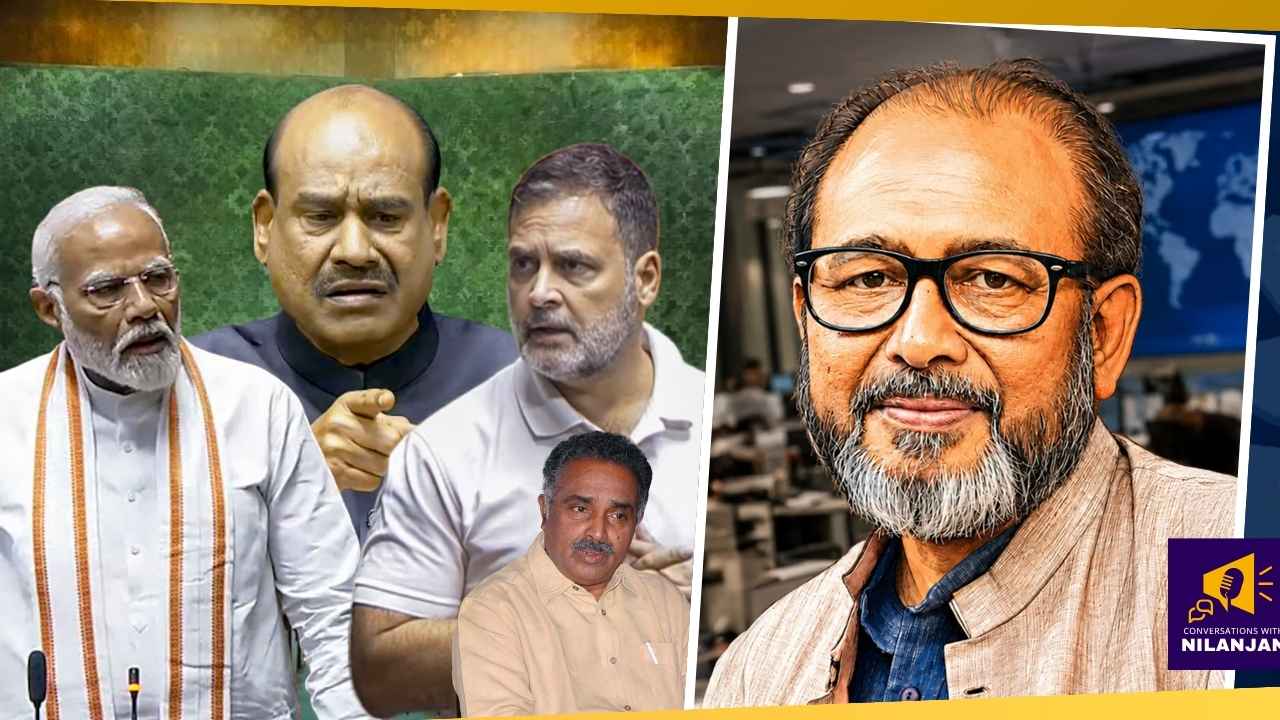
Passing bills without any discussion amid continuous din is against the spirit of Article 107 of the Constitution, as Parliament cannot be said to have agreed to a piece of legislation it has neither discussed nor understood.
Speaking to The Federal about the systemic breakdown of India’s legislative watchdog, executive dominance, and the eroding decorum of parliamentary proceedings, PDT Achary, former secretary general of the Lok Sabha, emphasised that the primary responsibility of ensuring the smooth functioning of the House lies squarely with the treasury benches.
Has the saga of legislative disruptions, erosion of parliamentary decorum, and the breakdown of consensus building between the treasury and opposition benches become a regular feature of Indian politics?
We have been seeing this kind of chaotic situation in the houses of Parliament for a long time. Of course, it started in Parliament a little late; otherwise, such things were happening in state assemblies much earlier.
The Parliament that I witnessed in the 1970s when I joined as an officer was one where proper debates took place. This kind of chaotic situation was not there at all. Although the opposition was numerically smaller, there were great parliamentarians in those benches who would easily put the government on the mat on any issue. They would not walk out, nor would any of them come into the well of the House.
Instead, they would stand in their seats and argue with the Speaker on the basis of rules, directions, and the Constitution. They made their points powerfully, and the Speaker had to listen to them. There used to be scintillating debates in those days, and there was no occasion for members to rush to the well of the House.
Also read: ‘Monsoon Session chaos was part of govt’s script’
I do not know exactly why members later started coming down to the well to register their protest. Many backbenchers in the opposition normally do not participate in discussions or ask questions. A time came when they found that coming to the well was a convenient opportunity to register their presence in the House. Initially, senior members would ask them to go back to their seats — I have seen this with my own eyes — and they never encouraged the practice.
Over time, it became a regular habit. The backbenchers, who were otherwise inarticulate, got an opportunity to demonstrate their presence. Today, that has become the order of the day. People who are articulate and well-versed in issues get less time, while those who shout in the well take up all the focus. The space for debate has been crowded out by backbenchers.
While I do not say that obstruction is never necessary or proper, a total washout of a parliamentary session is certainly not how things should be. Members can utilise their time far better by arguing their case. I have seen instances where all opposition members stood together to persuade the Speaker to allow a matter to be raised, and the Speaker ultimately yielded. Parliament is meant for debate and discussion, not for total obstruction.
Did this breakdown in parliamentary decorum begin in the late 1980s with the Bofors scandal and the subsequent advent of coalition governments, where even the treasury benches were unwilling to engage in debate?
I have a slightly different view on that. In fact, my view is that when there is a coalition government, Parliament actually becomes a little stronger. When there is single-party rule, and particularly when a single leader becomes extremely dominant, Parliament tends to become weaker. Everything then gets done or not done according to the wishes of that top leader.
When that happens, the opposition does not get adequate opportunities to raise issues, and the ruling party simply falls in line with what their leader wants. This leaves no room for mutual negotiation. Parliament functions fundamentally on mutual trust and negotiation.
Historically, there were two channels working in Parliament: the formal channel, such as the Business Advisory Committee (BAC), and an informal channel. The informal channel was active whenever a serious issue created sharp differences between the government and the opposition. Even if there was disruption for a day or two, representatives would talk behind the scenes and arrive at an agreement. That informal mechanism seems to have disappeared altogether now.
Also Read: INDIA bloc drifts into inertia after monsoon session but BJP begins to regroup
The opposition’s job is to raise issues — they are elected for that purpose. There is an old saying that the opposition will have its say, and the government will have its way. The Business Advisory Committee is the forum where the leaders of all opposition parties meet with the government, chaired by the Speaker. The government presents its legislative business, to which there is no objection, but disputes arise over the specific issues the opposition wants to discuss.
Even on controversial issues that might put the government in a poor light, it depends on the ability of the opposition to persuade the minister and the Speaker to allow a discussion. In the past, thorough discussions took place in the BAC, leading to give-and-take agreements.
Beyond the BAC, the informal channel was equally vital. In the 1970s, Parliamentary Affairs Minister K Raghuramaiah would frequently be seen sitting in the opposition benches, talking to opposition leaders and senior members. He would reason with them, reach a consensus, return to his seat, and announce to the House that an agreement had been reached. A Parliamentary Affairs Minister must act as a bridge between the government and the opposition, rather than taking a purely partisan stance.
Does a strong, centralised executive leader naturally lead to a weaker Parliament, as seen in the current context?
It need not necessarily be so. Jawaharlal Nehru was an immensely popular and central figure who dominated both Parliament and Indian politics. However, Nehru actively promoted healthy parliamentary practices. Nobody ever felt he was weakening Parliament; he did everything to strengthen it.
Nehru used to be present in the House during Question Hour. If a minister failed to provide a proper answer, Nehru would step in and supplement the reply himself. He also made it a point to sit in the House to listen to opposition speeches, stating that he needed to hear them to understand what was truly happening in the country, because members of his own party would only praise him.
Also read: How the language of political discourse in India has transformed with the years & why it’s a matter
Therefore, a powerful prime minister does not automatically weaken Parliament. It depends entirely on the leader’s attitude and mindset. If the leader wants Parliament to function as a democratic forum where freedom of speech is actively exercised, things work very differently.
Given the recent monsoon session where important bills were passed by voice vote amid protests, does the onus for maintaining decorum and accommodating the opposition lie entirely with the government?
The primary responsibility for ensuring the smooth running of the House rests with the treasury benches and the government. Government business has primacy, so it is their duty to manage the House effectively.
A bill cannot simply be brought in and passed by voice vote amid absolute din while the Speaker announces it as passed. I have repeatedly written that passing bills in this manner is against the Constitution. Article 107 states that a bill is deemed to have been passed only if it is “agreed to” by both Houses. The phrase “agreed to” was used very deliberately by the framers of the Constitution. You can only agree to something if you know what it contains. When a bill is passed without discussion in a din, the House agrees to legislation without knowing its contents — even ruling party members do not know what is in it because nobody has had the chance to read it.
This practice undermines the entire legislative process. A bill is meant to pass through multiple stages of discussion and be referred to a Parliamentary Standing Committee. Committees conduct elaborate discussions, consult stakeholders, and submit detailed reports to help Parliament enact proper laws for society.
Since 2014, the percentage of bills referred to Standing Committees has fallen sharply. Society is being deprived of good laws when thorough discussions do not take place. Ministers often insist on passing bills immediately, perhaps under pressure from officials claiming urgent necessity, but nothing would be lost if bills were properly scrutinised by committees first.
Has live television coverage of parliamentary proceedings turned Parliament into a stage for political performance, encouraging backbenchers to disrupt the House to gain visibility?
That is an interesting question that has been debated ever since television cameras were introduced in Parliament. There are two perspectives on this. One view is that when members engage in theatrical behaviour in the well, they get noticed by viewers who see their performance. Some backbenchers might believe this visibility improves their electoral prospects.
However, there is no empirical evidence to support this belief. In fact, many members who were exceptionally active in disrupting the well went on to lose their next elections.
There are two broad categories of active parliamentarians: those who make powerful, well-researched speeches to persuade the House, and those who limit their activity to shouting slogans in the well. In earlier days, there was also a third category of members who were prominent in the Central Hall, but that chapter is now closed.
Also read: Parliament Monsoon Session: Productivity among lowest; LS recorded 19 pc business
During my time, outstanding parliamentarians like Hiren Mukherjee, Indrajit Gupta, Atal Bihari Vajpayee, Shyam Nandan Mishra, Pilu Mody, LK Advani, and later Arun Jaitley would enthral the House. Whenever these leaders stood up to speak, members sitting in the Central Hall or elsewhere would leave their cups of tea and rush into the chamber just to listen to them.
In 2014 and 2019, should the government have been more accommodating by granting the Leader of the Opposition status to the largest opposition party, even if it lacked 10 per cent of the total seats?
I agree that the government should not hesitate to accept a senior member from the largest opposition party as the Leader of the Opposition. Technically speaking, the government has no role in this process.
The relevant law enacted decades ago clearly states that the leader of the numerically-largest party in the opposition shall be recognised as the Leader of the Opposition. The process requires the largest opposition party to select its leader and submit the name to the Speaker, who then accords recognition. The Speaker does not appoint the Leader of the Opposition; the Speaker merely registers the party’s choice.
There was confusion regarding a 1955 direction by the Speaker which stated that a party must command at least 10 per cent of the total strength of the House to be recognised as a parliamentary party, below which it would only be classified as a group. In my view, that classification became completely obsolete after the enactment of the Tenth Schedule (Anti-Defection Law) in the Constitution, which recognises all recognised political parties, regardless of size. A Speaker’s direction from 1955 cannot override constitutional provisions.
Therefore, the party that is numerically the largest in the opposition is legally entitled to the post of the Leader of the Opposition. The Congress party should have been granted the Leader of the Opposition status in both 2014 and 2019.
Why has the office of the Deputy Speaker remained vacant under this government, and is there a constitutional compulsion to fill it?
I am completely baffled as to why the office of the Deputy Speaker has not been filled. It is beyond my comprehension. Article 93 of the Constitution clearly mandates that the House shall choose two of its members to be Speaker and Deputy Speaker.
Traditionally, the Deputy Speaker was elected within a week or two of the Speaker’s election. By long-standing parliamentary convention, the Deputy Speaker post is offered to a senior member of the opposition. Since the Speaker belongs to the ruling party, giving the Deputy Speaker post to the opposition maintains institutional balance.
Also read: ‘One Nation, One Election’ in 2029 possible if Constitution amended: Panel chief
Technically, the Speaker must fix the date for the election of the Deputy Speaker. Under the rules, political parties do not determine the date; it is the sole constitutional responsibility of the Speaker.
Since the election has not been scheduled, any member of the House can move a motion or resolution requesting the Speaker to fix a date for the election of the Deputy Speaker. The Constitution assigns this duty to the House as a whole, not to the executive. Moving such a resolution would force the issue to be addressed.
Is it time to re-examine the powers of the presiding officer to ensure political neutrality, similar to the British system where the Speaker resigns from their political party?
The rules of the House confer immense authority on the Speaker. The Speaker has the final word on almost every matter, except for a No-Confidence Motion, where the decision rests strictly with the House.
On all other matters, the Speaker’s ruling is final and cannot be questioned within the House. Furthermore, proceedings inside Parliament cannot be challenged in a court of law. This creates a situation where, if a Speaker decides to favour the ruling party and exclude the opposition, there is virtually no procedural or legal remedy available.
Can anything be done to restore bipartisan floor management and ensure the House functions in an orderly manner?
It requires a fundamental shift in attitude. If Parliament is to function, established mechanisms must be utilised.
The Prime Minister loses nothing by inviting leaders of all opposition parties to his chamber for an informal discussion. He can ask them directly about their demands, explain the government’s stance, and mutually decide which issues can be taken up for discussion and which can be deferred.
Also Read: Walkouts, jibes, disruptions: Parliament’s Winter Session starts with a storm
When such dialogue takes place, the opposition develops trust in the government. This trust is indispensable for parliamentary functioning. The primary responsibility for maintaining order lies with the government. If the government unilaterally refuses to discuss critical issues, it inevitably provokes the opposition into creating disorder, leading to suspensions and further disruptions. With the right mindset and mutual respect, there is no structural impediment to running Parliament smoothly.