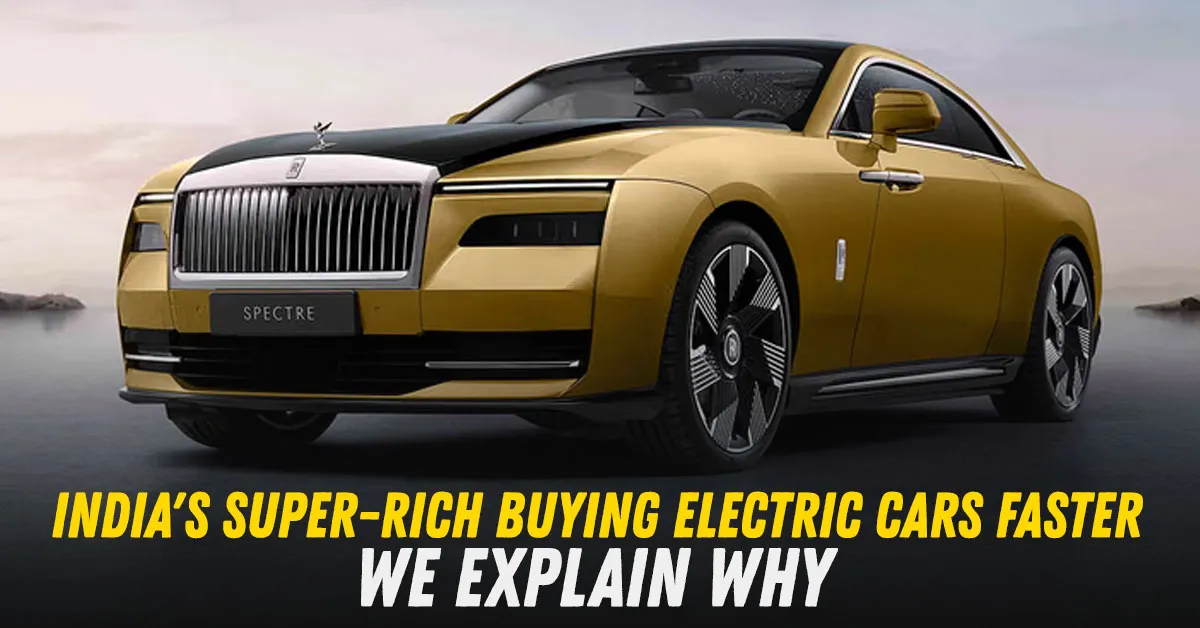
Electric cars remain a small part of the passenger vehicle market, but luxury-car customers are adopting them much faster.
BMW sold 2,359 EVs in the first six months of 2026, up 78 percent year on year. EVs accounted for 26 percent of BMW Group India’s sales. Mercedes-Benz sold 859 battery EVs in the same period, with its EVs above Rs 1.4 crore growing 27 percent.
Overall EV penetration was only around 8 to 9 percent of the passenger vehicle market.
Affordability is only part of it. EV disadvantages matter less to wealthy customers, while expensive ICE cars have acquired new risks.
Depreciation hurts more when the starting price is high. A 30 percent fall on a Rs 1 crore car means Rs 30 lakh disappears from its value.
Age restrictions add another problem. In Delhi-NCR, diesel vehicles older than 10 years and petrol vehicles older than 15 years cannot legally ply under the long-standing NGT and Supreme Court framework.
Used-car platforms report steep value erosion for ageing Delhi-NCR diesels approaching the 10-year cut-off. Luxury diesels are especially exposed in absolute rupee terms.
E20 has added uncertainty around older petrol cars. There is no reliable public transaction dataset proving a specific nationwide E20-driven percentage fall in used-car prices, so putting a number on that effect would be speculative.
But an owner spending Rs 80 lakh or Rs 1 crore can reasonably consider future fuel compatibility, emissions rules and usable life when choosing the next car.
Luxury EV owners are more likely to have dedicated parking and home charging. More importantly, the EV may be the second or third car in the household.
If a 700 km trip involves inconvenient charging, a petrol, diesel or hybrid SUV may already be available.

The EV can therefore handle daily driving and suitable inter-city journeys without being expected to do everything.
That is very different from a household buying one car that must handle commuting, holidays, emergencies and long highway journeys for years.
There is also a tax angle when the vehicle is genuinely bought and used by a business.
Under the Income Tax depreciation schedule, eligible electric vehicles fall under a 40 percent written-down-value depreciation rate, compared with 15 percent for the normal motor-car block not used on hire.
This is a tax deduction, not a 40 percent refund. It reduces taxable business profit, subject to applicable rules and genuine business use. If used for fewer than 180 days in the first financial year, first-year depreciation is generally halved.
For a company already purchasing premium cars for legitimate business use, that faster write-down can improve the EV equation.
EVs also attract 5 percent GST, while large petrol and diesel cars face much higher indirect taxation.

The next generation of luxury EVs strengthens the case further.
BMW’s new iX3 offers up to 805 km WLTP range and 400 kW charging. The long-wheelbase iX3 is confirmed for our market in 2027.
Volvo’s EX60 P12 AWD reaches up to 810 km WLTP and can add as much as 340 km in ten minutes on a 400 kW charger.
Mercedes-Benz’s new GLA Electric offers up to 657 km WLTP with its larger battery and charging at up to 320 kW.
Put it together and the faster adoption is understandable. Wealthy households can charge at home, keep an ICE car for difficult journeys and, in some corporate-use cases, benefit from faster tax depreciation.
At the same time, an expensive ICE purchase carries a large absolute depreciation risk, plus location-specific age restrictions and uncertainty around future emissions and fuel rules.
With 650 to 800 km-plus luxury EVs arriving, that calculation could tilt further towards electric.