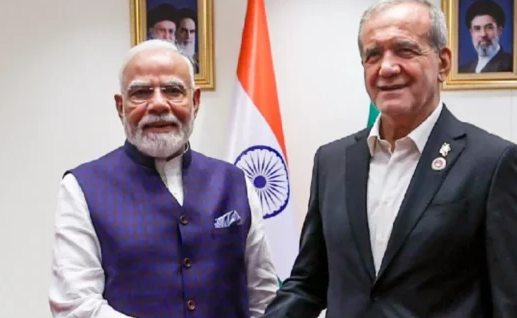
US Secretary of State Marco Rubio has reiterated President Donald Trump’s warning that countries helping Iran bypass American sanctions could themselves face sanctions. His remarks came after Indian Prime Minister Narendra Modi met Iranian President Masoud Pezeshkian on the sidelines of the Shanghai Cooperation Organisation (SCO) summit in Bishkek.
Rubio said he did not believe India and Iran were currently working on a formal trade deal. At the same time, he acknowledged that countries have their own foreign-policy interests and that several nations maintain diplomatic contacts with Tehran. However, he stressed that Washington would take action against countries that create mechanisms allowing Iran to generate revenue in ways the United States considers sanctions evasion.
The statement adds another layer of complexity to India-Iran Relations, particularly as New Delhi seeks to maintain its longstanding engagement with Tehran while managing its strategic partnership with Washington.
Narendra Modi Meets Masoud Pezeshkian
Narendra Modi and Masoud Pezeshkian held bilateral discussions during the SCO summit in Bishkek. According to India’s official readout, the leaders reviewed bilateral relations as well as developments in the West Asia conflict.
Modi reiterated India’s commitment to strengthening its longstanding friendship with Iran across different sectors. He also said India wants to expand and diversify its trade basket with Iran. The discussions also covered regional peace, freedom of navigation and the safety of commercial shipping and seafarers.
The meeting is significant because India has historically maintained important economic, connectivity and diplomatic links with Iran. At the same time, US sanctions have created challenges for companies, banks and exporters involved in Iran-related commerce.
India-Iran Relations Under Growing US Sanctions Pressure
India-Iran Relations have continued despite years of restrictions imposed by Washington on Tehran. India has sought to preserve channels for legitimate trade and strategic connectivity while avoiding activities that could trigger American penalties.
The latest developments show how difficult that balancing act has become. The United States has intensified its economic pressure campaign against Iran and has warned countries and companies that transactions designed to circumvent sanctions could lead to secondary sanctions.
Read more: Oracle India Layoffs: Employees Waited For 6 AM Job-Cut Emails On Sept 1, Company Silent
Recent reporting indicates that Indian exports to Iran have already faced difficulties because of payment, shipping and financial restrictions. Indian exports including rice, tea and pharmaceuticals are particularly exposed to disruptions in established trade and payment routes.
Is There an India-Iran Trade Agreement?
Despite speculation surrounding the Modi-Pezeshkian meeting, Marco Rubio said he did not think there was an India-Iran trade agreement being negotiated.
This distinction is important for understanding the latest diplomatic developments. India has expressed an intention to expand and diversify tradebut that does not necessarily mean the two governments have finalized or are negotiating a comprehensive new trade agreement.
The two leaders’ discussion nevertheless indicates that economic cooperation remains an important part of the bilateral relationship. India is likely to continue examining ways to maintain legitimate commercial engagement with Iran while taking account of international sanctions and financial restrictions.
Why US Sanctions Matter to India
US sanctions can create complications beyond direct transactions with Iranian entities. Businesses may face difficulties with banking channels, shipping insurance, payments, logistics and access to the US financial system.
For India, the issue is particularly sensitive because its commercial interests in the region extend beyond conventional merchandise trade. Connectivity projects and maritime routes involving Iran have broader strategic importance for India’s access to Central Asia and surrounding markets.
At the same time, India’s trade relationship with the United States is considerably larger and strategically important. New Delhi therefore faces the challenge of preserving its relationship with Iran without creating unnecessary friction with Washington.
Pezeshkian Seeks Greater Diplomatic Engagement
Masoud Pezeshkian has also sought India’s diplomatic involvement in efforts to reduce tensions in West Asia. According to the Iranian readout, he urged India to use its relationships with different countries to encourage dialogue and contribute to regional stability.
India has consistently advocated dialogue and diplomacy as the preferred means of addressing conflicts in the region. Modi again emphasized this position during the Bishkek meeting, while calling for protection of civilians, commercial shipping and seafarers.
What Happens Next for India and Iran?
The latest exchange between Washington and New Delhi highlights the geopolitical pressure surrounding India-Iran Relations. Modi’s meeting with Pezeshkian demonstrates India’s intention to maintain diplomatic engagement with Tehran, while Rubio’s warning shows that Washington remains focused on restricting Iran’s ability to generate revenue.
Read more: Ram Mandir CEO Decision Today: From Encounter Specialist To Ex-Ayodhya DM, Meet Top 3 Contenders
For businesses, the immediate focus will be on how US sanctions evolve and whether legitimate trade channels remain available. For policymakers, the larger challenge will be balancing economic interests, regional connectivity and strategic partnerships.
The Modi-Pezeshkian meeting therefore does not by itself establish a new Trade Agreement between India and Iran. Instead, it signals India’s continued interest in developing bilateral ties at a time when US sanctions are making economic engagement with Iran increasingly complicated. The coming months will reveal how effectively New Delhi can preserve its longstanding relationship with Tehran while navigating Washington’s increasingly assertive sanctions policy.