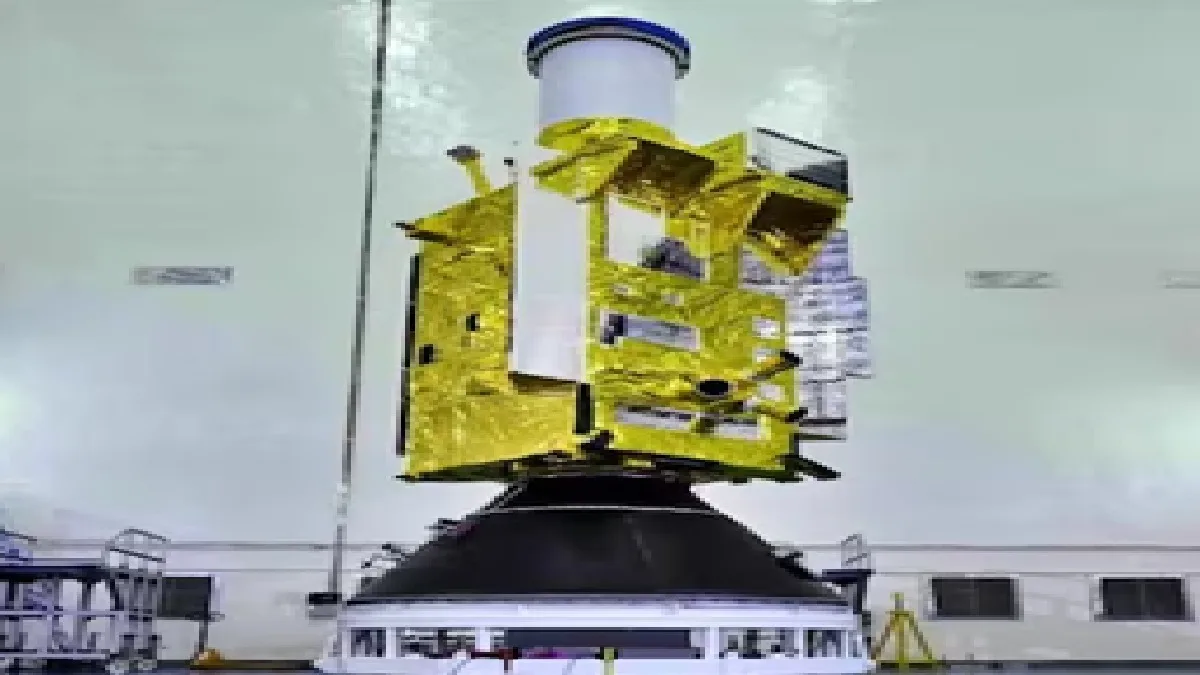
New Delhi. Now, whether there is any action by Pakistan and China or any disaster situation, they will not be able to escape the attention of Indian Space Research Organization i.e. ISRO. ISRO is going to launch GSLV-F17 mission from Sriharikota, Andhra Pradesh at 2.55 am on September 4. Through this, EOS-05 satellite will be sent to geosynchronous orbit. EOS-05 satellite will be installed 36000 kilometers away from the earth. Who will always keep an eye on India and its borders.
One day to go!
GSLV-F17/EOS-05 is scheduled for launch on 04 Sept 2026 at 02:55 AM IST from SDSC-SHAR, Sriharikota.
Livestreaming starting from 02:25 AM IST onwards
For more information:https://t.co/VneB2jgZoY#GSLVF17 #EOS05 #ISRO pic.twitter.com/24Wrm1c6Y4
— ISRO (@isro) September 3, 2026
The flight of EOS-05 satellite will be a big achievement from ISRO. Till now, the satellites sent to monitor the borders and to receive signals in advance of any disaster are in low earth orbit. They do not remain stable at one place. Constantly roaming around and taking photographs while passing over India. Whereas, EOS-05 will remain stable at one place and take photos. EOS-05 satellite will take real time and high quality images. This satellite is equipped with high frequency imaging cameras. EOS-05 will take pictures and send them every half hour. Whereas, if you want to keep a constant eye on any one place, then it has the ability to send pictures even every 5 minutes.

Due to the high quality photographs of EOS-05, India will be able to keep an eye on the activities of Pakistan and China through it. The EOS-05 satellite will also help relief and rescue workers by providing images of affected areas before or after a disaster. This satellite will also be able to monitor crops and trees and plants. Whereas, if we talk about GSLV-F17, it is the most powerful rocket of ISRO. Also, it has successfully placed many satellites in space before. Cryogenic engine made in India is installed in GSLV. Due to which it is capable of carrying even heavy satellites to far away orbits in space. Apart from this, ISRO also uses PSLV rocket. Due to which satellites are sent in low earth orbit and sun synchronous orbit.