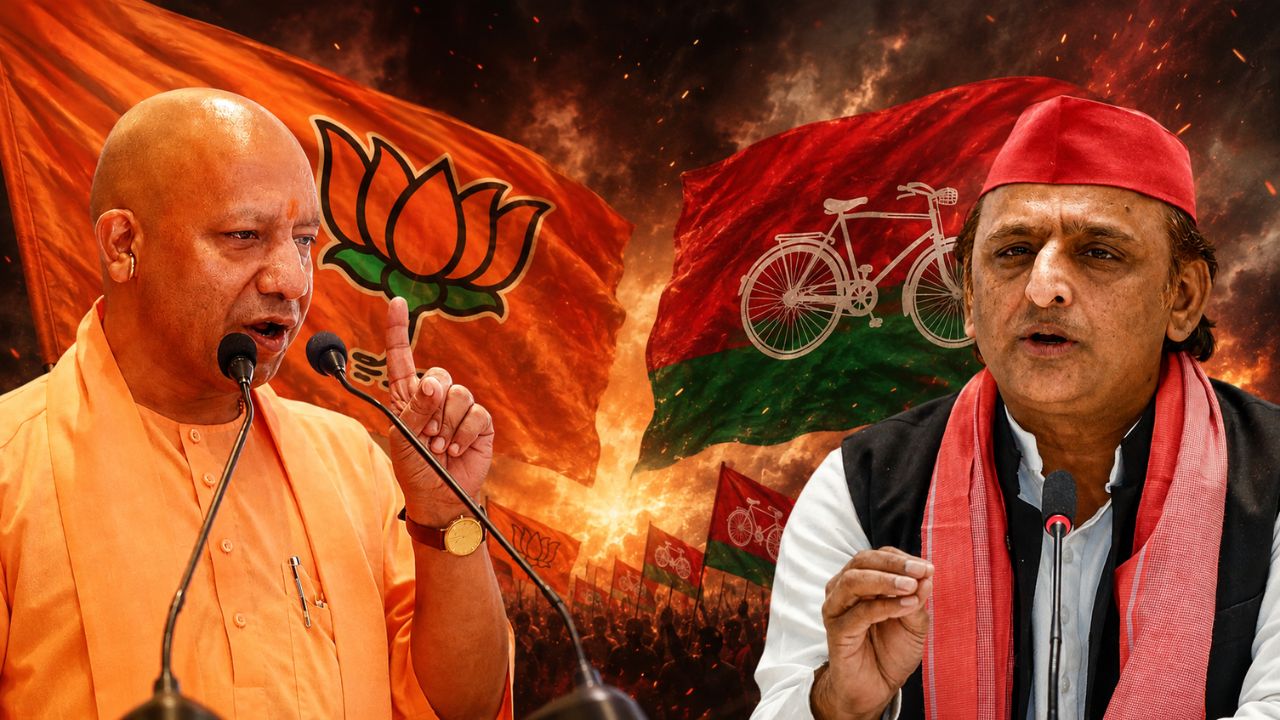
Samajwadi Party's campaign was at its peak in the 2022 elections. Many coalition partners were involved. Many new equations were formed from Western UP to Purvanchal and this also affected the vote percentage of SP. Despite this, SP remained away from power and its alliance partners kept moving away. Now Samajwadi Party is preparing to contest elections with the help of National Party Congress instead of smaller allies and this time new equations are being created. SP has also started giving special emphasis on those seats which were won and lost by small margins. Last time there were 55 seats on which the difference between victory and defeat was less than Rs 5,000. This is the reason why SP is paying more attention to winning such seats.
In 2022, SP's alliance was with Jayant Choudhary's Rashtriya Lok Dal (RLD), Krishna Patel's Apna Dal (Kameravadi), Pragatisheel Samajwadi Party (Lohia), Kesh Maurya's Mahan Dal and Om Prakash Rajbhar's Suheldev Bharatiya Samaj Party (SBSP). Along with BJP, there were Apna Dal (Sonelal) and Nishad Party. Then Congress and Bahujan Samaj Party (BSP) contested the elections separately.
Which party got how many seats?
There are a total of 403 assembly seats in Uttar Pradesh. For majority, victory on 202 seats is necessary. The main fight was between BJP and Samajwadi Party. There were some other parties along with both the parties. Apart from these two parties, Bahujan Samaj Party, Congress, AIMIM and Azad Samaj Party (Kanshi Ram) also contested the elections fiercely.
Also read: Fight between SP-RLD, which move did Congress make to woo the farmers?
BSP had fielded its candidates on all 403 seats, Congress on 399 seats and BJP on 376 seats. Samajwadi Party had fielded candidates on 347 seats, AIMIM on 95, RLD on 33, Apna Dal (Sone Lal) on 17 and Azad Samaj Party (Kanshi Ram) on 110 seats. Out of these, BJP had won 255 seats and SP had won 111 seats. Congress had won only 2 seats, BSP 1, Apna Dal (Sonelal) 12, RLD 8, Nishad Party 6 and On Prakash Rajbhar's SBSP had won 6 seats.
SP lags behind in tight competition
The biggest victory in the 2022 elections was achieved by BJP's Sunil Kumar Sharma. On Sahibabad seat, Sunil Kumar Sharma defeated SP's Amarpal Sharma by 2,14,835 votes. Noida, Dadri, Meerut Cantt, Agra North, Mehroni, Mathura, Lalitpur, Ghaziabad, Gorakhpur Urban and Hathras were the seats where BJP defeated SP or its allies by a margin of at least one lakh votes. However, we are talking about those seats where the game was changed by a difference of a few hundred or thousand votes.
Seats with difference less than 1000: There were a total of 15 seats on which the margin of victory and defeat was less than Rs 1000. In Dhampur Assembly, BJP's Ashok Kumar Rana defeated SP's Naseem Ul Hasan by a margin of just 203 votes. Out of these 15, Samajwadi Party won 6 seats and BJP won 8 seats. Ramesh Singh of Nishad Party had won one seat. That means BJP's alliance got 9 seats and SP got 6 seats.
Difference of 1000 to 2000 votes: There were a total of 14 seats on which the difference between victory and defeat was between 1000 to 2000 votes. Of these, 7 seats were won by BJP, 4 seats by SP, 2 seats by Apna Dal (Sonelal) and one seat was won by Virendra Chaudhary of Congress. Here BJP alliance got 9 seats and SP got only 4 seats. One seat went to the Congress party apart from both the alliances.
Also read: 7 Maharathis, Mission One, will Samajwadi Party be able to win over the Brahmins? understand the strategy
Difference of 2000 to 3000 votes: There were total 8 such seats. Of these, Samajwadi Party had won on 5 seats and BJP had won on 3 seats.
Difference of 3000 to 4000 votes: The total number of seats with a difference of 3 to 4 votes was 7. Out of these, SP won 4 seats, BJP won two and Apna Dal (S) won one seat. That means BJP alliance got 3 seats and SP got 4 seats.
Difference of 4000 to 5000 votes: There were a total of 9 such seats on which the difference between victory and defeat was only 4 to 5 thousand votes. Out of these, 7 seats went to BJP's account and SP could win only 2 seats.
Now if we look at the calculations of these 55 seats, BJP and its allies got a total of 33 seats. Samajwadi Party won on 19 seats and Congress Party won on one seat. This shows that BJP kept itself in a strong position by winning seats with small margins. At the same time, if SP had lost on these 19 seats, its situation could have become worse. This is the reason why both sides have given special emphasis on these seats this time. There is talk that tickets of such leaders from both sides who were barely able to win may be cut.
There will be exciting competition on how many seats?
If we expand the scope of this data a little further, it becomes clear that apart from 53 seats where the difference is less than Rs 5000, there are 71 seats on which the difference of victory or defeat is between 5 to 10 thousand. There are 46 seats on which the difference between victory and defeat is between 10 to 15 thousand votes. Thus, there are a total of 170 seats whose results were decided by a very small margin.
Also read: Samajwadi Party will take out 'Vijay Rath' from the same place where Akhilesh's cycle got stuck in 2022
Now if we look at it party wise, BJP won 86 out of 170 seats. SP won 64 such seats. At the same time, the parties that were allies of BJP won 10 seats while the parties that were with SP won 8 seats. These figures show that the ruling coalition won about 100 seats by a very small margin. If the opposition had won these seats, the government could have changed.