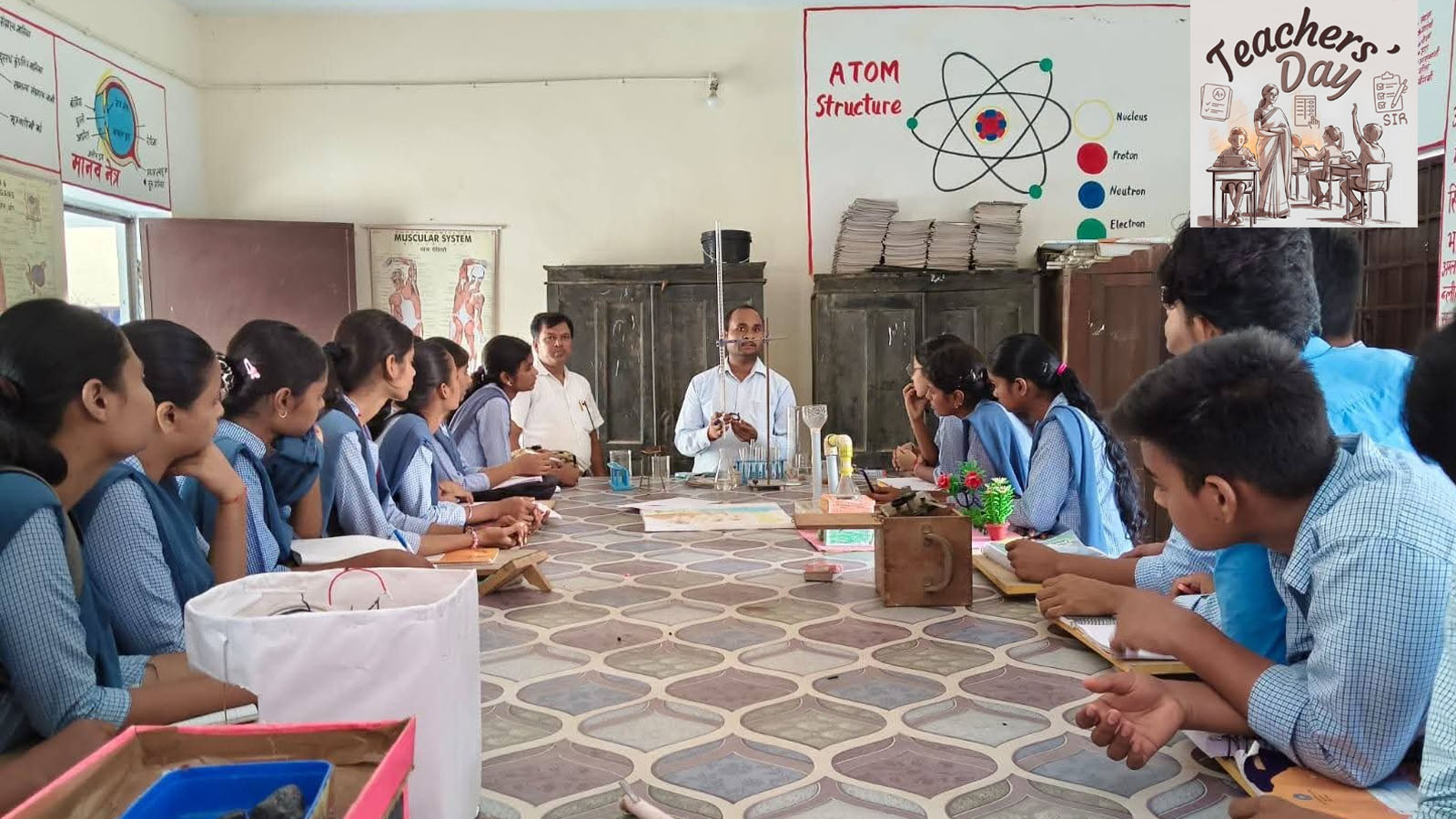
Teachers are among the education system’s biggest stakeholders, yet often have the least say in how it works. The Federal‘s Teachers’ Day series takes a hard look at the daily struggle of today’s teaching staff. The first of the series examined how teachers in Rajasthan are caught between poor infrastructure, low pay and increased work pressure.
The second part looks at how Bihar’s teachers are losing classroom time to non-teaching work, and what this means for students.
For teachers in Bihar’s government schools, the pressure is no longer confined to the blackboard, attendance register, exam papers and report cards. They are expected to complete the syllabus, improve students’ performance, cope with shortages of subject teachers and basic facilities, manage government schemes and respond to increasingly demanding parents — often without the support or resources needed to do any of it well.
The result is a workforce that feels increasingly stretched, anxious and ignored.
“The biggest problem is that there are not enough subject-wise teachers,” Sridhar Singh, 59, a teacher at Middle School Babhana in Jehanabad district, told The Federal. Having taught since the mid-1990s, Singh says the shortage is particularly acute in middle schools, where subjects such as Hindi, Sanskrit, English, social science and mathematics often do not have adequate teachers.
Feeling the pinch
The consequence is felt directly in the classroom. When there are vacancies or shortages, teachers have to manage multiple subjects and struggle to complete the syllabus on time. And when a teacher is absent or deployed elsewhere, there may be nobody available to take the class.
Jehanabad teacher Singh says teachers are being held responsible for students’ results even when the system does not provide them with the conditions necessary to deliver those results. This mismatch between accountability and support is a recurring concern among teachers. Posted at Middle School Babhana in Jehanabad, around 50 km from Patna, he blamed district and block officials for assigning such tasks. “A BDO even uses a school teacher as his driver and sometimes as an assistant for personal work,” he said.
Read Part 1 | CJP put Rajasthan students’ plight in the spotlight; ‘We Too’, say teachers
Manoj Kumar, a primary school teacher and leader of the Bihar Rajya Prathmik Shikshak Sangh (PSS, Bihar), says government schools continue to struggle with basic facilities. Computers, laboratories, libraries and sports grounds are often absent. There are also shortages of benches, fans, drinking water and toilets. Many schools do not have peons or clerks, leaving teachers to handle administrative work in addition to teaching.
Poor upkeep
Even where facilities exist, their upkeep can be a problem. The absence of toilets is particularly difficult for women teachers. Preeti Kumari, who teaches at a primary school without a toilet, says female teachers are forced to depend on nearby houses during the school day. “We drink less water and are forced to visit a nearby house to use the toilet,” she told The Federal.
Government data cited by teachers shows that 2,996 schools in Bihar, including 2,276 primary, middle and higher secondary schools, are functioning without their own building and toilets. Teachers’ organisations say the problem is wider, with schools that have buildings but no usable toilet facilities.
The deficiencies extend to the students themselves. Teachers say that despite the academic session beginning in April, many students had not received textbooks even by the end of August. Educational material such as notebooks and pencils was also yet to reach students in many schools.
Strained relations
For teachers, this creates another uncomfortable contradiction: they are expected to improve learning outcomes while working in schools where the basic requirements for learning are not always available.
The pressure is also changing the relationship between teachers and students and parents. Ramesh Kumar, a senior teacher at a high school in Jehanabad, says attendance is a growing concern, particularly in the higher classes.
Also read | Tutor, clerk, peon, cook, surveyor: Unseen travails of Indian teachers
Many students leave school after the lunch break and do not return, he told The Federalbecause they attend private coaching classes. Teachers’ efforts to persuade parents to ensure regular attendance often receive little support. “In the afternoon, only a few students turn up in class,” he rued. Parents often ignore teachers’ advice, he added.
Lacking a meaningful voice
Teachers are consequently caught between expectations from the education department, students and parents. They are expected to produce better results, keep students in school and implement government programmes, but say there is little recognition of the constraints under which they work.
There is also little sense among teachers that they have a meaningful voice in decisions affecting their profession and schools.
The workforce itself is divided into different categories — older permanent teachers, contractual teachers recruited after 2005 and newer recruits appointed through the Bihar Public Service Commission. While their service conditions and salaries differ, teachers across categories face many of the same problems inside schools.
Also read | Bihar protests: Is Gardanibagh becoming the next Jantar Mantar?
Contractual teachers have an additional grievance. Janardhan Rai, a contractual teacher in Vaishali district, says they are expected to perform the same teaching and non-teaching responsibilities as permanent teachers but continue to demand equal pay for equal work.
Pay, but other concerns too
Ahead of Teachers’ Day on September 5, teachers have launched an online campaign demanding implementation of 7th Pay Commission benefits and an end to salary disparities.
But teachers say their concerns go beyond pay.
They want schools to have enough subject teachers and basic infrastructure. They want administrative and support staff so that teachers can concentrate on teaching. They want better working conditions and meaningful professional support. And they want the government to recognise that improving education cannot simply mean imposing greater accountability on teachers.
One area where that tension is most visible is the growing burden of non-teaching duties. Teachers are routinely assigned work for elections, census operations, voter-list revision, surveys and government campaigns. Some have been deployed as Booth Level Officers, requiring them to undertake door-to-door work and regular online updating.
Ziaullah Khan, 55, a teacher at Middle School Ranipur in Patna district, is one such teacher. He told The Federal that the work as a BLO continues alongside his regular teaching responsibilities. “I have to work as BLO on a daily basis, updating online. There is work always. How can we focus on teaching?” he asked.
Food for concern
Teachers’ organisations say they have also been asked in the past to undertake tasks such as selling gunny bags used for the Mid-Day Meal (MDM) scheme, persuading people to stop open defecation and helping enforce prohibition. Some of these directives were opposed by teachers and subsequently withdrawn.
Also read | Teachers’ Day: 10 Indian films that celebrate the power of educators
The MDM scheme itself remains a major source of anxiety for headmasters. Grijesh Kumar, headmaster of a government primary-cum-middle school in Kinjar, Arwal district, says monitoring the scheme consumes a substantial part of his working day. He has to keep track of beneficiaries, food supplies, quantities, preparation and serving.
The concern is not only the time taken away from teaching but the accountability attached to these responsibilities. If a child falls ill after consuming a meal, the headmaster can face questions over the quality of food and monitoring.
“MDM has been wasting half the working time of a headmaster. It is stressful work. We always live in fear that anything can happen that may create trouble and lead to action against us,” he told The Federal. “Just last month, the government took action against teachers after some students reportedly fell ill after consuming mid-day meals in Nalanda and Arwal districts.”
Work beyond classrooms
A senior education department official acknowledges that the repeated deployment of teachers for non-academic work has affected schools in recent years.
Teachers in Bihar were involved in the caste survey in 2023, the 2024 Lok Sabha elections, the 2025 Bihar Assembly elections, the Special Intensive Revision exercise, BPSC examinations and census-related work. The official says thousands of schools have been affected when teachers are deployed outside their schools.
Also read | Once passionate teachers, NCLP staff turn daily wagers as Centre shuts project
The impact, the official added, is particularly visible among students in Classes 9 and 10, with some turning increasingly to private coaching to complete their syllabus.
For teachers, the issue is therefore not simply about being asked to perform duties outside the classroom. It is about a system that continues to add responsibilities while leaving unresolved the problems inside the classroom itself.
Back to basics
Singh, who is nearing retirement, believes the solution is to make teachers accountable for what they were recruited to do — teaching. Teachers want to be judged on the quality of education they provide. But for that, they say, the government must first give them the teachers, infrastructure, support staff, training and working conditions needed to provide it.
Otherwise, the demand for better results risks becoming another burden placed on a profession that already feels it is carrying too much.
Coming soon: Are teachers ready for Gen Z and Gen Alpha’s pushback?