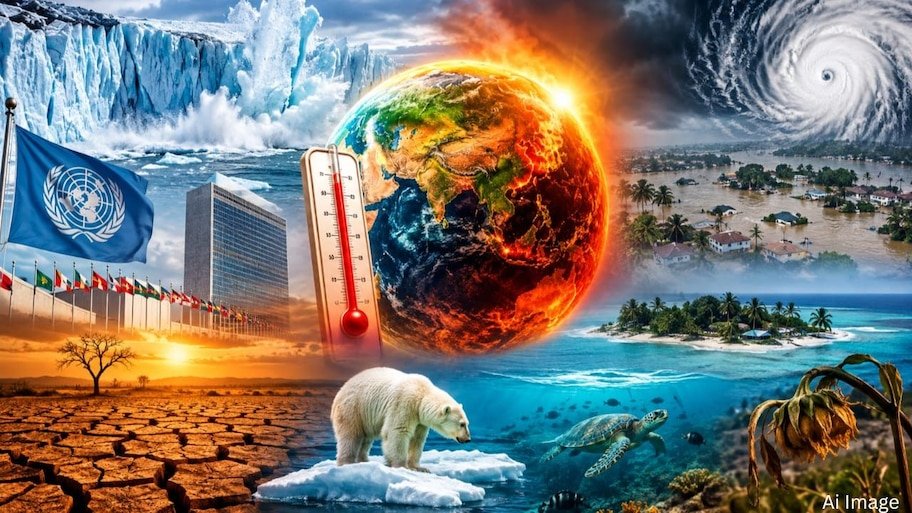
The United Nations has issued the most serious, shocking and frightening warning ever regarding global climate change and the ever-warming earth. The new scientific report 'Limiting Overshoot' released by the United Nations Environment Program (UNEP) has made it clear that the world is now going to cross that dangerous threshold, to avoid which many international treaties were being made for the last decade. According to the report, exceeding the limit of 1.5 degrees Celsius increase in global average temperature compared to pre-industrial levels is now almost 'unavoidable'. UN scientists say that even if all countries faithfully implement their existing carbon reduction commitments and 'net-zero' targets, in an optimistic scenario global temperatures could reach an average peak of 1.8 degrees Celsius by the middle of this century. Mirey Atallah, head of UNEP's Adaptation and Resilience Wing and coordinator of the report, has clearly said that now the world's policy-makers will have to change their mindset – the challenge now is not how we stay below 1.5 degrees, but how we bring it back down in the minimum time after crossing this limit. This warning shows that the climate crisis is no longer a future threat, but a present reality standing at our doorstep. Droughts, heatwaves and catastrophic floods: Unexpected and violent changes in the weather cycle. Even a mere decimal degree increase in global temperature is enough to cause catastrophic upheavals in the Earth's ecosystem and atmospheric balance. According to the basic law of physics, for every 1 degree Celsius increase in the temperature of the atmosphere, its moisture absorbing capacity increases by about 7 percent. The direct and fatal result of this is that the clouds are becoming unusually heavy, due to which the incidents of cloud bursts, extremely intense rainfall and sudden flash floods are increasing across the world. While the entire month's worth of water rains within a few hours, on the other hand, the problem of drought is deepening due to rapid evaporation of moisture from the ground. The UN report warns that if temperatures remain above 1.5 degrees, the frequency of deadly heatwaves will increase 4 to 5 times. Vast areas of the Middle East, North Africa and the Mediterranean region will be hit by severe water shortages, where drinking water sources could dry up completely. With this, uncontrolled wildfires will become more destructive than ever, which will not only turn billions of dollars worth of property and biodiversity into ashes, but will also create huge amounts of smoke and carbon dioxide in the atmosphere, making breathing difficult. Climate tipping points and irreversible damage: will the Earth be forever changed? The most frightening aspect of this new warning of the United Nations is the activation of 'Climate Tipping Points'. Tipping point is the situation after which the damage caused to nature becomes 'irreversible', that is, even if the temperature decreases again, that damage can never be compensated. Collapse of the Amazon Rainforest: The Amazon's dense forests, known as the lungs of the Earth, could dry out and turn into grasslands (savannas) due to extreme drought and temperatures, making them sources of carbon emissions rather than carbon sinks. Melting of Permafrost: In the icy regions of the Arctic and Siberia, the ice (Permafrost) that has been frozen underground for thousands of years is melting rapidly. Due to its melting, trillions of tons of methane gas buried in it will be released into the atmosphere, which is 28 times more dangerous greenhouse gas than carbon dioxide. Sea levels and sinking of islands: Destabilization of the giant ice sheets of Antarctica and Greenland could raise sea levels by several meters. The UN has clearly warned that many small island countries (SIDS) and dozens of major coastal metropolises of the world could be completely engulfed by the ocean waves, forcing millions of people to become homeless and become 'climate refugees'. Destruction of Coral Reefs: Due to rising ocean temperatures and acidification, 90 to 99 percent of the world's coral reefs will be completely destroyed, due to which the marine food chain will completely collapse. What will be the impact on India and South Asia? Double blow to Himalayan glaciers and monsoon India and the entire South Asian subcontinent are counted among the most sensitive and vulnerable areas of the world in terms of climate change. Breaking the 1.5 degree limit will have a direct impact on India's food security, agricultural economy and demography: Crisis of Himalayan glaciers: The glaciers in the Himalayas, which are called the 'Third Pole' of the Earth, are melting at record speed. This will initially lead to catastrophic floods and Glacial Lake Outburst (GLOF) disasters in perennial rivers like Ganga, Yamuna, Brahmaputra and Indus. After a few decades, when these glaciers will shrink, the flow of water in these rivers will be dangerously reduced, causing a famine of drinking water and irrigation for more than 50 crore people of North India. Irregular monsoon and crop failure: More than 60 percent of India's agriculture is dependent on monsoon rains. Temperature increases will cause monsoon patterns to become extremely erratic—prolonged droughts followed by devastating torrential rains within a matter of days. Due to this, the production of wheat, paddy and pulses may decline by 15 to 25 percent, which will deepen the risk of food inflation and starvation in the country. 'Wet-bulb' temperature and deadly heat: In the plains and coastal areas of India, such a deadly combination of temperature and excessive humidity (Wet-Bulb Temperature) can be formed, where the sweat of the human body will stop drying and it will become impossible to work outside in the open. This will directly affect the livelihood of crores of workers in construction, agriculture and unorganized sector. Coastal cities at risk of submergence: India's densely populated economic centers like Mumbai, Kolkata, Chennai, Kochi and Surat, with its 7,500 km long coastline, will face an existential threat from rising sea levels and frequent severe cyclones. 'Every decimal degree now counts': fossil fuel transition and intense pressure on COP conferences The United Nations Environment Program has warned the world that although 1.5 degrees of warming looks certain to be exceeded, this does not mean that the world should sit on its hands. The report emphasizes that the smaller the 'overshoot' and the shorter the duration, the greater the chances of saving the planet. Stopping warming at 1.6 degrees is many times better than letting it go to 1.8 or 2.0 degrees, because every additional 0.1 degree increase in temperature decides the loss of millions of lives and trillions of dollars. To deal with this crisis, the UN has called for the immediate implementation of three basic steps: Rapid phase-out of fossil fuels: immediately ending subsidies on coal, crude oil and natural gas and rapidly moving towards solar, wind and green energy. Immediate curbs on methane emissions: Strict restrictions on methane emissions from oil wells, gas pipelines and agricultural wastes are the most effective way to rapidly reduce temperatures in the short term. Afforestation and carbon capture technologies: End deforestation and make huge global investments in technologies that capture carbon directly from the atmosphere (Carbon Dioxide Removal). This new report is going to be the biggest focal point on the agenda of the United Nations General Assembly (UNGA) and the upcoming global climate conferences (COP). Developed countries, historically responsible for the most global pollution, have come under intense moral and legal pressure to transfer 'climate finance' and technology to poor and developing countries. If the big industrialized countries of the world do not unite leaving aside their ego and economic interests, then in the coming decades this gunpowder revenge of nature will raise questions on the very existence of human civilization.