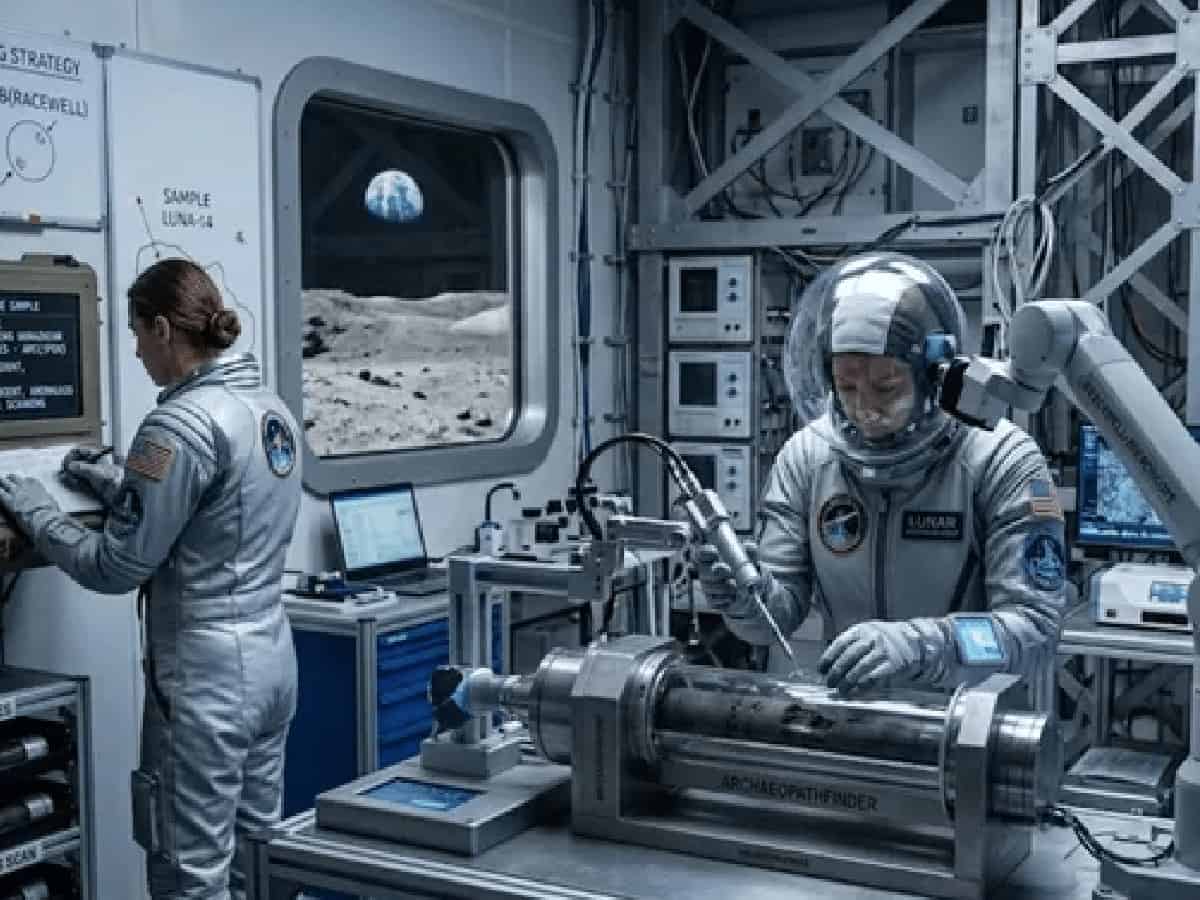
The quest to answer one of humanity’s most profound questions—are we alone in the universe?—is expanding beyond traditional radio signal monitoring and into the lunar dust beneath our feet. A groundbreaking new study conducted by researchers associated with the SETI (Search for Extraterrestrial Intelligence) Institute suggests that the answers to advanced extraterrestrial life might be hidden in microscopic particles floating through space and accumulating on the Moon over billions of years.
Modeling Interstellar Debris and ‘Arkhipov Particles’
Led by Louis Pinault, an affiliate scientist at the SETI Institute and a researcher at Birkbeck College, University of London, the study has been submitted for peer review to the International Journal of Astrobiology. The research team modeled how the decaying infrastructure of an immensely advanced alien civilization could break down into minute fragments over vast spans of time, becoming dispersed throughout interstellar space. These durable particles could potentially traverse star systems, enter our solar system, and quietly settle onto the undisturbed surface of Earth’s natural satellite.
Expanding on historical theories—such as suggestions by Ukrainian researcher Alexey V. Arkhipov in the 1990s that the Moon serves as an ideal preservation vault for space artifacts—the team categorized these hypothetical microscopic relics. Micron-sized pieces of technological debris have been termed “Arkhipov particles,” while tiny autonomous surveillance machines engineered by extraterrestrial intelligence are designated as “Bracewell particles,” honoring physicist Ronald Bracewell.
Future Lunar Missions and the Challenge of Filtering Earthly Contamination
Unlocking this cosmic mystery will require immense technological precision. According to the study’s framework, future lunar exploration missions could analyze approximately one cubic meter of lunar soil in meticulous detail, utilizing advanced instruments capable of isolating artificial compounds from natural minerals. However, scientists acknowledge that the challenge is monumental. Because the Moon already bears the footprint of human space exploration—littered with discarded spacecraft fragments and terrestrial debris from Earth—researchers would face the rigorous task of proving that any discovered technosignatures are genuinely extraterrestrial. This would demand advanced chemical and physical fingerprinting to rule out terrestrial origins. While the statistical probability of such a historic discovery remains exceptionally low at present, scientists emphasize that confirming even a single credible trace of alien technology in lunar soil would forever alter the course of human history.