Automotive maintenance can be scary, given that your vehicle is one of the biggest purchases you’ll ever make. DIY repair requires knowledge, tools, and a little bravery. Allowing a professional to perform the work, whether that’s at the dealership where you bought your car, a quick lube franchisee, or an independent shop, means finding a place you can trust and hopefully depend on for years to come. Regardless of which route you choose to take, one of the more common maintenance items that’s overlooked is spark plug replacement.
Spark plugs provide one of the main things every engine needs to function properly, those being compression, fuel, air, and spark. While there are different types, spark plugs all perform the same basic function — providing the sparks that ignite a mixture of air and fuel in your engine’s cylinders, forcing pistons down and creating vehicle power in the process.
Knowing when it’s time to replace your spark plugs is important to the performance and continued operation of your vehicle. Fortunately, your car has a number of ways to let you know something isn’t quite right under the hood. You’ve just got to know the signs. And that’s what this list is for: We’ve referenced trusted automotive sites and leaned on my own years of experience as a lube tech, lead mechanic, and parts salesperson to come up with five of the biggest warning signs that it’s time to replace your car’s spark plugs.
Manufacturer Scheduled Service Intervals
This one feels like a given, but you’d be surprised how many spark plugs I’ve inspected that look like they have never seen the light of day since their installation. Whether or not you’re experiencing any of the other issues on this list, the manufacturer sets its service intervals based on extensive testing, and those intervals should be adhered to. It’s not just “big spark plug” trying to sell you new plugs, or making a part designed to fail. Plugs naturally wear out over time because they see a lot of action — after all, they’re located in a chamber that produces multiple explosions every minute.
New spark plugs are often suggested by the manufacturer around 60,000 miles. This interval is different based on different car makers, with some extending to as many as 100,000 miles. A quick Google search or peek into the appropriate section of your owner’s manual will give you a more precise number.
Spark plug replacement is often pretty easy. My youngest sister taught herself how to replace the plugs and ignition coils in her first car after multiple failures and hundreds of dollars spent at a mechanic. However, there are some tricky plug jobs, too; the Chevy Colorado requires the removal of the entire upper manifold just to access the spark plugs. Just do a bit of research, don’t bite off more than you can chew, and find a pro if you need to.
Check Engine Light
There are few worse feelings for a motorist than starting your vehicle only to see the Check Engine light illuminated when you start your car. A trip to the parts shop for a code scan or a full diagnostic from your local mechanic will provide some insight as to why that light kicked on, with diagnostic codes being triggered for any number of your vehicle’s systems, including emissions, transmission, or brakes. We should pause here to mention that if the Check Engine light is flashing rather than steady, a severe issue has been detected and your best bet is to pull over and get a tow to a service station before serious damage occurs.
Codes that can be related to spark plug issues are generally in the P0300 range. P0300 itself indicates a “random or multiple misfire detected”, while P0301 through P0312 indicate individual cylinders where a misfire has been detected. P0301 indicates a cylinder one misfire, and P0312 indicates cylinder 12 — something you shouldn’t have to worry about unless you’ve got a V12 engine under your hood.
Spark plug wear or damage is one of the most common causes of a misfire, but other reasons include a distributor cap problem, low fuel pressure, or a bad sensor. And while ignition coils don’t need to be changed with every spark plug job, a bad one can also be the culprit. An easy way to check that is to swap coils, and if your p0302 becomes a P0304, replacement is a good idea.
Rough Idle
If you’ve experienced this symptom of failed or fouled plugs once, you’ll have a feel for exactly what we’re trying to describe. You’re stopped at a light and your vehicle that was just driving along smoothly gets in a huff, producing a knock, metallic rattle, or a vibration or “chugging” while at idle. These can all be indicators of plugs or wires that are in need of replacement. Misfires or timing issues caused by bad spark plugs can cause fuel in the car’s cylinders to improperly burn, and those small explosions inside your engine will feel much rougher when this happens.
Auto repair can be frustrating, especially for DIYers that don’t have access to the tools the pros do. Sure, you can pull a plug or look at wires for damage. But rough idle can have any number of other causes, from a stuck PCV valve to a vacuum leak. While a check engine light can point you in the right direction, often it’s patience and testing that will eventually reveal your problem. Well, that or you can be the guy constantly trying to return sensors and ignition coils at your local parts store. Fun fact: Most major parts retailers do not accept returns on those parts unless the package is sealed.
Decreased Fuel Mileage
Something the more eagle-eyed among us may notice when plugs are in need of replacement is a drop in fuel economy. If you’re noticing more frequent trips to 7-11, don’t just assume it’s the universe telling you to treat yourself to a Slurpee. If your spark plugs need to be replaced, they can provide a less efficient spark, leading to wasted fuel and worsening gas mileage. It’s not the only possible reason — other parts that can drop your MPG include a dirty air filter or tire issues.
Fortunately, many modern vehicles have trip computers that tell you your current remaining fuel mileage, and if you see that showing a lower number than you’re used to, it’s worth considering plugs as a culprit. That’s especially true if you haven’t replaced them in a while. Another simple experiment you can do is to manually track your fuel consumption using your trip meter as you run through fuel. Additionally, every vehicle has an EPA estimate for city and highway driving — just look up your year, make, and model and compare.
If you notice a drop of more than a couple miles of fuel efficiency, it might be worth swapping out your plugs. And really, even if you only end up gaining three or four miles per gallon with those new spark plugs, that’s a pretty decent savings considering the price of gas these days.
Visual Inspection
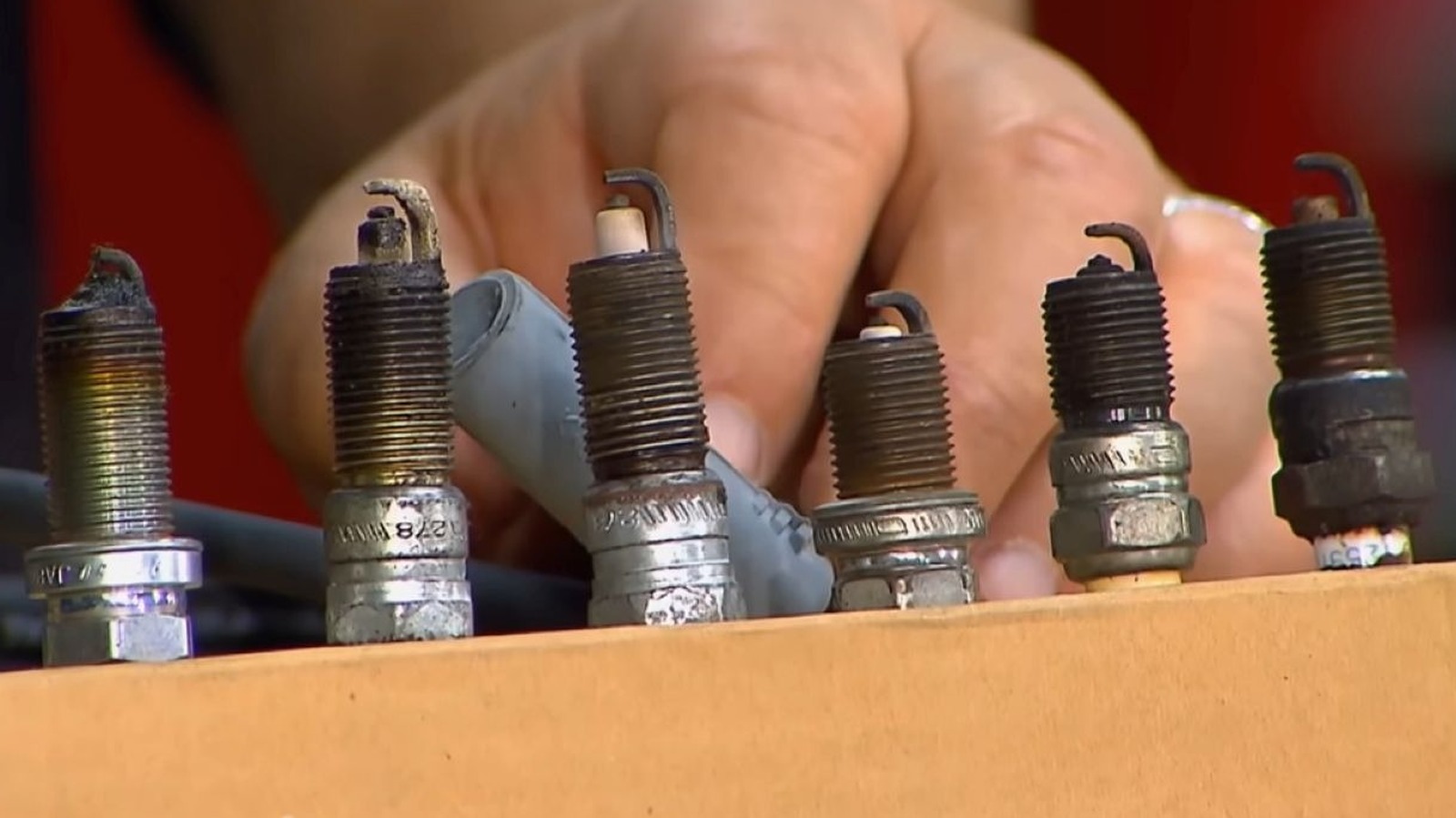
As long as you’re comfortable removing them, your spark plugs can offer up a host of information if you know what you’re looking for. In most cases the job isn’t terribly difficult and the list of tools you’ll need is short. A visual inspection can reveal reasons for a misfire or other spark plug issue, and even if you were planning on replacing the plugs based on the manufacturer’s service intervals it’s worth taking a look at your old plugs.
Carbon fouling can be caused by excessive idling, poor air filtration, or an air/fuel mixture that leans rich. Worn or corroded plugs indicate a part past its prime. A broken or damaged electrode can indicate that the wrong plug was installed previously, while a spark plug with chipped or cracked ceramic insulation can affect the flow of electricity. And oil on a spark plug indicates a leak into the cylinder, which could mean anything from a worn piston ring or a leaking valve cover gasket to overfilled engine oil. Knowing the reason you need to replace your plugs, and fixing that cause along with the symptom, will lead to a more complete repair.
Methodology
Warning signs were highlighted based on the opinions of respected auto publications and websites along with plug manufacturers. I compared those lists with my own experiences as a professional technician and parts salesperson, and came up with five signs that I thought are easy for anyone from a seasoned mechanic to a full automotive newbie to detect.