The newly released Program for International Student Assessment (PISA) 2025, conducted by the Organization for Economic Cooperation and Development (OECD), shows students in China’s Beijing-Shanghai-Jiangsu-Zhejiang (B-S-J-Z) group and Singapore outperforming their peers globally.
The 2025 ranking was the largest assessment to date. It evaluated 760,000 15-year-old students across 91 countries and economies in science, reading, mathematics, and computational problem-solving.
The PISA results showed B-S-J-Z students scored an average of 612 points in mathematics, the highest among all participating education systems.
Singapore followed with 563 points, while the OECD average sat at just 463 points. Macau, Taiwan, Japan, South Korea, and Hong Kong closely trailed the top two.
B-S-J-Z students also topped the global science ranking with an average score of 597 points.
Singapore again ranked second with 560 points, followed by Macau, Taiwan, Japan, Estonia, and South Korea. These results underline the consistently strong performance of East Asian education systems across core academic subjects.
The OECD noted that most participating Chinese jurisdictions, along with Estonia, Japan, South Korea, Singapore, and the U.K., ranked among the top 10 education systems in all three PISA domains: science, mathematics, and reading. Singapore took the top spot for reading.
In science, the gap between the leading systems and the OECD average was particularly striking.
B-S-J-Z students scored 115 points above the OECD average, while Singaporean students were 78 points higher. The OECD stated that students in B-S-J-Z and Singapore demonstrated stronger abilities to engage with broader, more demanding scientific ideas, complex investigations, and diverse sources.
At these top levels, students are expected not only to interpret or select evidence but also to evaluate claims, identify errors, and describe flaws. The results also highlighted that the leading systems had relatively few students struggling with basic science proficiency.
Fewer than 15% of students performed below Level 2 in science in B-S-J-Z, Macao, Singapore, Estonia, Japan, Taiwan, and South Korea. Level 2 represents the baseline at which students begin using science to reason in familiar, real-world situations.
In computational problem-solving, students in Macao (China), Singapore, B-S-J-Z (China), and Japan achieved the highest scores (572, 563, 560, and 557 points, respectively).
Students in Hong Kong (China), Malaysia, Brunei, the Philippines, Macao (China), and Iceland performed over 30 points above expectations based on their science performance.
|
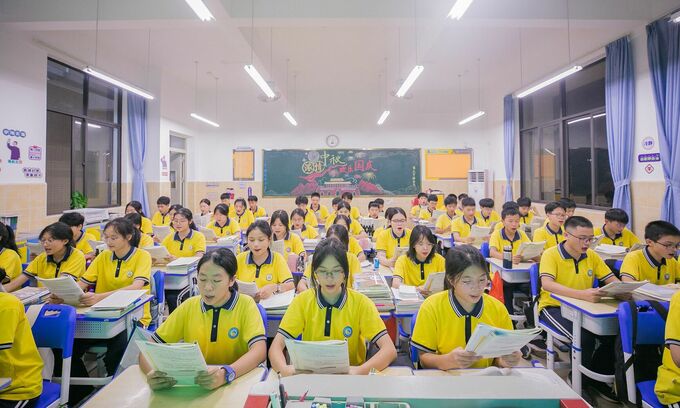
Students engage in a classroom activity in China, September 2023. Photo by Pexels |
Global declines and the future of learning
The strong performance from Asian education systems comes as overall results have deteriorated in many parts of the world. The OECD average mathematics score fell from 485 points in 2015 to 463 points in 2025, a significant decline of 22 points. Science performance declined more modestly, dropping from 489 to 482 points over the same period.
Between 2018 and 2025, reading performance fell in three quarters of the education systems with comparable data. Across the OECD, scores dropped by 25 points, which equates to more than a year of lost learning.
The biggest surprise was who fell furthest behind: it was not the most disadvantaged students, but rather those from wealthy families. This finding points to a much broader challenge than educational inequality alone.
Most troubling is the decline in the very skills that matter most in the AI age: evaluating information, making connections across multiple sources, and thinking critically about what we read. Consequently, the share of “hasty readers”– students who rush through texts and give quick but incorrect answers – almost doubled between 2018 and 2025.
“In a world increasingly flooded with information, our students are less likely to think deeply and separate signal from noise,” the OECD said in its statement.
“PISA 2025 shows that reversing declines in student performance is urgent. The most successful education systems focus on fewer areas in greater depth, invest in teachers, engage parents and provide targeted support for the students and schools that need it the most,” said OECD Secretary-General Mathias Cormann.
“Technology and AI can strengthen learning and help prepare young people for the future, but only when used purposefully and not as a substitute for attention, effort and understanding.”
The 2025 results show that educational success is no longer strictly tied to a country’s wealth or spending levels. Countries with fewer resources, such as Cambodia, are making notable progress.
Effective policies and smart financial decisions appear to matter far more than overall spending per student. Luxembourg, for example, spends significantly more per student than Ireland, France, and Italy, yet records lower average science scores.