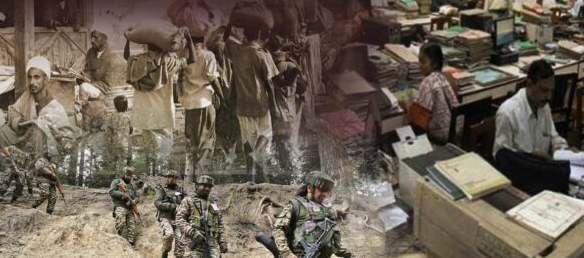
For a displaced family in Kashmir, returning to the valley is not just a return home, but an attempt to reclaim the life that terrorism and violence took away decades ago. Under this thinking, the government tried to pave the way for the return of Kashmiri migrants with the help of employment, house, financial help and security. But now the Kashmiri Pandit employees who were part of this rehabilitation process are facing the threat of alleged terrorist threats and leakage of personal information.
The threat letters that have appeared in the last few days have once again raised questions. What is the Prime Minister’s Rehabilitation Package, why were jobs given in it and why are efforts being made to target these employees only?
What is Prime Minister Rehabilitation Package?
The Central Government took several measures from time to time for the return and rehabilitation of displaced families from Kashmir. A comprehensive Prime Minister’s Package was announced during the visit of then Prime Minister Manmohan Singh to Kashmir in April 2008. Its objective was to help displaced Kashmiri migrants from the valley to return and resettle.
The package included provisions like repair and reconstruction of houses, transit accommodation, continuation of cash relief, scholarships for children, employment, self-employment, agri-horticulture assistance and interest waiver on old loans.
The employment part of the Prime Minister’s Rehabilitation Package was of special importance. In the 2008 plan, a target was set to provide employment opportunities to 15,000 unemployed migrant youth. Of these, there was a provision to accommodate 6,000 youth in state government jobs, while there was a plan to provide financial assistance to 9,000 youth for self-employment or business activities.
What else came in the package with the job?
Rehabilitation did not just mean providing jobs. The entire plan was based on the idea that if families have to be resettled back in the valley, then living arrangements will have to be made along with employment. Therefore, provision for transit accommodation was made. In 2015, the central government took forward the earlier employment provision and approved 3,000 additional state government jobs and transit housing in the valley. At that time, out of 3,000 jobs under the 2008 package, 1,963 had been provided and 469 transit housing had been built.
After this, construction of 6,000 transit houses was also approved under the Prime Minister’s Development Package of 2015. These houses were to be allotted to those Kashmiri migrants who had been given or were to be given state government jobs.
What was the real purpose of giving the job?
The objective of this scheme was not only to provide government jobs to unemployed youth. Employment was made a means of rehabilitation so that the youth of displaced families could return to the valley and establish their feet economically. That is, government jobs were seen as the economic foundation for comeback.
That is why calling the package merely an employment scheme would be incomplete. Jobs were linked with provisions like home repair, new housing, transit housing, children’s education and financial assistance, so that recovery was possible not just on paper but on the ground. The original 2008 package also provided for assistance of up to Rs 7.5 lakh per family for repair or reconstruction of damaged houses, Rs 2 lakh for dilapidated houses and, in some cases, Rs 7.5 lakh for purchasing or constructing a house.
Employees benefiting from this scheme have had to face threats. The murder of Revenue Department employee Rahul Bhat in 2022 and subsequent targeted killings including that of teacher Rajni Bala in 2026. Threat letters surfaced allegedly in the name of ‘United Liberation Council’ i.e. ULC.
In some media reports quoting Indian intelligence sources, ULC has been described as a front linked to the banned Lashkar-e-Taiba. However, due to the letters that have come to light, employees have written a letter to the Chief Secretary of Jammu and Kashmir demanding a review and increase in security at workplaces, residences and commuting routes. Why are employees being targeted?
Kashmiri Pandit employees working in the valley under the Prime Minister’s package have had to face terrorist violence and threats in the past also. The murder of revenue department employee Rahul Bhat in 2022 and subsequent targeted killings, including that of teacher Rajni Bala, had raised serious concerns about the safety of package employees. At that time a large number of employees had demanded to return to Jammu or be transferred to safer places.
Now in August 2026, threat letters surfaced allegedly in the name of ‘United Liberation Council’ i.e. ULC. In some media reports quoting Indian intelligence sources, ULC has been described as a front linked to the banned Lashkar-e-Taiba. However, the aspect of investigation by security agencies regarding the authenticity of the letters revealed is important and any alleged letter cannot be considered as a self-evident fact.
Was personal information of employees also leaked?
The most serious aspect of this development is the alleged private information becoming public. A threat letter that surfaced in August was reported to contain information like names, residential addresses and vehicle numbers of Kashmiri Pandit employees. According to another report, some of the letters also contained phone numbers and detailed information related to home and road.
For this reason, the employees wrote a letter to the Chief Secretary of Jammu and Kashmir demanding a review and increase in security at workplaces, residences and commuting routes. The employees’ union also clarified that the authenticity of the alleged poster was not verified by the police and security agencies at that time.
Did the letter call the employees ‘white-collar terrorists’?
According to media reports, in the alleged threat letters, employees working under the Prime Minister’s Package were addressed with words like ‘white-collar terrorist’ and ‘traitor’. It also came to light that they were threatened to leave the valley or face dire consequences.
In the alleged letters, the employees were accused of working at the behest of Delhi and implementing the agenda of RSS in Kashmir. These claims should be considered propaganda allegations by the threat actors and not established facts against the employees.
Are only the employees the target?
This question is also important because the alleged letters that came to light in August specifically targeted Kashmiri Pandit employees. In September, National Conference President Farooq Abdullah also raised the question that if other Hindu officials are working in the valley, then why only the employees associated with the Prime Minister’s package are receiving threats. He described it as a possible conspiracy, although this is his political assessment and its independent confirmation cannot be taken as fact.
Are employees being asked to leave the valley?
The purpose of the alleged threats is said to be to create psychological pressure on the employees and force them to leave the job or move away from the valley. Recent reports say that around 7,000 Kashmiri Pandits are under the security cover of PM Package employees.
This is the reason why employee organizations have been raising the demand for transfer to safer places or relocation in Jammu division for a long time. For them, the question is not just about the job, but also about going to work, returning home and keeping the family safe.
Are the employees the target of terror or the entire rehabilitation process?
This is the biggest question of this entire controversy. If an employee is intimidated because of his identity and his association with the rehabilitation scheme, the impact is not limited to that individual only. His message also reaches those families who may ever consider returning to the valley.
The success of the Prime Minister’s Rehabilitation Package cannot therefore be measured only by how many jobs were created or how many transit houses were built. The real test is whether the people who were given employment and accommodation to return are able to live a safe and stable life there. If the security confidence weakens then the entire exercise of employment and housing may also go away from its original objective.
What is the biggest challenge facing Kashmir Pandits now?
The basic idea of the Prime Minister’s Rehabilitation Package was to make the return of displaced families practical with the help of employment, housing and financial assistance. The effort, which began in 2008, expanded in subsequent years through additional jobs and transit housing. But the final condition for rehabilitation in Kashmir is not just government appointment but a safe environment.
The biggest question today is this – can jobs and housing bring back a displaced family if it is not assured of security? Employment can open the way to return, but security is necessary to step on that path. The alleged threats being received by Kashmiri Pandit employees are a reminder of the challenge that rehabilitation is not just a plan to bring people back to the valley, but is also a test of providing them a safe and dignified life there.