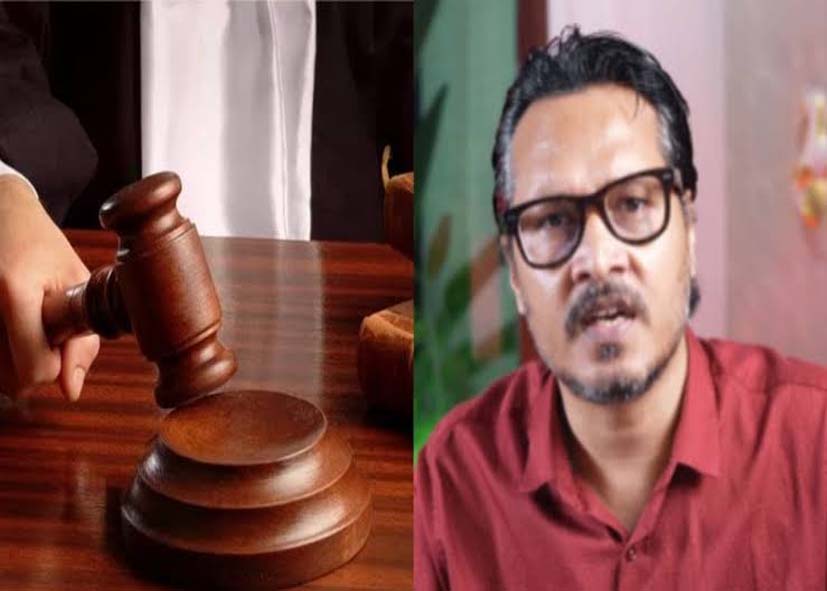
Delhi's Patiala House Court has refused to grant anticipatory bail to YouTuber Ajit Bharti. The court said that the kind of language used by Bharti in her video shows that she is promoting the caste system and the idea of caste-based superiority. Patiala House Court's Additional Sessions Judge Saurabh Pratap Singh Lalar, in his September 7 order, said the language used in the video promotes the idea of caste-based purity and the alleged superiority of upper castes over lower castes in matters of marriage and lineage. The court made this comment during the hearing of the case registered under the Scheduled Castes and Scheduled Tribes (Prevention of Atrocities) Act. The court rejected the anticipatory bail plea of Ajit Bharti in the same case.
According to the report of Bar & Bench, this case is related to the video of Ajit Bharti, in which he had commented about MP Chandrashekhar Azad. Chandrashekhar Azad comes from the Scheduled Caste community. Referring to Bharti's comments, Judge Saurabh Pratap Singh Lalar said there was a clear reference to caste in Azad being eligible to marry a girl from an upper caste and it was derogatory. The court questioned why a person who is eligible to marry anyone from the Scheduled Caste or Scheduled Tribe community should need to become separately eligible to marry a girl from a higher caste.
elements of humiliation were present
The Court prima facie found that the essential elements of the offense under Section 3(1)(r) of the SC/ST Act were present. Under this section, publicly insulting or insulting a person of SC/ST community or using caste-based derogatory words is considered a crime. On this basis, the court concluded that legal prohibition under Section 18 would apply, due to which anticipatory bail cannot be granted in such a case. This was the reason why the court rejected the anticipatory bail plea of Ajit Bharti.
There was no need for custodial interrogation
However, the court also said that if the case did not involve elements of an offense under the SC/ST Act, it could have considered granting relief to Bharti. According to the court, the incident prima facie appears to have happened out of the blue in response to some comment and there was no need for custodial interrogation of the accused.
Balkaram Buddhist had filed a complaint
The judge also made it clear in his order that the comments made were limited only to deciding on the anticipatory bail petition. These comments should not be construed as a finding by the Court as to Bharti's guilt or innocence, the veracity of the allegations, or the full context of the recording. An FIR was registered against Ajit Bharti on 23 August. He has been booked under SC/ST Act, Section 67 of the IT Act and Sections 196(1)(c) and 351(3) of the Indian Judicial Code (BNS). This complaint was lodged by Balkaram Boudh, Delhi State President of Azad Samaj Party (Kanshi Ram). The matter is related to the video of Bharti, in which she had commented about MP Chandrashekhar Azad.
What are the allegations in the complaint?
The complaint alleges that Ajit Bharti used caste-based and derogatory language in the video. According to the complainant, objectionable comments were also made in the video about Nagina MP Chandrashekhar Azad and Dr. BR Ambedkar. Apart from this, allegations of abusive language and threats against women have also been made. According to the FIR, Bharti was responding to a viewer's comment. The viewer had reportedly suggested that Bharti marry her sister to Chandrashekhar Azad, thereby calling for an end to caste-based reservations.
The complaint alleges that in response to this, Bharti made objectionable remarks mentioning caste and said that merely being from a particular caste or being an MP is not enough for marriage. He also reportedly said that Azad would have to first prove himself worthy to marry an upper caste woman.
Bharti's lawyer's argument
Advocate Jai Ananth Dehadrai, appearing for Ajit Bharti, argued that prima facie sections 3(1)(R) and 3(1)(S) of the SC/ST Act are not applicable in this case. He said that the complainant was neither present during the alleged incident nor was he personally insulted or threatened. The lawyer also argued that even a prima facie case of insulting a particular SC/ST person in public is not made out. He said that the things said in the video were in an imaginary context and were not said about any real or specific woman. Dehadrai told the court that the allegations could be properly investigated only after seeing the entire uncut recording and its context. He argued that no presumption could be made against Bharti at the stage before her arrest.
What did the court say?
After considering the matter, the court said that caste names were used in Bharti's comments. According to the court, these things were not said during any sudden dispute or quarrel, but the main basis of his reaction was the reference to caste. Based on this conclusion, the court held that prima facie elements of the offense under Section 3(1)(r) of the SC/ST Act are present against Bharti. Due to this the court rejected his anticipatory bail petition.
Follow the LALLURAM.COM MP channel on WhatsApp