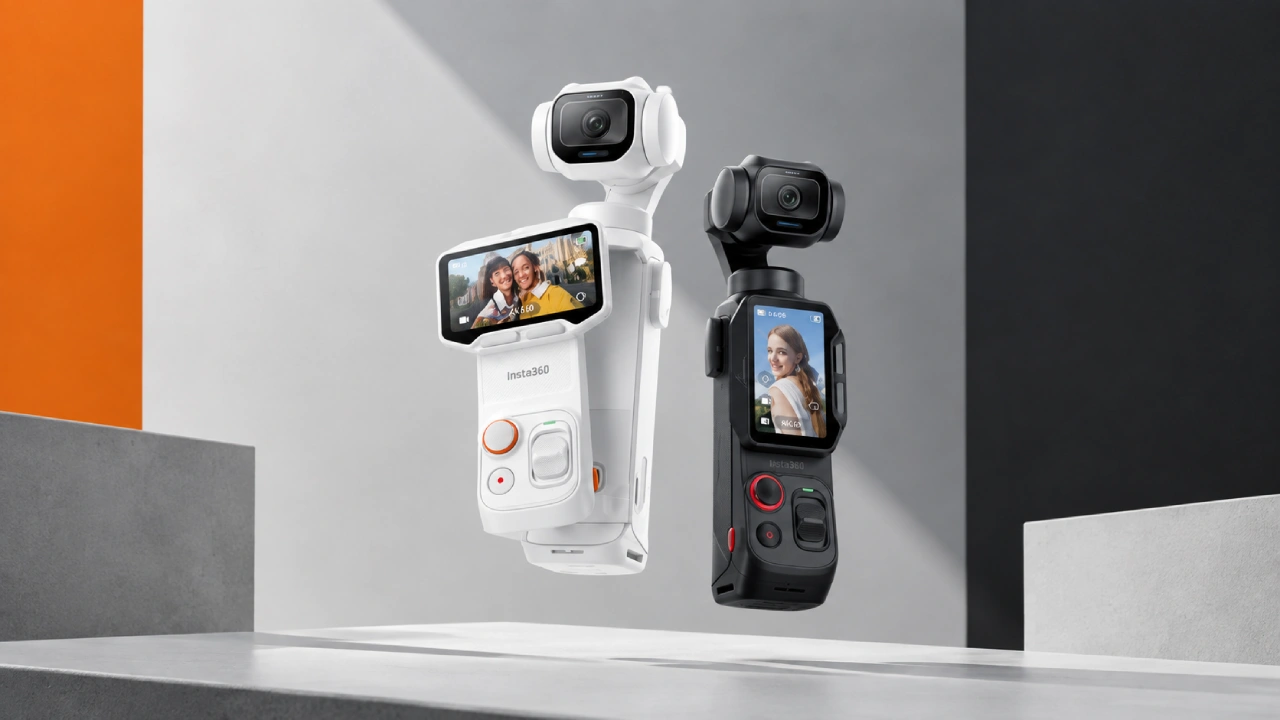
Insta360 has launched the Luna Pro globally as a more affordable single-lens alternative to its flagship Luna Ultra. Starting at $599.99, the new gimbal camera keeps several of the Ultra’s headline features, including a 1-inch 8K sensor, Leica Summicron optics, a detachable 2-inch OLED touchscreen, 10-bit I-Log recording, and AI-powered subject tracking.
However, the reduced cost does come at the cost of losing one crucial element in the Luna Ultra: the extra telephoto camera. For those who only want to film themselves, take travel videos, and create social content, it is not likely to be a problem. Indeed, the Pro could make the Ultra’s higher price harder to justify for many creators.
Insta360 Luna Pro Brings 1-Inch 8K Imaging to a Cheaper Package
Luna Pro comes with a 1-inch sensor combined with a Leica Summicron lens that provides an equivalent focal length of 20 mm as well as an aperture of F1.8. According to Insta360, the camera can provide up to 14 stops of dynamic range, and hence the Pro has impressive hardware for capturing images despite its positioning in the Luna series.
The device is capable of recording 8K videos at the speed of 30fps. In addition, the camera supports 4K videos at the rate of 120fps. It can even record 1080p slow-motion videos at the speed of 240fps. Luna Pro supports Dolby Vision in addition to 10-bit I-log.
Native 4K Vertical Video Is a Major Creator Advantage
One of the Luna Pro’s most interesting features is native 4K30 vertical video. Instead of relying on post-production to crop horizontal footage, users can simply rotate the camera’s touchscreen and record in a 9:16 format. According to Insta360, it uses 6K oversampling technology to get clear results. So the application of such a feature makes sense when creating content for platforms like Instagram Reels, TikTok, and YouTube Shorts that primarily depend on vertical content.
The Detachable OLED Screen Helps With Solo Shooting
The Pro also retains the detachable 2-inch OLED touchscreen. It can be removed from the camera for remote monitoring and control, with Insta360 claiming HD image transmission over distances of up to 20 meters in suitable conditions. For solo creators, that can be more useful than a conventional fixed display, particularly when setting up talking-head shots, travel footage, or self-recorded content.
What Does the Luna Pro Actually Lose Compared With the Luna Ultra?
That gives the Ultra a significant advantage when shooting distant subjects. Insta360 lists up to 12× zoom and 6× lossless zoom for the Ultra, compared with up to 4× HighRes Zoom and 2× lossless zoom on the Pro. This difference brings an obvious advantage for taking pictures and recording videos from afar.
The Pro also retains 3-axis stabilization, Deep Track 5.0 AI tracking, 4K60 PureVideo, Leica color profiles, and the detachable display, meaning the core creator experience remains remarkably close to the Ultra.
Luna Pro vs DJI Osmo Pocket 4: The Creator Camera Battle Gets More Interesting
The Luna Pro enters an increasingly competitive pocket-camera market that includes DJI’s Osmo Pocket lineup. Rather than competing only on stabilization and portability, Insta360 is emphasizing a larger 1-inch sensor, 8K capture, native 4K vertical recording, AI tracking, and its detachable-screen design.
This combination makes the Luna Pro stand out as a creation-oriented model. Particularly, the native vertical shooting feature is especially important for creators seeking to shoot social media videos ready to post without the need for additional editing and cropping later on. The 1-inch sensor, Leica lens, and 10-bit recording also give the Pro ambitions beyond casual social clips, particularly for creators who want to move between quick vertical content and more carefully graded video.
The Luna Pro Also Promises Long Battery Life
Another aspect in which the Luna Pro stands out on paper is its battery life. According to Insta360, the Luna Pro’s 1,550mAh battery supports up to four hours of shooting. However, that figure comes from the company’s own laboratory testing using 1080p24 recording with the screen and Wi-Fi turned off. Actual runtime will vary depending on resolution, frame rate, display use, and other shooting conditions. Also, the camera has 47 GB of built-in memory and can work with microSD memory cards up to 2 TB.
Who Should Buy the Luna Pro Instead of the Luna Ultra?
Luna Pro can be considered the better option for content creators who value portability and social videos over anything else. It may lack the flexibility of the dual-lens model, but it still has 1-inch 8K imaging, a Leica Summicron lens, a removable OLED screen, and advanced recording capabilities with AI tracking. The Luna Ultra still makes sense for users who regularly need its telephoto lens and substantially greater zoom range. For everyone else, the Pro could offer a better balance between price and capability.
Does the Luna Pro Make the Ultra Unnecessary?
The Luna Pro does not feel like a stripped-down version of the Luna Ultra. Instead, it removes one of the Ultra’s most specialized features while keeping much of the hardware and software that makes the Luna series interesting. At $599.99, the Pro gives creators a 1-inch 8K camera, Leica optics, 10-bit I-Log, 4K120 slow motion, native 4K vertical video, AI tracking, and a detachable OLED display.
The real question is therefore not whether the Luna Pro is good enough. It is whether you actually need the Ultra’s second telephoto lens. For vloggers, solo creators, travelers, and social-first shooters, the answer may be no. And that could make the Luna Pro the Luna camera that makes the most sense for everyday creators.
(Source)