The Iran war and the resulting temporary closures of Gulf airspace forced the company to abandon its earlier forecast that Dubai International Airport (DXB) would handle nearly 100 million passengers this year.
DXB, the world’s busiest international travel hub last year, handled 31.5 million passengers in the first half of 2026, down from 46 million a year earlier.
Griffiths said capacity has now recovered to 84% of pre-war levels while customer numbers are back to 78%.
|
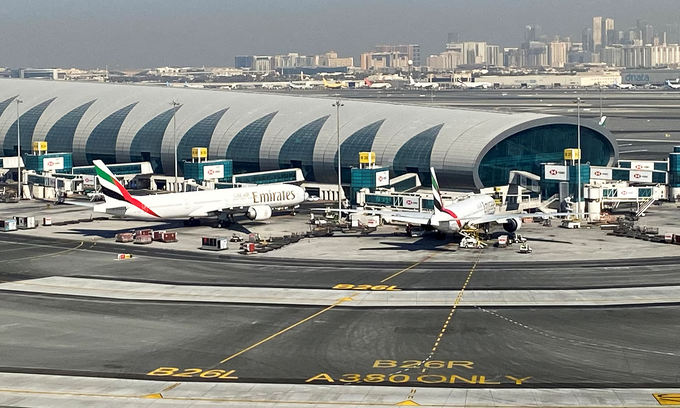
Emirates planes are seen on the tarmac in a general view of Dubai International Airport in Dubai, United Arab Emirates Jan. 13, 2021. Picture taken through a window. Photo by Reuters |
The return from next month of some of the European carriers that suspended flights to the region due to the war supported the new projection, he said.
“I’m absolutely convinced by the end of the year, we’ll be pretty much back,” he said.
“The transfer market and the point-to-point market are incredibly healthy, and I think they will continue to be healthy,” he said.
India, Saudi Arabia and the United Kingdom remained the top markets to and from Dubai, he noted, and business travel remained generally strong.
Advances in smaller, longer-range aircraft could support further growth, he said.
The number of cities served directly from Dubai could increase from the current 240 by mid-2027, he said.
“We’re talking to a number of airlines that are going to plan services from cities that have never been operated between Dubai and Europe and Africa in particular,” he added.
Griffiths said, as a result of the conflict, there might be potential “design changes to the new airport to make it a bit more resilient.”