Woo is relaunching Aijek on Sep. 24 with biodegradable natural fabrics the only materials used for production.
“Everything is plant-based fibre. Because the key is that after the lifespan (of the textile) is up, it can return to the soil. You can’t have even 1% of polyester,” the 47-year-old told The Straits Times.
Aijek was founded in Shanghai, China, in 2010. At its height, the brand operated with 15 factories, generated nearly SGD4 million in annual revenue and was sold in about 200 stores across Asia and the U.S.
Its retailers included Tangs in Singapore as well as major U.S. names such as Anthropologie, Shopbop, Neiman Marcus and Bloomingdale’s, according to The Business Times.
|
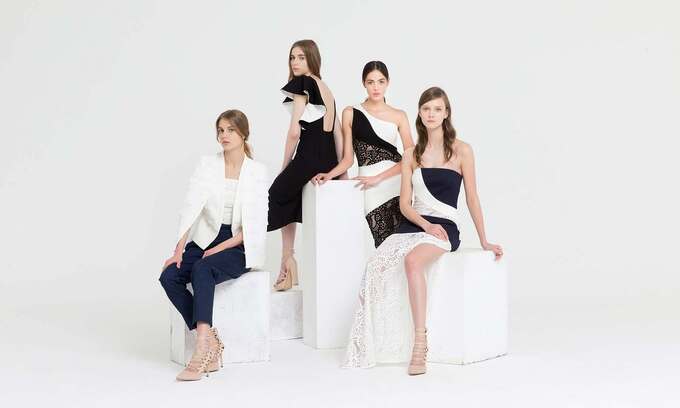
Models wearing Aijek products. Photo via Facebook/Aijek |
The brand earned local recognition for its international success. In 2017, it represented Singapore at the Asia Fashion Federation in Hangzhou, China.
Explaining her decision to close Aijek in 2019, Woo told Harper’s BAZAAR Singapore magazine: “I had asked Kai if he would like me to stop working and spend more time with him. Obviously he was jumping with joy.” Her son, 11 at the time, later said that he supported her decision, whatever it was.
Now that her son has turned 18, Woo is ready to make a comeback, with what she believes is a way to make and sell clothes without contributing to the world’s waste.
In early 2025, frustrated by the dilemma of wanting to create fashion without causing harm, she conducted an experiment. She buried samples of nine fabrics in a shallow trench beside a curry leaf plant in her father’s garden.
Six months later, she searched the soil for the cotton, tencel and linen samples but found nothing. The only material left was a recycled polyester-cotton blend.
“That closed the loop for me to feel that maybe there is a way to go back and create again, to continue designing in a more meaningful and intentional way,” she says.
Her decision to prohibit synthetics has forced Woo to abandon lace, her former specialty, because it is often made from polyester.
She has instead turned to Balinese artisans who work with kerawang, a centuries-old Indonesian cutwork embroidery technique. The method appears throughout her 22-piece collection through original lotus motifs, shown both as buds and flowers.
 |
|
Daniel Woo. Photo courtesy of Singapore Fashion Council |
Her style has also changed. During the brand’s first chapter, Woo focused on dressy occasionwear and developed a popular bridal line. For its return, she is taking a more casual direction that reflects her more relaxed outlook and new lifestyle.
Production is ready. Woo is satisfied with four factories in Bali, where she knows the owners and workers by name and can share meals with them. She will sell the collection online and open her home studio to customers by appointment.
Each new release will be produced in small quantities. Although Woo has already designed collections through the following season, the total number of pieces is still below the 200 items Bloomingdale’s once ordered from her.
The biggest challenge in returning has been adapting to the social media era. Her previous approach, centered on focusing solely on products and attending trade shows, is, by her own admission, outdated. Woo is now racing to understand the rules of the TikTok era.
Still, the return allows her to create again. “I already have a lot more new ideas in my head. It’s very silly to say, but after I finish a collection, I want to burn it and start all over again. Figuratively, anyway.
“As a designer, it’s always in my head that I have to do something better.”