The luxury car market has been growing significantly in India. Some years back, these were beyond the reach of many. Now, even people with monthly salaries of Rs 1 lakh, are buying cars and SUVs worth Rs 50 lakh. How is that happening? One of the ways is car leasing. A recent video by Zero1 by Zerodha discusses the leasing option in detail- its structure, business model, and advantages and disadvantages.
First of all, car leasing in India is a long-term rental arrangement. You don’t pay for the whole car upfront. You pay a fixed monthly fee to use a brand-new car for a particular period- usually five years. After this, you can give the car back to the company or buy it completely by paying an additional amount. This option, in theory, would make sense to a lot of people. But not for everyone.
If you aspire to own a luxury car that’s otherwise out of your budget, taking the leasing route may not be a good idea. This video explains this. There are two types of leasing- one, financial and the second, operational. In the second one, there would be no option to own the car at the end of the tenure. It will be a strict rental. Let’s start by understanding the differences between these.
Financial leasing is essentially a structured loan. In it, the buyer will have to first pay a down-payment- much like what he/she would do with a regular car loan. There will be monthly payments as well, typically lower than a loan. You will get to use the car just like a regular car, and will thus have to pay for its maintenance, insurance, road tax and other such expenses. At the end of the tenure, in this case, you have the option to return the vehicle to the company or own it completely by paying the remaining amount.
Operational leasing works just like renting a car, the conventional way. There is little to no down payment in this case. All payments are included in the rent itself. More importantly, the car has to be returned to the company when the tenure ends, or the contract has to be renewed. There is no option to pay for the vehicle and buy it.
The host explains the structure of financial leasing using the example of a luxury car that has an ex-showroom price of around 51 lakh. In this case, the downpayment is taken as just Rs 10 lakh. Then the monthly EMI will be a little over Rs 54,000. The car will attract a road tax of approximately Rs 5.09 lakh. The insurance amount will be around Rs 2.20 lakh for 4 years. During the ownership period, you will also pay for fuel and maintenance as well. So, over the leasing period, which let’s assume to be four years, you will spend more on the car. The upfront costs alone, in this case, will be over Rs 18 lakh.
After four years, the car can be returned to the company and if desired, the customer can pay an additional amount and buy the car fully. By then, the monthly EMIs of Rs 54,000 would have turned into a huge amount. According to the video, the car in question demanded Rs 24 lakh for the customer to own it completely. Clearly, this amount is much bigger than the upfront costs. This method makes the payments easy for the customer, but comes with a set of terms and conditions. In four years, the user will end up paying over Rs 44.76 lakh, under leasing. This is, however, just the usage fee and the car has still to be returned.
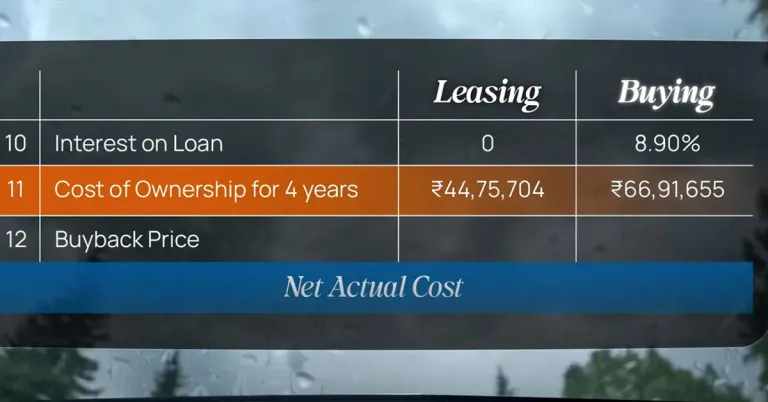
If taking a car loan instead and buying the same car, the user will end up paying Rs 66.92 lakh- considerably more than the leasing option. The EMIs in the second case, the video mentions, will be double. The good side here, is that you can keep the car even after four years. In leasing however, an additional Rs 24 lakh needs to be paid to keep the car. That would make the total cost approximately Rs 68 lakh. Almost a lakh more.
The video also claims that in financial leasing, if you crash the car and cause serious structural damage to it, the dealership will force you to pay the remaining amount and buy the car. In case of other wear and tear, the dealership would assess the extent of wear and possibly charge the owner. There will also be a mileage cap- you can only drive a certain number of kilometres every year. The video even talks about a possible way that a leased car could save you taxes.
The honest answer: depends on the salary and income of individuals. There is no blanket rule in this. The best way it to work hard, save up and plan the purchase wisely. Ideally, one should follow the 20/4/10 rule with car purchases. This is when you can make 20% of the car’s price as down payment, and keep car expenses, including EMIs under 10% of your income, and pay for four years. That said, it is ok to do some amount of adjustments within, as cars can be more than just machines for many. They can be dreams and status symbols.